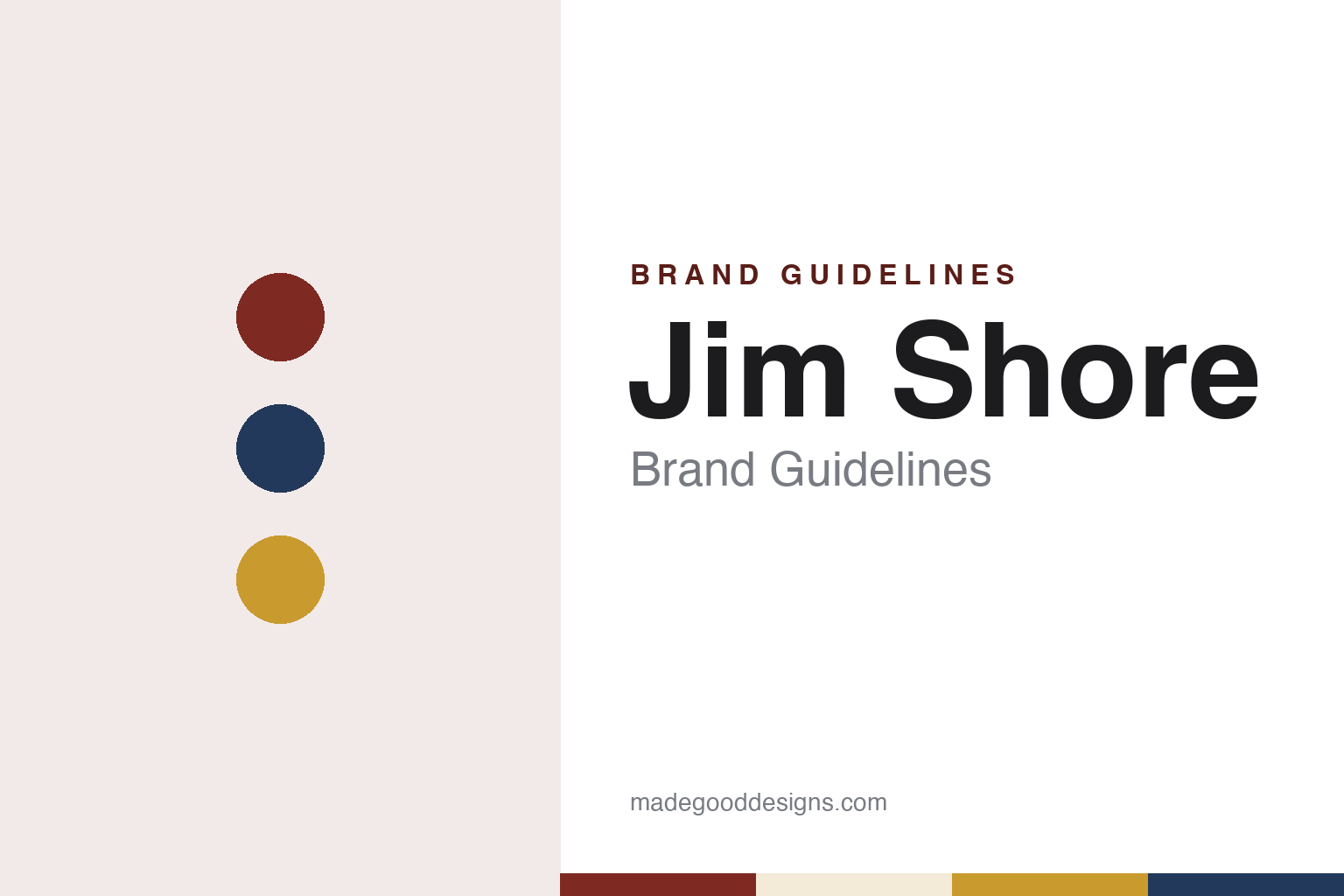
Jim Shore Brand Guidelines
Quilt patterns and painted flowers, carved into a figure.
Aa
Two constants: a barn red, quilt navy and mustard gold palette and a folk serif register. Abstract homage — not a Jim Shore product or mark; no figurine, pattern or logo is reproduced.
A quilter’s grandson
Folk art learned at home.
The Jim Shore brand is built on one artist’s name and one way of decorating a surface. Enesco, the giftware company that sells his work, says Jim Shore grew up in rural South Carolina, the son of artistic parents who gave him a love of American folk art. Both Enesco and the artist’s own website say his grandmother was a master quilter who taught him the patience and skill to bring intricate designs to life.
That upbringing explains the look. Shore’s website and Enesco’s artist profile both trace his style to American and European folk-art forms, naming three in particular: quilting, rosemaling and tole painting. Rosemaling is the decorative flower painting of Norwegian folk tradition, and tole painting is the decorative painting of household metal and wooden objects. Enesco describes the result as handmade, hand-carved art inspired by themes of folklore and tradition, and says it has a handmade, hand-carved feel that evokes heartfelt memories of a shared past.
Shore built that style before he had a large partner. Enesco’s US store page says he spent decades developing his craft, making his own designs and travelling the country to sell them, and an Enesco news item from January 2017 says he partnered with the company after decades of making his own work in relative obscurity.
Colour
From a small group of Santas to a year-round line.
The partnership with Enesco gave the work a name. Enesco’s UK artist profile says the company and Shore joined forces in November 2000 and worked together through the following year to launch Heartwood Creek at the beginning of 2002. Shore’s own website and Enesco’s US store page date the partnership to 2001, and Enesco’s January 2017 news item says Heartwood Creek debuted in retail stores in 2002. English Wikipedia’s article on Enesco says the company partnered with Shore in 2002 to create and license the brand.
The first range was narrow. Enesco’s 2017 news item says the collection grew from an original small group of Santas, and its US store page says it began with Santas, snowmen and angels before growing into a year-round brand. The 2017 item names Masterpiece Angels, Nativities and Mini Figurines among the lines, and the store page describes a range running from large statues down to mini figurines.
Enesco marked the milestones in public. Its 2017 news item celebrated the fifteenth anniversary of Heartwood Creek, and its UK artist profile says the company celebrated twenty years of partnership with Shore in 2022. Wikipedia says the Heartwood Creek agreement was renewed in 2014 for five more years and has since continued on an “open-ended” basis.
Seasonal storytelling remains a staple. On 31 January 2023 Enesco’s UK site announced a seven-piece ’Twas The Night Before Christmas collection from Heartwood Creek, based on Clement Clarke Moore’s poem. Enesco said its centrepiece, a figurine shaped like a storybook, plays a recording of Shore narrating part of the poem, and that the range used his folk-art patterns and motifs in festive reds and greens. Enesco said the pieces came in a branded gift box and were sold exclusively through Enesco.
Typography
Design and documentation.
Figurine and collectable brands work with a small object and a long memory. A piece may be cast in porcelain, moulded in resin, carved from wood or shaped in felt, and it is usually made to be kept, displayed and added to rather than used up. That gives the brand behind it an unusual job: its name has to live on the underside of the piece as well as on a shop shelf.
Much of the identity of a collectable is carried by marks rather than advertising: a backstamp or base mark, a signature or sculptor’s credit, a dated series name, a box and a catalogue. Collectors use those details to tell one period or one workshop from another, so the way a maker marks its pieces can matter as much as the figure itself. The company behind a name may also have changed owners, moved its studio or changed where its pieces are made.
Each guide separates what independent sources record from what the company says about itself — its founding story, its owners over time, where its pieces are made and how its marks have changed — and marks plainly what rests only on the company’s own word.
Aa
A warm, calligraphic text serif. (Specimen set in Alegreya, a serif STAND-IN; NOT the Jim Shore logo.)
Jim Shore
One artist’s pattern, applied to other people’s characters.
The style travels beyond Shore’s own Santas and angels. Enesco’s US store page names him as the creator of Heartwood Creek and Disney Traditions, and lists partnerships with Disney, Peanuts, Coca-Cola and The Grinch. Enesco’s 2017 news item says his style has also been applied to Looney Tunes and Hanna-Barbera characters, and its UK artist profile names further lines including DC Comics, The Wizard of Oz and Beatrix Potter “by Jim Shore”. Shore’s website says he most recently partnered with Garfield.
The licensed pieces follow the same rule as the originals: a familiar character is dressed in quilt blocks, painted florals and folk borders, and the artist’s name is part of the line name. That naming pattern, “by Jim Shore”, is how Enesco presents the ranges on its sites.
Enesco itself has changed hands around the partnership. English Wikipedia says Enesco began in 1958 as the import division of the N. Shure Company. It says Enesco Group, Inc. was bought by Tinicum Capital Partners in February 2007 and became Enesco, LLC, and that the Los Angeles private equity fund Balmoral Funds acquired Enesco, LLC in November 2015. Wikipedia also says Enesco acquired Department 56 from Lenox in 2009, and that the holding company Ad Populum acquired Enesco in January 2023. Wikipedia gives Enesco’s headquarters as Itasca, Illinois, and lists subsidiaries including Enesco Limited in the UK, Enesco Canada and Enesco France; the UK company’s website carries Shore’s artist profile and news of his collections. Shore’s website describes a 25-year partnership with Enesco that grew his collection into a year-round brand.
For a design guide, Jim Shore shows how an artist’s signature surface, rather than a single character, can become the brand: the same quilt-and-flower vocabulary applied to Santas, nativities and licensed cartoon figures, with the artist’s name on every line. Compare the giftware company behind Heartwood Creek in our Enesco brand guidelines and its village brand in our Department 56 brand guidelines. For this guide we use barn red, quilt navy and mustard gold with a serif, an unofficial interpretation; no product or logo is reproduced.
Explore & save
Keep Jim Shore’s identity on hand — save it to a board in the Made Good inspiration library.
Jim Shore identity set
Pin the Jim Shore barn red, quilt navy and mustard gold palette and the folk serif register to your own board.


