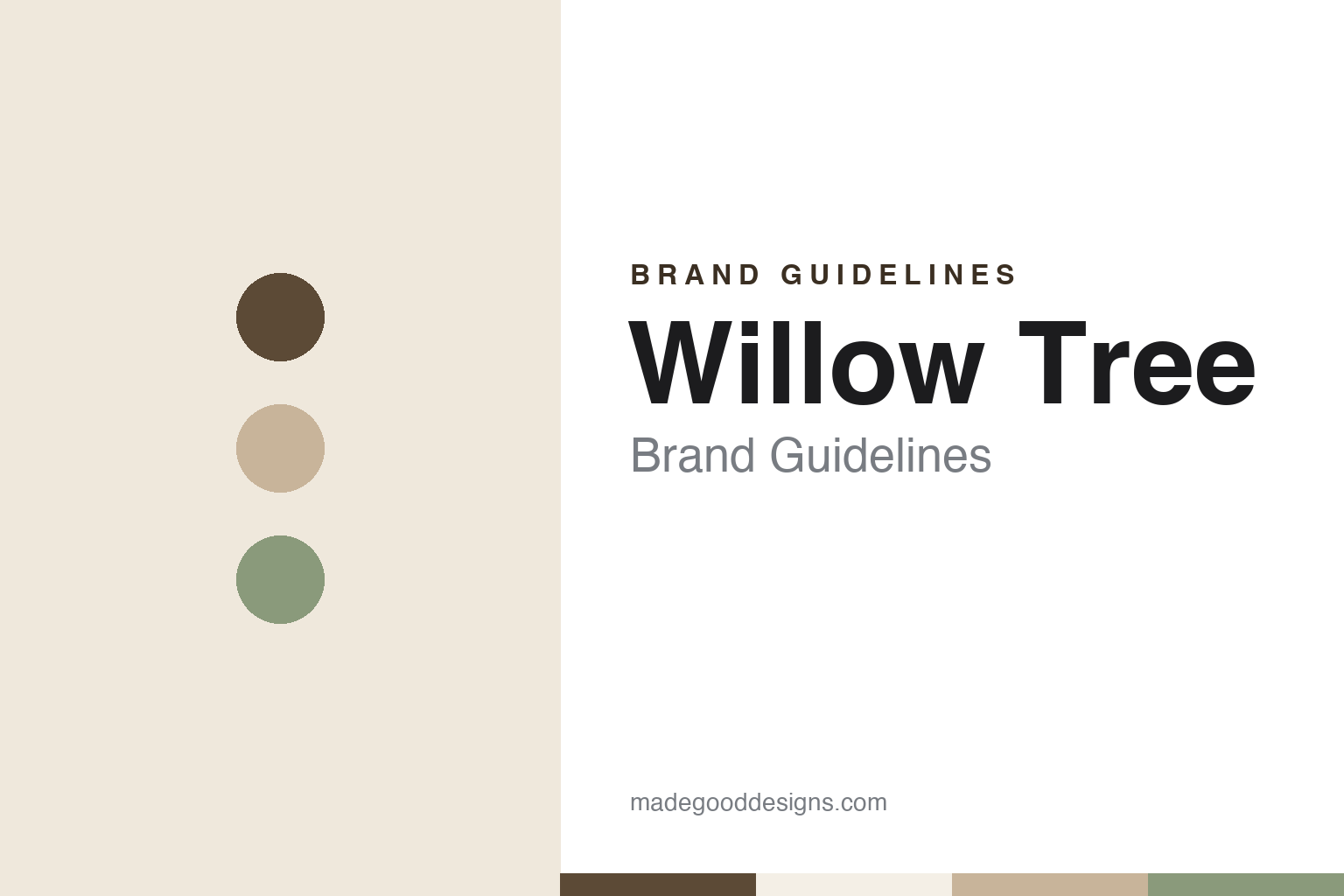
Willow Tree Brand Guidelines
A tilt of the head instead of a face.
Aa
Two constants: a carved walnut, raw clay and willow leaf palette and a quiet classical serif register. Abstract homage — not a Willow Tree product or mark; no figure, box or logo is reproduced.
An artist and a gift company
One sculptor’s line, made and sold by a Kansas firm.
Willow Tree is a line of figurative sculptures created by the artist Susan Lordi. English Wikipedia dates the line to January 2000, and the brand’s own website calls itself “The Official Home of Willow Tree® sculptures since 2000”. The figures are people and angels, along with some animals, and Wikipedia describes them as intended to represent feelings or life events; the range also includes a nativity scene.
The business behind the line is a partnership. Lordi designs and carves; the gift company DEMDACO makes and sells. The Willow Tree website says that since 1999 Lordi has worked in partnership with DEMDACO to produce, market and distribute Willow Tree, which it describes as “her line of carved, figurative sculptures”. The same site gives DEMDACO’s home as Leawood, Kansas, and credits copyright in the images jointly to Susan Lordi and DEMDACO from 2000 onward. Wikipedia says the line is sold through independent gift shops and Hallmark stores.
Lordi came to the figures from textiles. The Willow Tree site says she holds a Master of Fine Arts in Textile Design from the University of Kansas, that her fibre art has been exhibited internationally, and that a monograph of her art textiles was published in the Portfolio Collection by Telos Art Publishing. It also says she is featured in Art Textiles of the World: USA. She works from a studio in Kansas City, Missouri, where, according to the brand, she hand carves the original of every figure.
Colour
Expression carried by gesture, not features.
The defining decision in Willow Tree is what the figures leave out. The brand says that expression is revealed through gesture only — “a tilt of the head, placement of the hands, a turn of the body” — and that the simplicity of form and absence of facial features signify Willow Tree. Lordi is quoted on the site saying she tries to keep the interpretation open, so that the viewer can decide what a piece means, and that the ideas come from her own life experiences.
The production chain was described in detail by Christian Retailing in April 2014. Its report said that since the line’s inception, the original of each figure had been conceived, sculpted and carved by Lordi in her Kansas City studio, and that she makes each original in three dimensions rather than sketching it first in two. From each original sculpture a mould is cast that keeps her knife marks, and artists then paint each production piece individually, following her specific techniques. Wikipedia describes the finished figures as hand-painted resin cast from Lordi’s hand-carved clay sculptures.
The look has changed over time without leaving its base. The Willow Tree site says Lordi’s carving has grown to include delicate patterns of pierced metal, pressed gold leaf, free-hand surface etchings and pieces carved in the round, so that each angle gives a different reading. In the same 2014 report, DEMDACO’s owner Dave Kiersznowski said Lordi had subtly changed and evolved the line with pieces carved in the round, colour variations and carving details. The brand describes her process as intuitive, saying she “sketches” in clay as she forms each piece, and it frames the subjects in terms of love, closeness, healing, courage and hope.
The site also says that much of Lordi’s inspiration comes from time outdoors, and quotes her on restoring an area of tall-grass prairie and watching the birds, insects and plants it attracts.
Typography
Design and documentation.
Figurine and collectable brands work with a small object and a long memory. A piece may be cast in porcelain, moulded in resin, carved from wood or shaped in felt, and it is usually made to be kept, displayed and added to rather than used up. That gives the brand behind it an unusual job: its name has to live on the underside of the piece as well as on a shop shelf.
Much of the identity of a collectable is carried by marks rather than advertising: a backstamp or base mark, a signature or sculptor’s credit, a dated series name, a box and a catalogue. Collectors use those details to tell one period or one workshop from another, so the way a maker marks its pieces can matter as much as the figure itself. The company behind a name may also have changed owners, moved its studio or changed where its pieces are made.
Each guide separates what independent sources record from what the company says about itself — its founding story, its owners over time, where its pieces are made and how its marks have changed — and marks plainly what rests only on the company’s own word.
Aa
A soft, high-contrast classical serif. (Specimen set in Cormorant Garamond, a serif STAND-IN; NOT the Willow Tree logo.)
Willow Tree
A licensing partnership that has run since the start.
DEMDACO tells its own story on its website. It says the name, pronounced “dem-day-koh”, comes from its founders, Demi and Dave; that the pair set up a business called DD Traders in Hong Kong in 1991; and that after returning to the United States they founded DEMDACO in May 1997, approaching three artists to help start a gift company. Willow Tree, the company says, launched a few years later.
The arrangement with Lordi is a licence. Christian Retailing reported on 8 April 2014 that Demdaco had extended its licensing contract with Lordi through 2020, and quoted Lordi describing the company as a partner in the manufacturing, distribution, sales and marketing of the brand. The current Willow Tree website continues to present the line as Lordi’s work produced in partnership with DEMDACO.
On manufacturing, DEMDACO says its gifts are handcrafted overseas in factories run by carefully selected manufacturing partners, and it singles out the paint strokes on Willow Tree figures as part of that handwork. It also says it packages all of its products and that its packaging carries bookmarks and postcards, the postcards inviting customers to write back.
For a design guide, Willow Tree shows how a brand can be built on restraint: a single artist’s hand, a consistent carved texture and the deliberate removal of the face, with the name and the sculptor credited together on the brand’s own pages. Compare a porcelain figurine house in our Lladró brand guidelines and an American figurine line built on a single artist’s drawings in our Precious Moments brand guidelines. For this guide we use carved walnut, raw clay and willow leaf with a serif, an unofficial interpretation; no product or logo is reproduced.
Explore & save
Keep Willow Tree’s identity on hand — save it to a board in the Made Good inspiration library.
Willow Tree identity set
Pin the Willow Tree carved walnut, raw clay and willow leaf palette and the quiet classical serif register to your own board.


