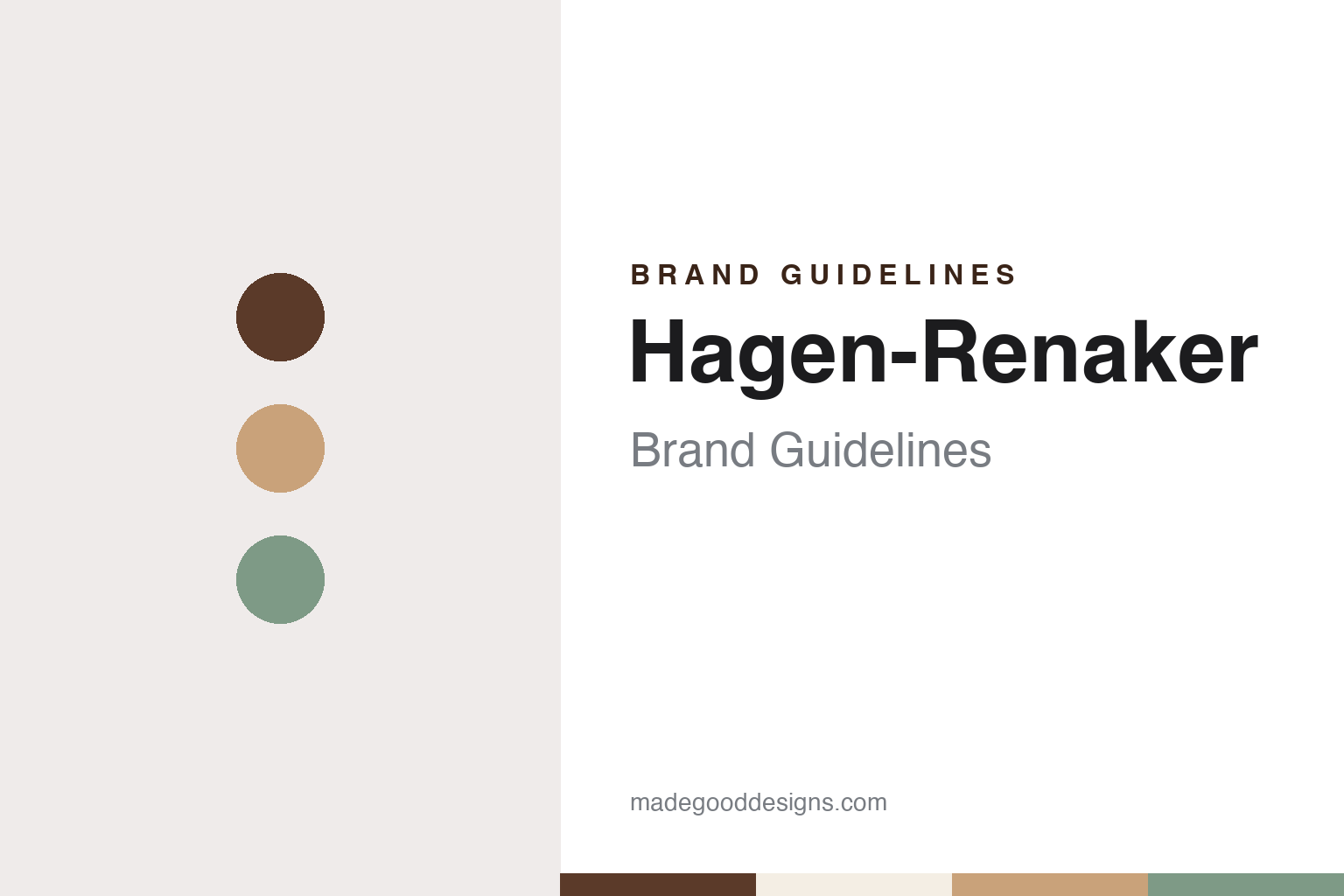
Hagen-Renaker Brand Guidelines
A garage pottery that turned a little clay duck into a menagerie.
Aa
Two constants: a glaze brown, bisque tan and sage glaze palette and a studio serif register. Abstract homage — not a Hagen-Renaker product or mark; no figurine, backstamp or logo is reproduced.
A pottery named for a father-in-law
The hyphen is a thank-you.
Hagen-Renaker is a California pottery name built from two family names. English Wikipedia says the company was established in Southern California in 1946, founded and owned by John Renaker Sr. and Maxine Renaker. Their earliest production was practical tableware rather than figures: Wikipedia lists plates, butter pats and bowls, made in the couple’s garage in Culver City, California.
The move out of the garage came with family help. Wikipedia says that with the support of Maxine’s father, Ole Hagen, John and Maxine Renaker built their first small factory in Monrovia, California, in 1946. The hyphenated company name was chosen, Wikipedia says, as a way to thank Ole Hagen and pay tribute to him, which is why his surname stands first on every piece of the brand’s history.
The turn to figurines began with a demonstration piece. Wikipedia says Maxine made a little duck to show a Brownie troop touring the factory how pottery was made. The duck was fired in the kiln in the spaces between the larger items, and Wikipedia describes it as an immediate success. John Renaker saw the potential in animal figurines, and the company went on to make them exclusively. Wikipedia links the brand’s miniature line to that duck and says the miniatures remained popular. Wikipedia says the company is known for its miniature figurines and its horse figurines.
Colour
A studio of named designers.
Unusually for a giftware maker, Hagen-Renaker’s history is told through the people who sculpted its models. Wikipedia says decorator Helen Perrin Farnlund was hired early in the company’s life and became known as the designer of most of its “cute” animal and human models. Maureen Love was hired as a decorator too, but Wikipedia says she quickly established herself as a designer of realistic animals: most of the horses, and much of the realistic wildlife, farm and domestic animals, were her work.
Other designers widened the range. Wikipedia says Tom Masterson worked for the company in the early 1950s and is known for the realistic Pedigree Dog line and some larger animals. Nell Bortells designed many of the Disney pieces and the Little Horribles, a line of caricature critters, while Martha Armstrong-Hand designed some Disney pieces, cats and human models. Don Winton and Will Climes, who ran California pottery companies of their own, also designed figurines for Hagen-Renaker; Wikipedia credits Winton with many of the Disney pieces.
Collectors sort the output partly by size. Wikipedia describes roughly three sizes of pottery animals. The Designers Workshop line covers animals of approximately five to twelve inches, made from the early 1950s through the mid-1980s and including farm, wild and domestic animals alongside Maureen Love’s horses, which Wikipedia says were being released again in the late 2000s. The miniatures are the smallest, and a Specialty size, started in the 1990s, sits between the miniatures and the Designers Workshop pieces.
Typography
Design and documentation.
Figurine and collectable brands work with a small object and a long memory. A piece may be cast in porcelain, moulded in resin, carved from wood or shaped in felt, and it is usually made to be kept, displayed and added to rather than used up. That gives the brand behind it an unusual job: its name has to live on the underside of the piece as well as on a shop shelf.
Much of the identity of a collectable is carried by marks rather than advertising: a backstamp or base mark, a signature or sculptor’s credit, a dated series name, a box and a catalogue. Collectors use those details to tell one period or one workshop from another, so the way a maker marks its pieces can matter as much as the figure itself. The company behind a name may also have changed owners, moved its studio or changed where its pieces are made.
Each guide separates what independent sources record from what the company says about itself — its founding story, its owners over time, where its pieces are made and how its marks have changed — and marks plainly what rests only on the company’s own word.
Aa
A soft, warm display serif. (Specimen set in Fraunces, a serif STAND-IN; NOT the Hagen-Renaker logo or backstamp.)
Hagen-Renaker
From Monrovia to San Dimas, and a family handover.
The factory followed the economy around Southern California. Wikipedia says that during the post-war expansion, from the late 1940s to the mid-1950s, the factory grew to several buildings in Monrovia. Later, as competition from Japanese ceramics cut into the domestic business, Hagen-Renaker shrank back to a single building there. In the early 1960s the company moved its factory to San Dimas, California, where John Renaker also had a plant nursery.
A later expansion added a second site for a time. Wikipedia says Hagen-Renaker bought the Freeman-McFarlin factory in San Marcos, California, and produced the Designers Workshop line there from 1980 to 1986, before closing that facility and regrouping in San Dimas. The factory matters to collectors: Wikipedia says pieces are identified partly by where they were made, because each factory had its own style and features.
The business stayed in the family. Wikipedia says John and Maxine Renaker retired from the pottery in 1996, and their eldest daughter, Susan Renaker Nikas, took over running the company. It says that at the end of 2021 the official Hagen-Renaker website was updated to state that no new ceramics would be produced in San Dimas, and that the remaining inventory was sold to a third party for purchase by dealers and collectors. Wikipedia adds that the tradition of American-made figurines continues under the name Hagen-Renaker Tennessee.
The brand’s record has been kept largely in collector books. Wikipedia’s sources include three titles by Nancy Kelly published by Schiffer between 2000 and 2003, among them Hagen-Renaker Pottery: Horses and Other Figurines (2000), Hagen-Renaker Through the Years (2001) and a volume on the horse, bird and wildlife figures of Maureen Love (2003). It also cites the third edition of the Charlton Standard Catalogue devoted to Hagen-Renaker, compiled by Gayle Roller and published by Charlton Press in 2003.
For a design guide, Hagen-Renaker shows how a small studio pottery can build an identity from its makers and its places: a family name with a thank-you in it, a roster of credited sculptors, and pieces read by size and by factory. Compare a German porcelain figurine house in our Goebel brand guidelines and a Spanish porcelain maker in our Lladró brand guidelines. For this guide we use glaze brown, bisque tan and sage glaze with a serif, an unofficial interpretation; no product or logo is reproduced.
Explore & save
Keep Hagen-Renaker’s identity on hand — save it to a board in the Made Good inspiration library.
Hagen-Renaker identity set
Pin the Hagen-Renaker glaze brown, bisque tan and sage glaze palette and the studio serif register to your own board.


