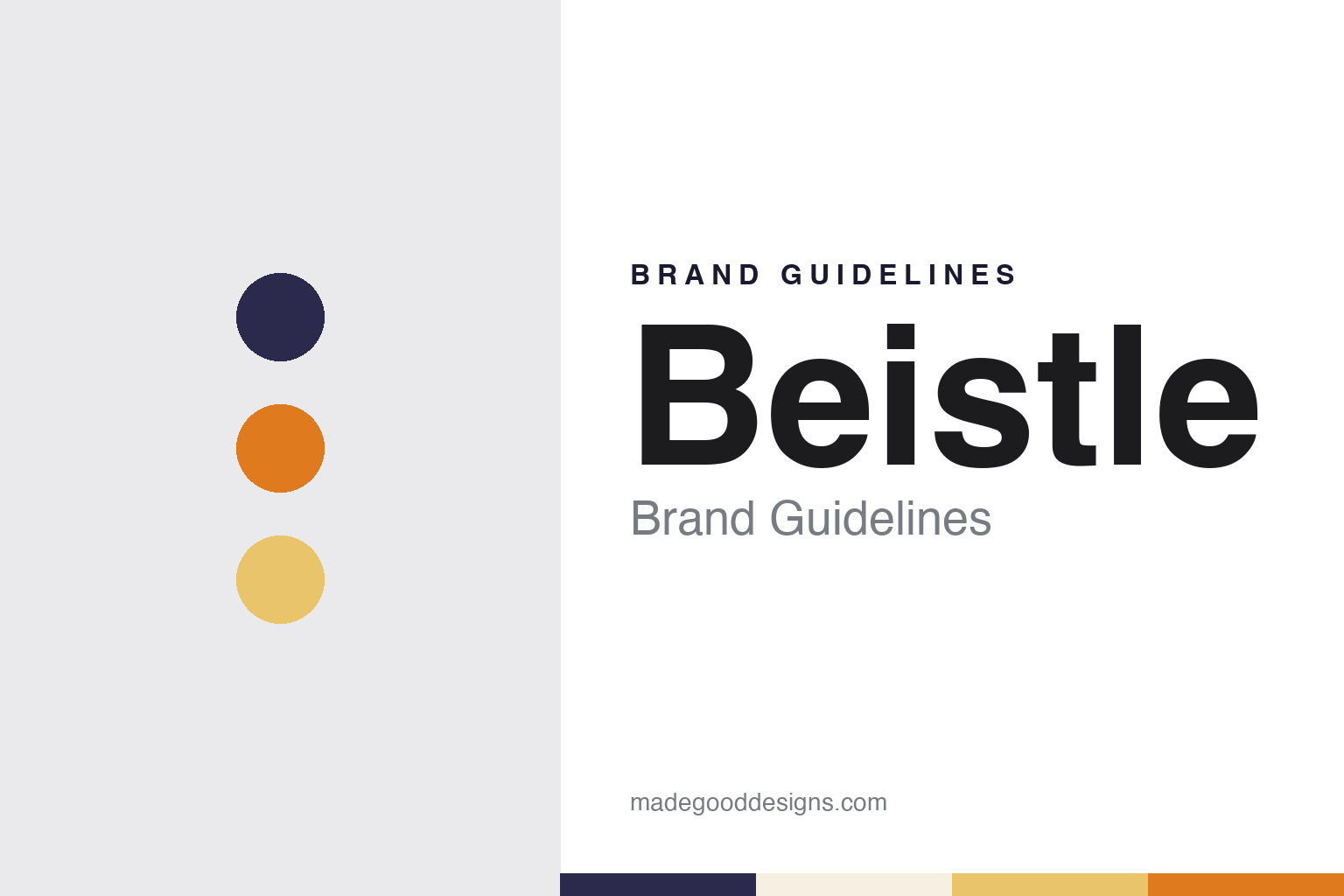
Beistle Brand Guidelines
Honeycomb tissue, Halloween and a family business in Pennsylvania.
Aa
Two constants: a midnight ink, pumpkin orange and tissue gold palette and a party-poster serif register. Abstract homage — not a Beistle product or mark; no decoration, cut-out or logo is reproduced.
Paper plants for hotel lobbies
A calendar salesman found a second business in the lobby.
The Beistle Company began with a sales round. English Wikipedia says that around 1900 Martin Luther Beistle was working as a salesperson for the Pittsburgh Art Calendar Company. Showing his calendars in hotels, he heard customers remark that the plants in the lobbies needed watering, and that gave him the idea of making artificial plants out of paper, which would need no water at all.
Wikipedia says he started the company in 1900 in the basement of his home in Pittsburgh, making artificial flowers and wooden products. The company’s own history page opens with the same year, which it calls the start of a new century, and refers to its founder by the initials employees, shareholders and friends used for him: M. L. Beistle. It says he had worked for the Pittsburgh Art Calendar Company before going into business on his own.
The idea that defined the business came from abroad. Both Wikipedia and the company say Beistle visited Heidelberg, Germany, where he saw a honeycombing technique for paper. It inspired a line of honeycombed tissue paper decorations and products. The company says honeycomb tissue remains part of what it makes.
The business soon left the basement. Wikipedia and the company both say it outgrew its Pittsburgh start and moved east to the small town of Oakville, Pennsylvania, where it was incorporated in 1907 and where manufacturing took place on the second floor of a wagon shop. Further growth led to larger premises in nearby Shippensburg, which remains the company’s home.
Colour
Honeycomb, then Halloween.
Wikipedia says that in 1910 Beistle brought honeycomb tissue technology to the United States, at a time when it had been available only in Europe and Asia, with Germany a popular source for such materials, and that he acquired a number of patents along the way.
The seasonal catalogue arrived in the following decade. Wikipedia says that in the 1920s the company partnered with the Paper Novelty Company on paper decorations for Valentine’s Day, Easter, Halloween, Thanksgiving and Christmas, citing Penn Live (May 2019) and Redbook (October 2016), and that Halloween was the first seasonal line added to Beistle’s catalogue. Wikipedia adds that the low cost and wide availability of the company’s Halloween products helped to popularise Halloween decorating in the United States. It also says that in the late 1920s and early 1930s Beistle released fortune-telling games for Halloween parties, and that collectors now value them.
Those Halloween designs are the part of the Beistle archive most often seen outside the party aisle. Wikipedia says that in 2015 a company called Creepy Company was founded to make apparel and enamel pins based on Beistle designs under licence; Inverse profiled that business in September 2016 under the headline “How Creepy Co. Turns Horror Icons Into Wearable Art”. The imagery has also reached music: Wikipedia notes that in 2017 the band Acid Witch released a song titled “Mr. Beistle” on its album Evil Sound Screamers, referring to both the founder and the company, a release Kerrang! covered in a September 2018 feature on the band. Coverage of the brand in Redbook, Inverse and Kerrang!, cited by Wikipedia, followed the same thread of Halloween nostalgia.
Typography
Design and documentation.
The brands in this group all make or sell the things people buy for a celebration: paper plates and napkins, balloons, banners, tableware, decorations and the catalogues and shops that bring them together. Party-supply brands sit at many different points in the trade, from small design studios that print their own papers to wholesale makers and national retail chains, and a single name can turn up on a supermarket shelf, in a mail-order catalogue and on a party table at home.
A party brand’s identity is usually carried less by one product than by colour, pattern and a recognisable name, because the company behind it may have changed hands, moved its production or widened its range far beyond where it started. That makes the questions behind each name worth asking plainly: who started it, who owns it now, and where its goods are actually designed and made.
Each guide separates what independent sources record from what the company says about itself — its founding story, its owners over time, where its goods are made and how its look has changed — and marks plainly what rests only on the company’s own word.
Aa
A high-contrast display serif with a vintage poster feel. (Specimen set in Abril Fatface, a serif STAND-IN; NOT the Beistle logo.)
Beistle
A family company in Shippensburg.
Beistle has stayed in the hands of its founding family. English Wikipedia says that in 1935 ownership passed to Martin Luther Beistle’s son-in-law, Henry E. Luhrs, and his family. The company’s own history describes the business as having passed from one generation to the next, and refers to its employees as “the Beistle family”. Wikipedia lists the company’s headquarters as Shippensburg, Pennsylvania, the town where the business settled after Oakville, and cites a history of Shippensburg published by Arcadia in 2012, along with a Penn Live feature of vintage photographs of the town, among its sources. Wikipedia’s infobox lists Henry E. Luhrs as the company’s key person and describes Beistle’s business as manufacturing and distribution.
The company describes itself as a maker of decorations and party goods, and says honeycomb tissue decorations are still part of that offer more than a century after M. L. Beistle saw the technique in Heidelberg. The route from Pittsburgh to Oakville to Shippensburg is told the same way on the company’s site and in Wikipedia, and both name the wagon shop in Oakville as the place where manufacturing first ran after the company was incorporated in 1907.
The Beistle name now sits in two worlds. In the party aisle it is a working supplier of decorations and party goods; among collectors it is attached to the Halloween designs and fortune-telling games of the 1920s and early 1930s that Wikipedia describes. The licensing of Beistle designs for apparel and enamel pins from 2015 shows the archive itself being treated as a brand asset.
For a design guide, Beistle shows how a party brand can be built from a technique and a season rather than a slogan: folded tissue that opens into a shape, and printed Halloween designs that collectors still seek out. Compare a Philadelphia party-goods maker in our Unique brand guidelines and a Wisconsin party tableware name in our Creative Converting brand guidelines. For this guide we use midnight ink, pumpkin orange and tissue gold with a serif, an unofficial interpretation; no product or logo is reproduced.
Explore & save
Keep Beistle’s identity on hand — save it to a board in the Made Good inspiration library.
Beistle identity set
Pin the Beistle midnight ink, pumpkin orange and tissue gold palette and the party-poster serif register to your own board.


