Läderach Brand Guidelines
The Glarus truffle-shell maker that became a global chocolatier.
Aa
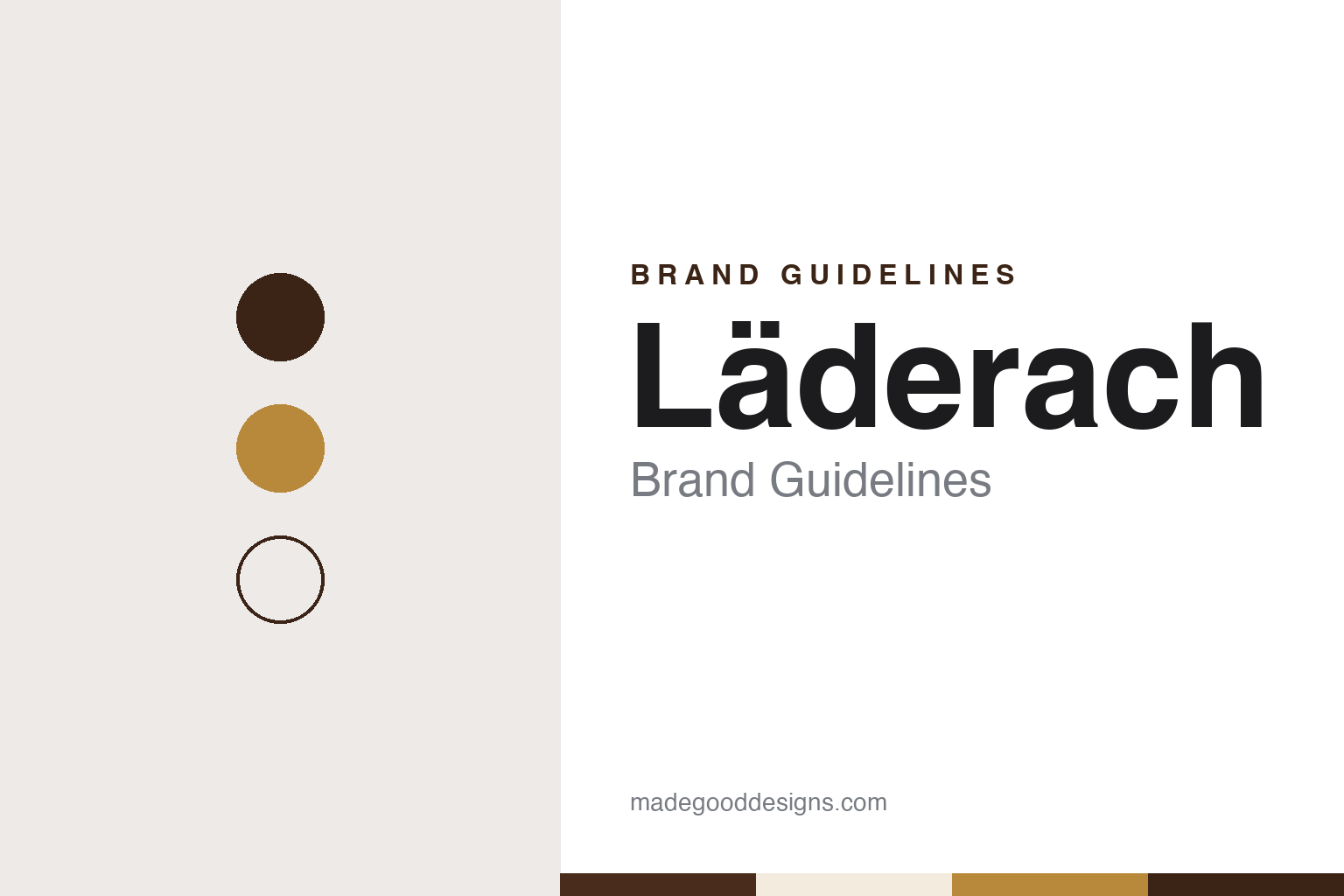
Two constants: a Läderach cocoa, cream and gold palette and a Confiseur serif register. Abstract homage — not a Läderach product or mark; no product, logo or packaging is reproduced.
Glarus, 1962
A baker’s son and a hollow shell.
Läderach is a family company from the canton of Glarus, in eastern Switzerland. English and German Wikipedia both say it was founded in 1962 in Glarus by the confectioner Rudolf Läderach (1929–2013), whose father, also called Rudolf, had run a bakery in nearby Netstal since 1926. Today the business is Läderach (Schweiz) AG, based in Ennenda, now part of the municipality of Glarus, and it trades as Läderach Switzerland.
Its early reputation rested on a technical idea. In 1970 Rudolf Läderach patented a “process for manufacturing thin-walled hollow truffle balls,” German Wikipedia says, citing the Swiss broadcaster SRF; until then chocolatiers had rolled truffles into spheres by hand. Ready-made shells let confectioners work with much more delicate fillings than piping allowed, the Swiss trade paper foodaktuell noted in 2012, and German Wikipedia says the invention set the village business on the path to expansion. It moved into Germany in 1981 and began exporting overseas the same year.
In 1994 Rudolf Läderach handed operational management to his second son, Jürg Läderach. The third generation joined in 2011. Johannes Läderach became chief executive in 2018 and chairman at the start of 2022; his brother Elias, a trained confectioner, joined the management the same year and was named World Chocolate Master in 2018; a third brother, David, has run the German business since 2021. The Zürich daily Tages-Anzeiger reported in 2023 that Jürg Läderach no longer held any shares in the company; he had left its board at the end of 2021.
Colour
From supplier to shopkeeper.
Läderach entered retail in 2004, when it bought Merkur Confiserie AG of Olten, a long-established Swiss chocolate and coffee retailer, from the Valora group, and with it a chain of shops. The same year it introduced FrischSchoggi — Swiss German for “fresh chocolate” — large slabs broken at the counter in whatever quantity the customer asks for. By the end of 2014 the 41 Merkur shops had been converted into Läderach chocolateries, according to Wikipedia, which cites a St. Gallen management textbook.
The bigger step was making its own chocolate. Until 2012 Läderach, like most confectioners, bought its couverture — the chocolate confectioners work with — from suppliers, made to its specifications. In September 2012 it opened its own couverture factory at Bilten, in Glarus Nord, which foodaktuell called a rarity in Switzerland. The paper reported that the plant cracked the beans before roasting, roasted the nibs in batches by variety, refined the chocolate to 20 microns and shipped it liquid, in one-tonne containers, to the confectionery works at Ennenda and to the company’s German plant at Dillenburg, in Hesse; German Wikipedia gives its capacity as 1,100 tonnes a year. The aim, the then chief executive Ralph Siegl told the paper, was to control “the whole value chain, from the cocoa bean to the finished product.”
The company now says it controls the entire production process. Its website names its cocoa origins as Costa Rica, Ecuador, Trinidad, Brazil, Ghana, Madagascar and India, and says the beans are tested on arrival in Switzerland; we give that as its own account. Production at Ennenda was expanded in 2017, and a second factory at Bilten, with a high-bay warehouse, began production in August 2025, the news service swissinfo reported. The Dillenburg plant closed in March 2019 with the loss of 134 jobs, the regional paper Mittelhessen reported. In November 2020 the company opened a visitor centre, the House of Läderach, at Bilten.
Its best-sellers, German Wikipedia says, are hazelnut milk and dark almond chocolate, alongside pralines, truffles and seasonal gifts; a vegan line based on a cashew drink followed in 2022.
Typography
Design and documentation.
The seven brands in this group all make chocolate, and they come from three countries: Läderach, Sprüngli, Camille Bloch and Villars from Switzerland, Hachez and Rausch from Germany, and Bernachon from France. Six are Swiss and German chocolate houses; the seventh is a Lyon chocolatier that makes its chocolate from the bean in its own workshop.
Swiss and German chocolate brands tend to reach the public through the bar, the box and the shop window, and their identities are often built on a family name, a home town and a long list of dates. A bean-to-bar chocolatier works the other way round: it buys cocoa beans, roasts and grinds them itself and sells the result over its own counter, so its identity rests on the maker, the recipe and the place where the chocolate is made. Some firms combine the two, running shops while selling bars far beyond them.
Each guide separates what independent sources record from what the company says about itself — who founded it, who owns it now, where its beans come from and where its chocolate is made — and marks plainly what rests only on the company’s own word.
Aa
A confiseur serif — “Läderach Switzerland.” (Specimen set in Playfair Display, a serif STAND-IN; NOT the Läderach logo.)
Läderach Switzerland
From “chocolatier suisse” to “Switzerland.”
The shop network has grown quickly. Läderach opened shops on Zürich’s Bahnhofstrasse and Bern’s Spitalgasse in 2008 and in South Korea from 2009; its first branches in Toronto, New York and London followed in 2019. Its 100th shop opened on Fifth Avenue in New York in December 2020, Bloomberg reported, and in February 2021 it announced that it would take over 34 sites in the United States previously used by Godiva. Its 200th shop opened on Kensington High Street in London in 2024, and swissinfo reported in June 2025 that it had opened its first African shop, in Cairo, and expected to be present in 25 countries by the end of that year, partly through franchise partners.
The brand name has changed with that growth. In 2008 the company began presenting itself as “Läderach – chocolatier suisse,” foodaktuell reported; in December 2023, as it opened its first shop in Paris, it announced that the name would become “Läderach Switzerland,” a change the company linked to its internationalisation. The Swiss marketing site Konsider reported the change but gave no details of designers, typeface or colours, and we found no published brand guidelines.
The family has also faced public criticism. In January 2020 Swiss and German LGBT groups called for a boycott over Jürg and Johannes Läderach’s involvement in the association Christianity for Today, which opposed same-sex partnerships and abortion, WirtschaftsWoche reported; Johannes Läderach later said he would never discriminate against anyone because of their sexual orientation, Blick reported in September 2020. In September 2023 an SRF documentary carried allegations by former pupils against a Christian school founded by Jürg Läderach; he denied in a sworn statement that he had ever struck or mistreated pupils, and Johannes Läderach said he and his brothers condemned what had happened. In March 2024 Johannes Läderach told SRF that the company had at first lost a single-digit percentage of its Swiss retail sales.
For a design guide, Läderach shows how a supplier of hollow shells became a retail brand built on the theatre of the counter, with slabs broken to order and a name that now carries “Switzerland.” Compare Felchlin, a Swiss couverture house, and Sprüngli, the Zürich confiserie. For this guide we use a cocoa brown, a cream and a gold with a serif, an unofficial interpretation; no product or logo is reproduced.
Explore & save
Keep Läderach’s identity on hand — save it to a board in the Made Good inspiration library.
Läderach identity set
Pin the Läderach cocoa, cream and gold palette and the Confiseur serif register to your own board.