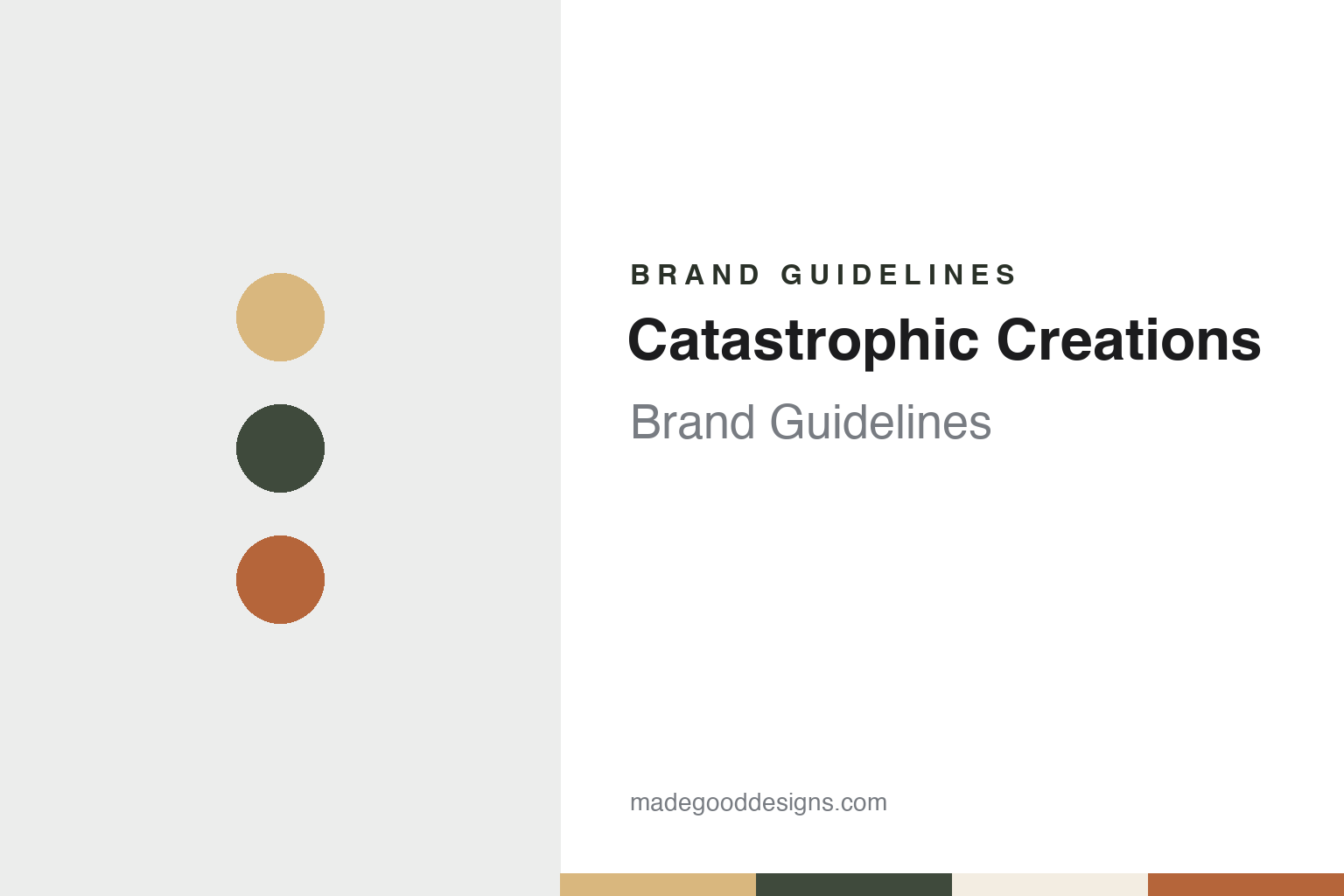
Catastrophic Creations Brand Guidelines
Cat wall furniture that started with a rope bridge.
Aa
Two constants: a pine, forest and rust palette and a workshop slab serif register. Abstract homage — not a Catastrophic Creations product or mark; no shelf, bridge or logo is reproduced.
One cat, one bridge
A cat furniture business that began in an apartment with a borrowed idea from the movies.
Catastrophic Creations is an American maker of wall-mounted cat furniture: shelves, bridges, hammocks, scratching poles and modular climbing systems fixed to the wall rather than standing on the floor. Its website writes the name as a single word, CatastrophiCreations, while its shop lists the maker as Catastrophic Creations Furniture. The company’s timeline says the business started in 2013, when its founders, Mike and Megan, brought home their first cat, Ickle.
The design website Houzz told the story in two articles by Brenna Malmberg, published on 8 January 2018 and 15 March 2018. They named the founders as Mike Wilson and Megan Hanneman, describing them as a couple, and said Ickle had moved into their apartment in Portland, Oregon. Two more cats, Heisenberg and Lylah, followed so that Ickle would have company. The couple could not find cat furniture they liked, so they began building their own. Wilson had a background in design, Houzz reported, but “neither of us had picked up a saw more than a handful of times,” he said.
The company’s timeline describes those early days in detail. The founders built in a third-storey apartment, running the mitre saw and sander when the neighbour downstairs was out, and shared stranger ideas online, among them a Mario-themed cat condo and a cat biplane. The piece the company says it built at the start was an Indiana Jones-style cat bridge, which it says went viral. Houzz also named the rope bridge among the company’s early products, and said it was Ickle’s favourite.
Colour
From a garage “fire hazard” to Michigan workshops.
The workshop moved several times as the business grew, according to the company’s own timeline. After the apartment came a one-car garage, nicknamed “the fire hazard,” covered in sawdust and warmed by an electric heater, and then a two-car garage. In 2014 the shop moved to a townhouse garage, with lumber bought from Home Depot and carried home in a two-door Honda Civic. In 2015 the company moved into its first commercial space, where the woodshop, assembly and packing all shared one building, before moving within about a year to a pair of adjacent warehouses that kept sawdust away from finished products. The timeline lists a further move to its current building in 2020.
The business moved across the country along the way. Houzz reported in January 2018 that the company had an office and warehouse in Byron Center, Michigan, where the founders then lived, and the art and design site Colossal, in a piece by Laura Staugaitis on 8 May 2019, described it as based in Grand Rapids, Michigan. The company says its products are made in its own workshops, which its timeline describes as including a woodshop, a staining area, an assembly area and a packing and shipping area.
A third owner joined in 2016. The timeline names Gabe Blauer, a childhood friend, who it says has led operations since then. It adds that Mike and Megan both still hold key positions in the company.
Typography
Design and documentation.
The brands in this group all make furniture, scratchers, toys or other accessories for cats. Cat accessory brands in general sit at many different points in the pet trade, from small workshops run by their founders to names that now belong to much larger pet companies or investment groups, and a single brand can be sold everywhere from a specialty pet shop to an online marketplace.
A cat accessory brand’s identity is usually carried less by one product than by a name, a mark, its packaging and the way its range is organised and described, because the company behind the name may have changed hands, moved its production or grown well beyond its first workshop or catalogue. That makes the questions behind each name worth asking plainly: who started it, who owns it now, and where its products are actually designed and made.
Each guide separates what independent sources record from what the company says about itself — its founding story, its owners over time, where its products are made and how its range and packaging have changed — and marks plainly what rests only on the company’s own word.
Aa
A sturdy slab serif for a brand built in garages with a saw and sander. (Specimen set in Bitter, a slab-serif STAND-IN; NOT the Catastrophic Creations logo.)
Catastrophic Creations
Wood, canvas and sisal, arranged as a playground on the wall.
The products rely on a small set of materials. Houzz reported in 2018 that the company used pine and a thicker sisal rope, joined pieces with heavyweight canvas chosen after testing several options, and left the wood without a polyurethane coat. “The wood is real and soft enough for the cats to dig their claws into,” Wilson said. “We also don’t put a polyurethane coat on it, which gives the cats more traction.” Colossal described the systems in 2019 as solid wood, hidden brackets and canvas, and said the founders avoided bright colours and plastic. The company’s own site today names solid bamboo, heavy-weight canvas and steel brackets.
Much of the range is designed to be fitted at home. Houzz said most customers could install the pieces themselves from step-by-step instructions, and that most pieces needed only a No. 8 screw, which leaves small holes in the wall that renters can patch when they move out. Colossal summed up the approach in a single line, saying the founders design modular wall-mounted systems to keep cats active. The company’s catalogue today mixes larger named systems, such as the Juggernaut and the Wayfinder, with single shelves, hammocks, feeders, planter shelves and replacement parts, so that a wall can be built up piece by piece. Colossal named two of the larger layouts of 2019, the Thunderdome and the Temple Complex, which it described as vertical play spaces where cats could climb, jump, scratch and cross swinging bridges.
Testing stays close to home. The company’s timeline says its own cats try out prototypes, which usually stay on the walls for about two weeks before being changed or dropped, and Houzz reported in 2018 that some designs still in testing existed only in the founders’ house, with the cats also modelling for product photographs, usually on the days Wilson worked from home.
For a design guide, Catastrophic Creations shows how a small workshop brand can build its identity from a founding cat, a homemade bridge and a plain palette of wood, canvas and rope. Compare Tuft + Paw, a design-led cat furniture brand, and Catit, the cat products brand of the Hagen Group. For this guide we use pine, forest and rust with a slab serif, an unofficial interpretation; no product or logo is reproduced.
Explore & save
Keep Catastrophic Creations’s identity on hand — save it to a board in the Made Good inspiration library.
Catastrophic Creations identity set
Pin the Catastrophic Creations pine, forest and rust palette and the workshop slab serif register to your own board.