Meccano Brand Guidelines
Half-inch holes, Liverpool-made.
Aa
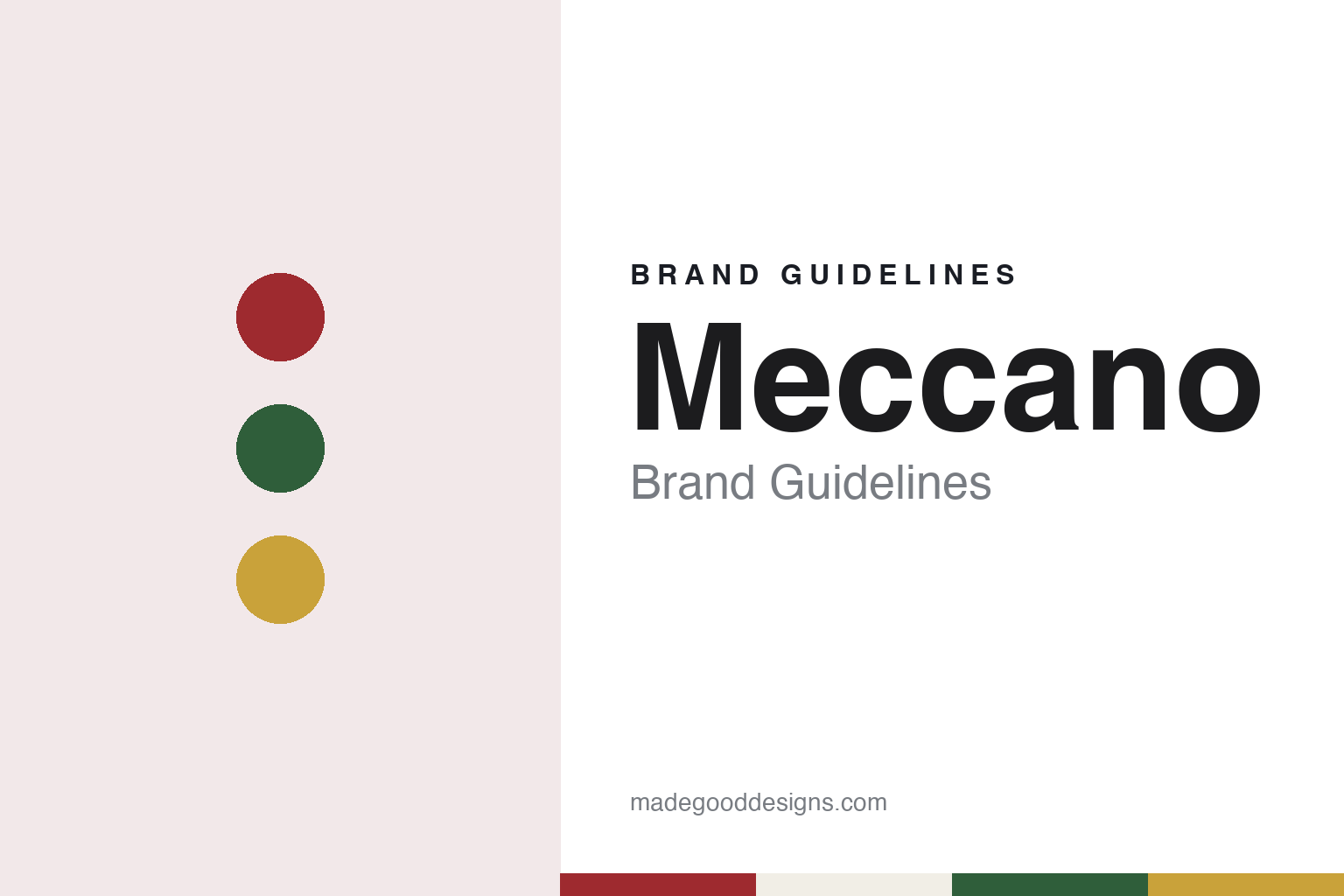
Two constants: a plate red, strip green and brass palette and a condensed engineering sans register. Abstract homage — not a Meccano product or mark; no set, part or logo is reproduced.
Mechanics made easy
A Liverpool clerk’s patented construction kit.
Meccano began in Liverpool. English Wikipedia says that in 1901 Frank Hornby, a clerk in the city, patented a construction toy he called Mechanics Made Easy, made of perforated metal strips, plates and girders, with wheels, pulleys, gears and axles for movement, joined by nuts and bolts. The Guardian, in a report of 23 February 2023, dates Hornby’s work on the idea to 1898 and says he marketed it as Mechanics Made Easy in 1901 and as Meccano in 1907.
The system rests on fixed dimensions. Wikipedia says the holes were spaced at a standard half-inch pitch, the nuts and bolts used a 5/32-inch Whitworth thread, and the only tools needed were a screwdriver and spanners. The same article says these imperial standards have not changed, so that parts made decades apart still fit together; The Guardian made the same point in 2023, noting that modern kits still use the strips, screws and imperial hole spacing of the originals.
The business grew quickly. Wikipedia says the parts were at first supplied by outside manufacturers, until Hornby set up his own factory in Duke Street, Liverpool. It says he registered the Meccano trademark in September 1907 and formed Meccano Ltd in May 1908, and that a new factory was built at Binns Road, Liverpool, in 1914, which served as the company’s headquarters for the next sixty years. The encyclopedia records factories in France, Spain and Argentina as well. Both Wikipedia and The Guardian say the name was thought to come from the phrase “make and know”.
Colour
Nickel, then red and green, then gold and blue.
Colour has been Meccano’s most visible identity device, and it changed with each era. Wikipedia says the earliest strips and plates had a tinplate finish, and that by 1907 the strips were made of thicker steel with rounded ends and nickel plating, while wheels and gears were machined from brass.
In 1926, to mark the twenty-fifth anniversary of the patent, the company introduced “Meccano in Colours”. According to Wikipedia, the plates were at first a light red and the braced girders pea green; the following year strips and girders became dark green and the plates a burgundy red, while wheels and gears stayed brass. In 1934 the scheme changed again in Britain, to gold strips and girders and blue plates printed with gold criss-cross lines on one side. Wikipedia says the red-and-green sets continued for export and returned to the British market after the Second World War. A lighter red and green followed in 1958, and in 1964 came a black and yellow scheme with silver, then zinc, strips.
The range was organised as a numbered ladder. Wikipedia says the first sets under the Meccano name were numbered 1 to 6, that accessory sets converted one outfit into the next size up, and that the No. 10 Outfit, introduced in 1937, remained the flagship set until it was discontinued in 1992. Individual parts were also sold to extend existing sets.
The brand also built a community. Wikipedia says Hornby launched the Meccano Guild in 1919 for builders and their clubs, and that Meccano Magazine was published from 1916 to 1981, informing members of each other’s activities and carrying model plans.
Typography
Design and documentation.
The brands in this group are classic toy names: drawing boards, building sets, craft kits and construction toys that many families have known across more than one generation. Toy brands in general sit at many different points in the trade, from names still run by the company that started them to labels that have passed through several owners, and to marks that are licensed out to other manufacturers for years at a time.
A toy brand’s identity is usually carried less by any single product than by a name, a logo, a box and a handful of colours, because the company behind the name may have changed hands, moved its manufacturing or licensed the mark to someone else. That makes the questions behind each name worth asking plainly: who started it, who owns it now, who makes the toy today and where it is made.
Each guide separates what independent sources record from what the company says about itself — its founding story, its owners and licensees over time, where its toys are made and how its packaging has changed — and marks plainly what rests only on the company’s own word.
Aa
A condensed, engineered display sans. (Specimen set in Oswald, a condensed-sans STAND-IN; NOT the Meccano logo.)
Meccano
From Binns Road to Calais, Erector and Spin Master.
Meccano has had many owners. Wikipedia says Lines Bros, the company behind the Tri-ang name, bought Meccano Ltd in 1964; that after Lines Bros went into liquidation in 1971, Airfix bought the British business and General Mills bought the French one; and that Airfix closed the Binns Road factory, ending manufacture of Meccano in England. General Mills then bought Airfix’s remaining Meccano interests in 1981, according to the encyclopedia, and production centred on Calais, France. Wikipedia says General Mills sold Meccano in 1985 when it left the toy business, that it changed hands again in 1989, and that the Japanese toy maker Nikko took a stake in 2000 before selling it back to the French parent in 2007.
The American cousin joined later. Wikipedia says the Erector set was patented by A. C. Gilbert and first sold by his Mysto Manufacturing Company of New Haven, Connecticut, in 1913, and that its sets came in wooden boxes until 1932 and then in painted steel boxes until 1962. The French company Meccano S.A. later bought the Erector trade name; Wikipedia says that in 1990 it built a giant Ferris wheel in France and shipped it to the United States to promote Erector by Meccano.
Spin Master, headquartered in Toronto, has owned Meccano since 2013; Wikipedia, citing The Globe and Mail, dates the acquisition to August of that year. The Guardian reported in February 2023 that Spin Master would close the Calais factory, which it described as the last dedicated Meccano plant, and that the company said its toys would continue to be made by a network of partners in Europe, Asia and Latin America. Wikipedia says the factory closed on 31 October 2023, and that in January 2025 Spin Master licensed Meccano to the British toy company Addo Play, which Toy World reported would develop, design and make a refreshed range.
For a design guide, Meccano shows how a fixed technical standard — the half-inch hole and the Whitworth bolt — can sit underneath decades of changing colour schemes, numbered outfits and its own magazine. Compare a wooden construction set from the same decade in our Tinkertoy brand guidelines and a plastic rod-and-connector system in our K’NEX brand guidelines. For this guide we use plate red, strip green and brass with a condensed sans, an unofficial interpretation; no product or logo is reproduced.
Explore & save
Keep Meccano’s identity on hand — save it to a board in the Made Good inspiration library.
Meccano identity set
Pin the Meccano plate red, strip green and brass palette and the condensed engineering sans register to your own board.