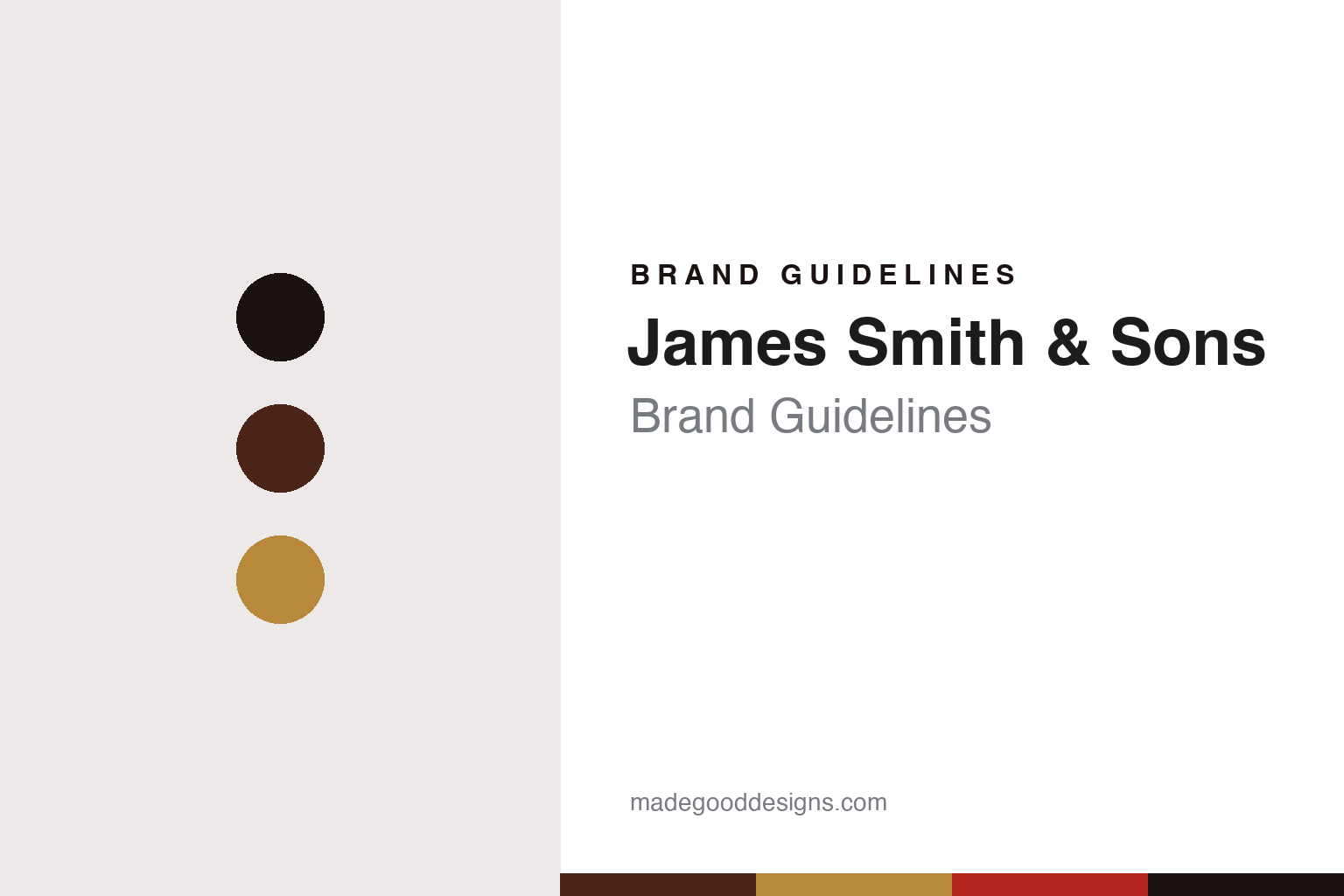
James Smith & Sons Brand Guidelines
The Victorian umbrella shop on New Oxford Street.
Aa
Two constants: a mahogany, brass and red palette and a Victorian serif register. Abstract homage — not a James Smith & Sons product or mark; no umbrella, sign or shopfront lettering is reproduced.
Foubert’s Place
A Mr Smith, a back-room workshop and a steel frame.
James Smith & Sons began in London in 1830, when James Smith opened a shop in Foubert’s Place, a short street just off Regent Street in the West End. English Wikipedia gives that founding date and place, and so does the company’s own history page, which says umbrellas were made in a small workshop at the back of the shop and sold at the front. A 1982 profile in The Christian Science Monitor put the origin more modestly, saying the first James Smith sold umbrellas as a sideline in his barbershop.
The business grew with the umbrella itself. The company says that in 1851 Samuel Fox introduced a lightweight steel frame that made umbrellas cheaper and more popular, and that James Smith II used Fox frames. Fox’s frames stayed part of the shop’s work for more than a century: in 1982 the Monitor reported that the standard men’s umbrella sold there was built on Fox frames made in Sheffield, with steel ribs and a nylon cover.
The shop moved several times. The company’s history lists a narrow shop at Saville Place, where umbrellas had to be opened outside and which was later demolished for a new road, and a branch on Burlington Street near Piccadilly Circus that it says was destroyed in a bombing raid in the Second World War. English Wikipedia also mentions branches on Savile Row and New Burlington Street. The address that survived is 53 New Oxford Street, at the corner with Shaftesbury Avenue, in Holborn. Sources give two dates for it: the company and Suitcase magazine (2022) say the New Oxford Street shop opened in 1857, while a 2014 Completely London feature said the firm had occupied the building since 1867.
Colour
Umbrellas, sticks and a workshop underground.
The shop’s trade is umbrellas and walking sticks, with seat sticks — sticks that fold out into a small seat — alongside. Completely London wrote in 2014 that the shop once also sold swordsticks, swagger sticks and ceremonial sunshades, and that a large share of its stock was unique.
The making has stayed on the premises. The 1982 Monitor profile described a basement workshop handling repairs and fitting covers to handmade umbrellas. Forty years later, Suitcase magazine visited the subterranean workshop and reported that a bell is rung when an umbrella is finished. The same 2022 piece said most umbrellas now use a durable nylon twill, with silk available on request; that shafts and handles are cut from woods such as Indian rose, malacca and ebony; that parts come from specialist suppliers across Europe; and that the range runs from slim gentlemen’s umbrellas with needle ends or Derby handles to blackthorn umbrellas cut to size and hand-carved handles shaped as hares, skulls or a parrot.
The shop has also had a life on screen and in print. English Wikipedia notes that Ben Macintyre’s 2014 book A Spy Among Friends records that Kim Philby owned a James Smith umbrella, that the storefront appears, renamed, in the 2011 film Captain America: The First Avenger, and that it featured in an episode of the BBC’s Partners in Crime in 2015. The company says London’s black-cab drivers simply call it “The Umbrella Shop.”
Typography
A shop as the identity.
The seven brands in this group are all umbrella names: James Smith & Sons, totes, Knirps, London Undercover, Il Marchesato, GustBuster and ShedRain. Umbrella brands sit at many different points in the trade, from a single London shop to names sold in department stores and supermarkets around the world, and from makers that still sew in their own workrooms to brands whose umbrellas are designed in one country and made in another.
An umbrella brand’s identity is usually carried by a handful of things — a name, a handle, a canopy colour or print, a label sewn into the cover — rather than by any one product, because the company behind the name may have changed hands or moved its production since it began. Some names are very old: James Smith & Sons, which English Wikipedia says was founded in 1830, still trades from a Grade II* listed shop on New Oxford Street in London. Others have moved country: the Knirps name, which German Wikipedia traces to Hans Haupt’s folding umbrella of 1928 in Solingen, is now run from Braunau am Inn in Austria.
That makes the questions behind each name worth asking plainly: who started it, who owns it now, and where its umbrellas are actually designed and made. Each guide separates what independent sources record from what the company says about itself — its founding story, its owners over time, where its umbrellas are made and how its products and labels have changed — and marks plainly what rests only on the company’s own word.
Aa
A Victorian serif — the register of painted shopfront lettering. (Specimen set in Playfair Display, a serif STAND-IN; NOT the James Smith & Sons sign or logo.)
Established 1830
Mahogany, brass, glass and neon.
For James Smith & Sons the shop is the brand. The New Oxford Street premises is listed at Grade II* on the National Heritage List for England; Completely London quoted the listing’s description of it as a “typical high-class late Victorian or Edwardian shop” and “a rare survival in London.” English Wikipedia dates the shop-fittings to around 1865. The 2014 feature described a frontage of carved mahogany, brass, enamel and engraved glass, with “Established 1830” in richly painted lettering; the 1982 Monitor piece described a curved-glass Victorian window, polished brass, the word “Umbrellas” on the glass and red neon letters running up the height of the three-storey building.
Change has been slow. In 2014 the owner, Robert Harvey, told Completely London there had been “some changes but not many” — a new till and electric lighting among them — and the magazine reported that the business was still owned by descendants of the first James Smith. The company says that in 1930 the founder’s great-grandson came from Tasmania to run it, and Suitcase magazine reported in 2022 that it was owned by the fifth generation of the Smith family, with Phil Naisbitt as manager. He told the magazine the shop did not close during the war or in any recession, only during the coronavirus pandemic.
For a design guide, James Smith & Sons shows how a single, preserved shopfront can carry an identity for well over a century, with materials and painted lettering doing the work a logo does elsewhere. Compare Fox Umbrellas, another long-lived English umbrella name, and London Undercover, a newer London umbrella brand. For this guide we use mahogany, shop black, polished brass and a neon red with a Victorian serif, an unofficial interpretation; no product or logo is reproduced.
Explore & save
Keep James Smith & Sons’s identity on hand — save it to a board in the Made Good inspiration library.
James Smith & Sons identity set
Pin the James Smith & Sons mahogany, brass and red palette and the Victorian serif register to your own board.


