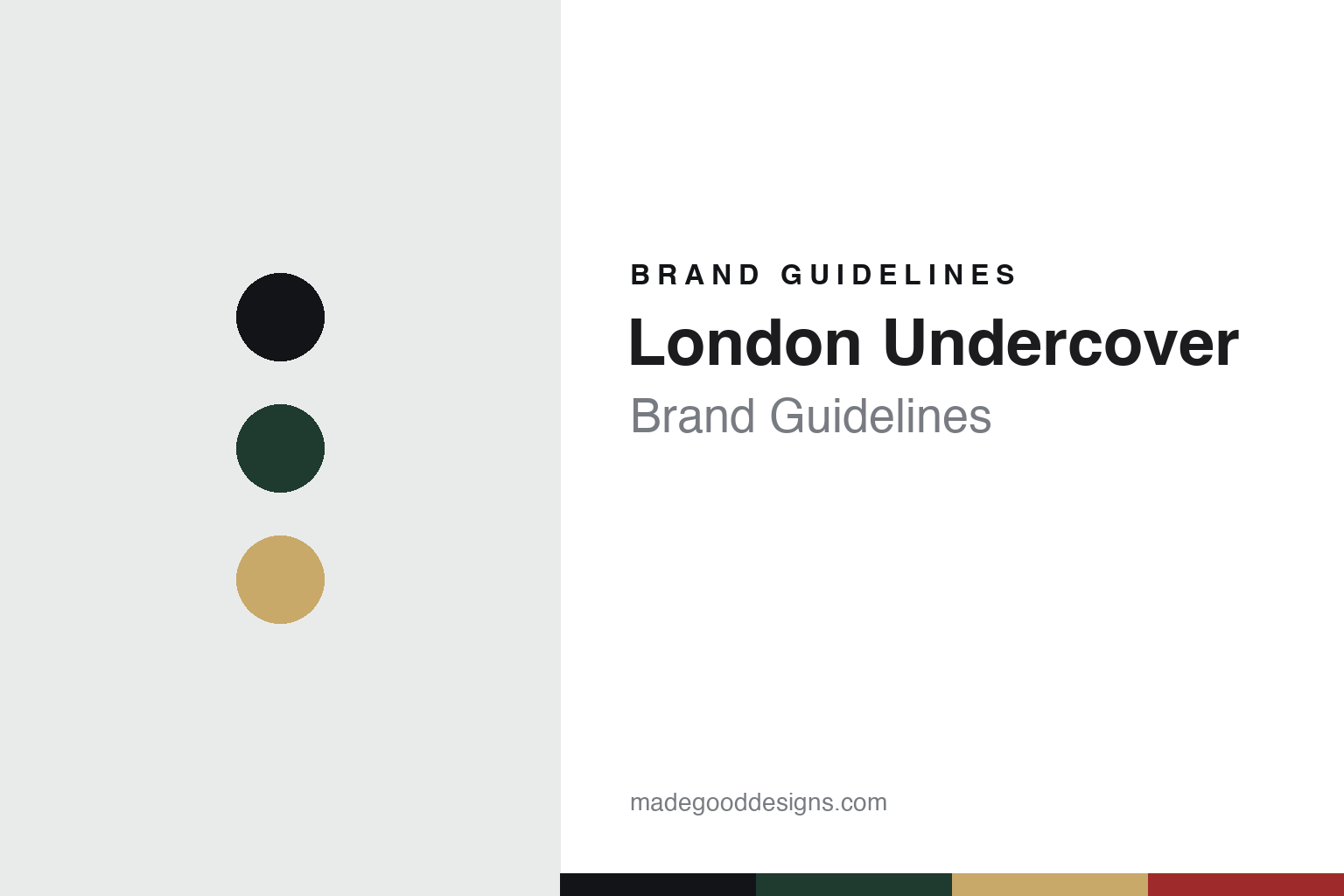
London Undercover Brand Guidelines
Jamie Milestone’s umbrella label from Spitalfields.
Aa
Two constants: a Lincoln green, brolly black and whangee cane palette and a bookish serif register. Abstract homage — not a London Undercover product or mark; no umbrella, print, logo or monogram is reproduced.
An umbrella for the younger gentleman
A graphic designer, a school-days idea and a company in 2008.
London Undercover is an independent umbrella label from London, founded in 2008 by Jamie Milestone. In an interview for the Page Hotels journal Page Common, Milestone describes it as “a British umbrella brand in London” that makes “traditional handcrafted umbrellas with a modern aesthetic and with an environmental approach.”
He told the same interview that the idea came to him at 17, while he was still at school. He did not feel there were modern umbrellas appealing enough to own, “particularly for the sort of younger gentleman.” The thought stayed with him for years. When, eight years later, such an umbrella still did not exist, he says, he left his job as a brand consultant and graphic designer and “made it happen in 2008.” That background in design and branding is a useful key to the label: from the beginning it treated the umbrella less as a utility than as something to be designed, printed and collaborated on.
The public record matches the date. Companies House, the UK register of companies, shows London Undercover Limited incorporated on 16 December 2008, with Jamie Milestone appointed a director the following day; the company is listed as active. The website still carries the line “Since 2008,” and an archived version of its About page from 2019 opened with “Established in 2008.”
Milestone frames the brand around Britishness, with humour. In Page Common he recalls having once compared umbrellas in Britain to hamburgers in America, and calls it a tongue-in-cheek comparison: like cups of tea, bowler hats and Mary Poppins, the umbrella is part of a caricature of Britain, “charming, ridiculous and insulting in equal measure.” The 2019 About page put it more simply, opening with the line “With the celebration of Britishness at the core, London Undercover continues to bring the humble umbrella to life.”
Colour
Shops, stockists and collaborations.
London Undercover sells through its own shops and through other retailers. In 2019 its website listed a single shop, on Hanbury Street in Spitalfields, in East London; today it lists two, adding a shop on Lamb’s Conduit Street in Bloomsbury, which its journal calls the label’s flagship. The same journal marked ten years in Spitalfields with a renovated store it describes as taking a “futuristic, supermarket-style approach,” in contrast to the more conventional Bloomsbury shop. In Page Common Milestone names Liberty, Mr Porter and the Conran Shop among the retailers it supplies, and says much of the work in the shops is about curation, including selling other brands.
Collaborations are the label’s signature. Its 2019 About page listed work with A Bathing Ape, Carhartt, Fred Perry, Monocle and Vans “to name a few.” The company journal documents several more. With Staple Design, the New York label founded by Jeff Ng, known as Jeff Staple, it put a New York twist on its own “London Pigeon Monogram” umbrella, after Milestone and Staple were introduced in Paris. With Transport for London it made a Green Line Umbrella, following an earlier Commuter Umbrella: the journal says the canopy takes the Lincoln green and gold paintwork of the Green Line Routemaster buses on the outside and the Routemaster seat moquette on the inside.
Other journal entries record a Space Camo umbrella with Billionaire Boys Club, the label of Pharrell Williams and Nigo, which it calls its second collaboration with the brand; an Auto-Compact umbrella with Edwin for tsuyu, Japan’s rainy season; and umbrellas made with Claridge’s, the London hotel, and the design studio JJJJound. Milestone told Page Common that the label works “in a very traditional way like any fashion brand would,” starting each season from a design theme, with prints and designs based mainly on the team’s own instincts and interests.
Typography
Design and documentation.
The seven brands in this group are all umbrella names: James Smith & Sons, totes, Knirps, London Undercover, Il Marchesato, GustBuster and ShedRain. Umbrella brands sit at many different points in the trade, from a single London shop to names sold in department stores and supermarkets around the world, and from makers that still sew in their own workrooms to brands whose umbrellas are designed in one country and made in another.
An umbrella brand’s identity is usually carried by a handful of things — a name, a handle, a canopy colour or print, a label sewn into the cover — rather than by any one product, because the company behind the name may have changed hands or moved its production since it began. Some names are very old: James Smith & Sons, which English Wikipedia says was founded in 1830, still trades from a Grade II* listed shop on New Oxford Street in London. Others have moved country: the Knirps name, which German Wikipedia traces to Hans Haupt’s folding umbrella of 1928 in Solingen, is now run from Braunau am Inn in Austria.
That makes the questions behind each name worth asking plainly: who started it, who owns it now, and where its umbrellas are actually designed and made. Each guide separates what independent sources record from what the company says about itself — its founding story, its owners over time, where its umbrellas are made and how its products and labels have changed — and marks plainly what rests only on the company’s own word.
Aa
A bookish serif — a quiet register for a loud umbrella. (Specimen set in Libre Caslon Text, a serif STAND-IN; NOT the London Undercover logo.)
London Undercover
Handcrafted, repairable and still independent.
Beyond the prints, London Undercover’s identity rests on a set of claims about how its umbrellas are made and kept. The company says its umbrellas are handcrafted “using age-old techniques” with carefully chosen parts, fabrics and trims, and that it selects materials for longevity and environmental sustainability as well as looks. Its range runs from auto-compact and telescopic folding umbrellas to full-length stick umbrellas, with personalisation, and the shop now also sells grooming, home, stationery and bag lines.
One material recurs. A journal post titled “Why Whangee?” explains the label’s use of whangee, a bamboo cane used for umbrella handles, which the company describes as fully biodegradable. The environmental theme also runs through its repair service: the company says it fixes broken ribs, torn canopies and snapped sticks and returns the umbrella to its original quality. Its help pages compare an umbrella to a good pair of British brogues that may need re-heeling, and note that umbrella repairers, once found across London, have all but disappeared.
The label remains in its founder’s hands. Companies House lists Jamie Milestone as a director of London Undercover Limited continuously since December 2008, and the company describes itself as an independent, “the secret go-to capital independent for fashion brands and brolly aficionados alike.” Milestone told Page Common that what he enjoys most is the creative freedom of having the final say, after leaving a design world where decisions were often made by committee, and that the most satisfying thing is walking down the street when it rains and seeing people carrying the label’s umbrellas.
For a design guide, London Undercover shows how a graphic designer’s eye can turn the most ordinary British accessory into a canvas for prints, monograms and collaborations, while a shop, a repair bench and a bamboo handle keep it rooted in craft. Compare James Smith & Sons, the long-established umbrella shop of New Oxford Street, and Fox Umbrellas, the English city umbrella maker. For this guide we use Lincoln green, brolly black and whangee cane with a bookish serif, an unofficial interpretation; no product or logo is reproduced.
Explore & save
Keep London Undercover’s identity on hand — save it to a board in the Made Good inspiration library.
London Undercover identity set
Pin the London Undercover Lincoln green, brolly black and whangee cane palette and the bookish serif register to your own board.


