Calvo Brand Guidelines
The Carballo canner behind Spain’s round tuna can.
Aa
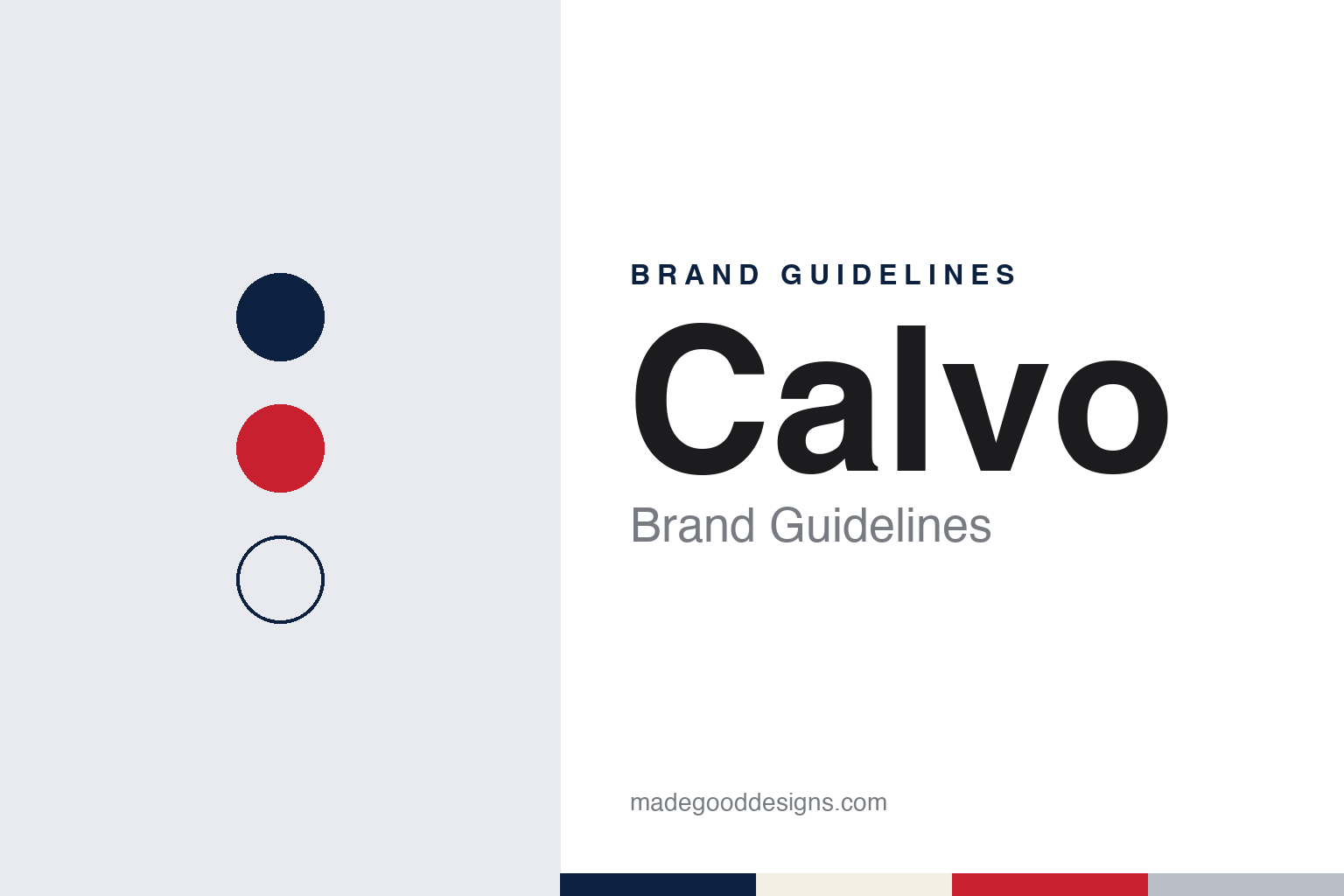
Two constants: an Atlantic navy, tin red and can silver palette and a sturdy grotesque sans register. Abstract homage — not a Calvo product or mark; no can, logo or pack is reproduced.
A shop in Carballo
A grocer’s son, a trip to Vigo and a factory named after its founder.
Calvo comes from Carballo, an inland town in the province of A Coruña, in Galicia, close to the stretch of coast known as the Costa da Morte. Spanish and English Wikipedia both date the company to 1940 and name its founder as Luis Calvo Sanz; the operating company is still called Luis Calvo Sanz, S.A., and it is still based in Carballo. The brand on the tins is simply the founder’s surname.
The company tells a longer story. In the history it published on its group website, captured by the Internet Archive in 2019, Grupo Calvo says Luis Calvo Sanz was eleven when he and his mother inherited the family business, a colonial-goods shop in the centre of Carballo trading as “Hijos de J. Calvo,” which sold oil, salt cod and wine to the surrounding Bergantiños district. Spanish Wikipedia likewise describes the beginning as a small grocery. The company says he first tried tinned meat and then pulses and fabada, without much success, until a friend in the canning industry in Vigo pointed him towards fish.
In 1940, the company says, Luis Calvo travelled to Vigo with his wife, Maruja, to visit a cannery run by the industrialist José Figueroa, and came home to set up a small factory of his own, using his surname as the brand. Its first business was preserved fish, including bonito, and the company recalls that an automatic boiler, bought on Maruja’s advice, let the plant cook fish around the clock with a staff of 45 to 60 people.
Machines run through the company’s own account of those years. In 1956, it says, Luis Calvo saw a French can-filling machine fail in Vigo and built his own from the parts of an old coffee grinder, a gluing machine and an artillery shell; Grupo Calvo calls it the first can-packing machine in Europe and says it filled 36 cans a minute, enough to start exports to the United States. His eldest son, José Luis Calvo, joined the management and, the company says, toured more than 250 factories across Europe to learn the trade.
Colour
Yellowfin, a round can and three words on television.
Much of what made Calvo a household name in Spain was a matter of format. In 1964, the company says, José Luis Calvo came across yellowfin tuna on his travels and Calvo began canning it as atún claro, the Spanish trade name for the species. A year later, as the business turned 25, Calvo says it imported the round can for its new atún claro at a time when Spanish tuna was sold in oval tins; the company says the round format went on to become the norm for tuna in Spain.
The three-can pack came next. In 1978, according to the company’s history, José Luis Calvo saw a machine in Parma, Italy, that bundled beer bottles in threes, and adapted the idea at the Carballo factory to sell tins of tuna banded together. Calvo says the multipack was later copied in Italy and Japan. Supply was brought in-house at about the same time: in 1977 another son, Manuel Calvo, started the company’s own fleet, beginning with a tuna boat named Montecelo, and Grupo Calvo says its own boats catch tuna that it then processes and cans.
Television made the name stick. In 1979, the company says, Calvo became the first brand in its sector to advertise on television, buying spots in the popular quiz show Un, dos, tres. The adverts starred two well-known bald actors, Juanjo Menéndez and Jesús Puente — a pun on the brand, since calvo means “bald” in Spanish — trading a deadpan three-word exchange: “atún, Calvo, claro.” Later campaigns kept the comic register: the company recalls a “Piltrafilla” campaign built around the line “hay que ser muy atún para ser Calvo,” and in 2007 a campaign called “Sacatunn,” which it says was meant to make the brand feel younger.
The identity itself was redrawn for the brand’s 70th anniversary. In 2010, Grupo Calvo says, it introduced a new logo with what it called a new, clearer typographic definition, intended to work as a global mark. The company has not published the colour values or typefaces of that logo, so the palette on this page is our own reading of a canned-fish brand from the Atlantic coast.
Typography
Design and documentation.
The seven brands in this group are all food brands, and all of them come from Spain: Calvo, Isabel, Cola Cao, Nocilla, ElPozo, Campofrío and Pescanova. Spanish food brands in general sit at many different points in the trade, from family firms that still carry a founder’s surname to names that now belong to much larger food groups, and a single brand can be sold everywhere from a neighbourhood shop to a supermarket shelf.
A food brand’s identity is usually carried less by a single product than by a pack, a name and the meal or snack it promises, because the company behind the name may have changed hands, moved its factory or grown far beyond the town where it started. That makes the questions behind each name worth asking plainly: who started it, who owns it now, and where its food is actually made and packed.
Each guide separates what independent sources record from what the company says about itself — its founding story, its owners over time, where its food is made and how its packaging and advertising have changed — and marks plainly what rests only on the company’s own word.
Aa
A sturdy grotesque sans for a brand that sells itself on a pun. (Specimen set in Archivo, a sans STAND-IN; NOT the Calvo logo.)
Grupo Calvo
Esteiro, Italy, El Salvador and Brazil.
Calvo grew from one factory into a group with plants on three continents. In 1986 it opened a second Galician factory at Esteiro, on the Ría de Muros in A Coruña, which the company says initially employed 250 people and made salads, sardines, mussels and squid as well as tuna. Spanish Wikipedia also records the opening of the Esteiro plant in 1986.
Expansion abroad began in Italy. In 1993 Calvo bought the Italian tuna brand Nostromo, Italian Wikipedia says, and the company says Nostromo products were packed at a factory in Grado, in north-eastern Italy. English Wikipedia records an earlier venture in Venezuela, where a cannery at Guanta was closed between 1991 and 2001, and a cannery at Laayoune that closed in November 2008. In 2003 the group opened a plant at La Unión, in El Salvador, which the company says processes fish for Central America, Mexico and the United States and also makes its own cans. In 2004 it took over Gomes da Costa, the Brazilian canner founded in 1954 by the Portuguese-born Rubem Gomes da Costa, with a plant at Itajaí; English Wikipedia says the Brazilian facility was expanded in 2006. The group’s three main brands today are Calvo, Nostromo and Gomes da Costa, and Spanish Wikipedia says its products are sold in more than 65 countries, with production in Spain, El Salvador and Brazil.
Ownership has stayed largely with the Calvo family. English Wikipedia names José Luis Calvo Pumpido as president and Manuel Calvo García-Benavides as managing director. The Italian canned-food group Bolton, owner of Rio Mare, holds a minority stake, though sources differ on its size and timing: Spanish and English Wikipedia describe a 22.2% stake bought in 2017, with the family keeping 77.8%, while Italian Wikipedia says Bolton took 40% of Grupo Calvo in 2012. Spanish Wikipedia also records that in 2017 the group began supplying own-label tuna to the supermarket chain Día for the first time.
For a design guide, Calvo shows how a surname, a can shape and a pun can carry a fish brand for more than eighty years. Compare Isabel, the Basque canner that answered with a jingle, and Century Tuna, the Philippine tuna brand. For this guide we use an Atlantic navy, a tin red and a can silver with a sturdy grotesque sans, an unofficial interpretation; no product or logo is reproduced.
Explore & save
Keep Calvo’s identity on hand — save it to a board in the Made Good inspiration library.
Calvo identity set
Pin the Calvo Atlantic navy, tin red and can silver palette and the sturdy grotesque sans register to your own board.