Cola Cao Brand Guidelines
The Barcelona cocoa drink, its lumps and its 1950s radio song.
Aa
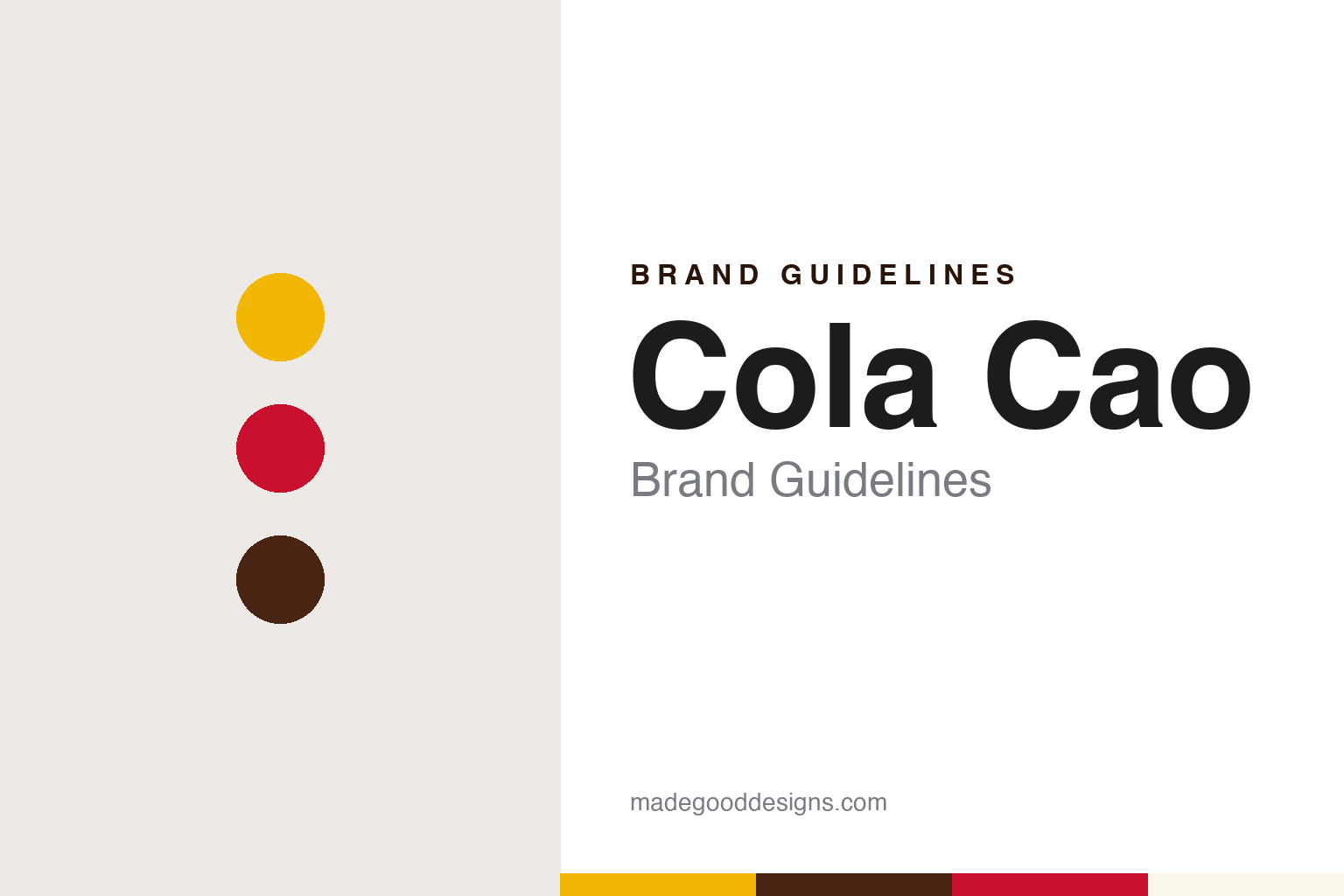
Two constants: a Cola Cao yellow, cocoa brown and red palette and a sturdy slab serif register. Abstract homage — not a Cola Cao product or mark; no tin, logo or advertisement is reproduced.
Two brothers-in-law in Gràcia
A cocoa powder, a Barcelona partnership and a family split.
Cola Cao is a Barcelona brand. In the account given by El Español in 2019, it was created in 1945 in the city’s Gràcia district by two brothers-in-law, José María Ventura and José Ignacio Ferrero, who named their soluble cocoa ColaCao; Spanish Wikipedia also gives 1945 as the launch year. Their company, Nutrexpa, had been set up by the same two men in 1940 to make food for the Spanish home market, and Spanish Wikipedia, citing a business-school case study, says it began selling Cola Cao in 1946, the date Catalan Wikipedia uses too. The powder is a mix of sugar, soluble cocoa, wheat flour and malted cola nut, Spanish Wikipedia says, and the brand has long made a point of the little lumps it forms in milk, which it calls “grumitos.” Nesquik, its best-known rival, reached Spain more than a decade later, El Español noted.
Nutrexpa grew around its cocoa. Spanish Wikipedia says that in the 1970s it bought the rival cocoa drink Phoscao and the Girona biscuit maker Galletas Paja, which brought the Phoskitos cakes; that it began making and selling Cola Cao in Chile in 1980, its first step abroad; and that the drink later reached Poland, Russia and China, where it was sold as Gao Le Gao. Nutrexpa added the pâté maker La Piara in 1988, bought Nocilla from Unilever in 2002, and moved into biscuits with Cuétara in 2009 and Artiach in 2012.
The two founding families then went separate ways. In June 2014 the shareholders agreed to split Nutrexpa, El País reported, and from 1 January 2015 the cocoa business became Idilia Foods, owned by the Ferrero family of Barcelona — not the Italian Ferrero group behind Nutella — while the Ventura family kept the biscuits as Adam Foods. Idilia Foods also took Nocilla, Paladín, Okey and the sweetener Mesura. It sold its factory in China in December 2015, La Vanguardia reported, and in 2017 moved its registered office to Valencia, citing the political situation in Catalonia, while keeping its operations in Barcelona, Spanish Wikipedia says.
Colour
A radio serial, a song and a rewrite.
Cola Cao’s advertising is better known than any of its tins. In the 1950s the brand sponsored Matilde, Perico y Periquín, a radio serial on Radio Barcelona, part of Cadena SER; El Español calls it the first brand to sponsor a radio serial. Its song, composed by Aureli Jordi Dotras, opened with the line “Yo soy aquel negrito del África tropical” and was sung in the first person by a caricatured African cocoa grower. Catalan Wikipedia dates the radio campaign to 1955 and names the singer as Roberto Rizo. Spanish Wikipedia describes the figure, known as “el Negrito del África Tropical,” as a stereotyped image that ran through the brand’s posters, leaflets and promotions as well as its broadcasts.
Television followed in 1962, when the first Cola Cao spots on Televisión Española turned the radio tune into cartoons, and in the late 1980s the brand moved onto Spain’s new private channels, El Español reported. The song also tied the drink to sport — its verses named footballers, swimmers, cyclists and boxers — and sport became the brand’s long-running theme. Spanish Wikipedia says Cola Cao first called itself an “alimento olímpico” after sponsoring the Spanish team at the 1972 Munich Olympics, and that it has backed the Spanish Olympic Committee’s ADO programme since 1988.
The song drew criticism for its racial caricature. In 2017 an advertisement for Cola Cao Shake that turned the drink’s foam into a Black man with afro hair was heavily criticised by members of Spain’s Black community, Verne, the El País site, reported, and Spanish Wikipedia says the campaign for its withdrawal was joined by the film director Santiago Zannou and the rapper El Chojin. For its 75th anniversary the brand kept the melody and changed the words. The new version, by the musician Manu Guix, was presented in Barcelona on 30 January 2020, sung by the children’s and youth choir of Xamfrà, a music centre in the Raval, Verne reported; it drops the “negrito” and names female athletes alongside male ones. The company’s general manager, Xavi Pons, said in a press release that the recipe had stayed the same since the brand began but that the song had to evolve to stay relevant.
Typography
Design and documentation.
The seven brands in this group are all food brands, and all of them come from Spain: Calvo, Isabel, Cola Cao, Nocilla, ElPozo, Campofrío and Pescanova. Spanish food brands in general sit at many different points in the trade, from family firms that still carry a founder’s surname to names that now belong to much larger food groups, and a single brand can be sold everywhere from a neighbourhood shop to a supermarket shelf.
A food brand’s identity is usually carried less by a single product than by a pack, a name and the meal or snack it promises, because the company behind the name may have changed hands, moved its factory or grown far beyond the town where it started. That makes the questions behind each name worth asking plainly: who started it, who owns it now, and where its food is actually made and packed.
Each guide separates what independent sources record from what the company says about itself — its founding story, its owners over time, where its food is made and how its packaging and advertising have changed — and marks plainly what rests only on the company’s own word.
Aa
A sturdy slab serif for a breakfast tin with a long memory. (Specimen set in Roboto Slab, a serif STAND-IN; NOT the Cola Cao logo.)
Cola Cao
Turbo, Noir and a plant in Parets del Vallès.
The range has grown around the original powder. Spanish Wikipedia lists Cola Cao VIT, an instant version of the 1980s; a reduced-calorie version from the mid-1990s that became Cola Cao Light and, in 2009, Cola Cao 0%; and, around the turn of the century, the instant Cola Cao Turbo, whose launch renamed the classic as Cola Cao Original. El Español reported in 2019 that the brand says half its consumers are adults, and that it had added Cola Cao Noir and Cola Cao Puro, a pure cocoa, with them in mind. The brand’s own site now writes the name as one word, ColaCao, and marks 75 years of its “grumitos.”
On where it is made, the company told El Español in 2019 that the recipe is a secret known to a small number of people and is made at the Idilia Foods plant in Parets del Vallès, near Barcelona; the Nocilla website likewise invites school groups to visit “the Nocilla and ColaCao factory” there. An earlier plant in Palencia, which made Cola Cao and Okey, closed in 2014, Spanish Wikipedia says, citing ABC.
For a design guide, Cola Cao shows how a cocoa tin can live on its sound — a radio tune of the 1950s whose melody survived a new set of words in 2020 — and on a texture its owner turned into a word, “grumitos.” Compare Nocilla, its stablemate at Idilia Foods, and Ovaltine, the Bern malt drink. For this guide we use tin yellow, cocoa brown and a breakfast red with a slab serif, an unofficial interpretation; no product or logo is reproduced.
Explore & save
Keep Cola Cao’s identity on hand — save it to a board in the Made Good inspiration library.
Cola Cao identity set
Pin the Cola Cao tin yellow, cocoa brown and breakfast red palette and the sturdy slab serif register to your own board.