Galbani Brand Guidelines
The Lombard cheesemaker behind Bel Paese and a promise of trust.
Aa
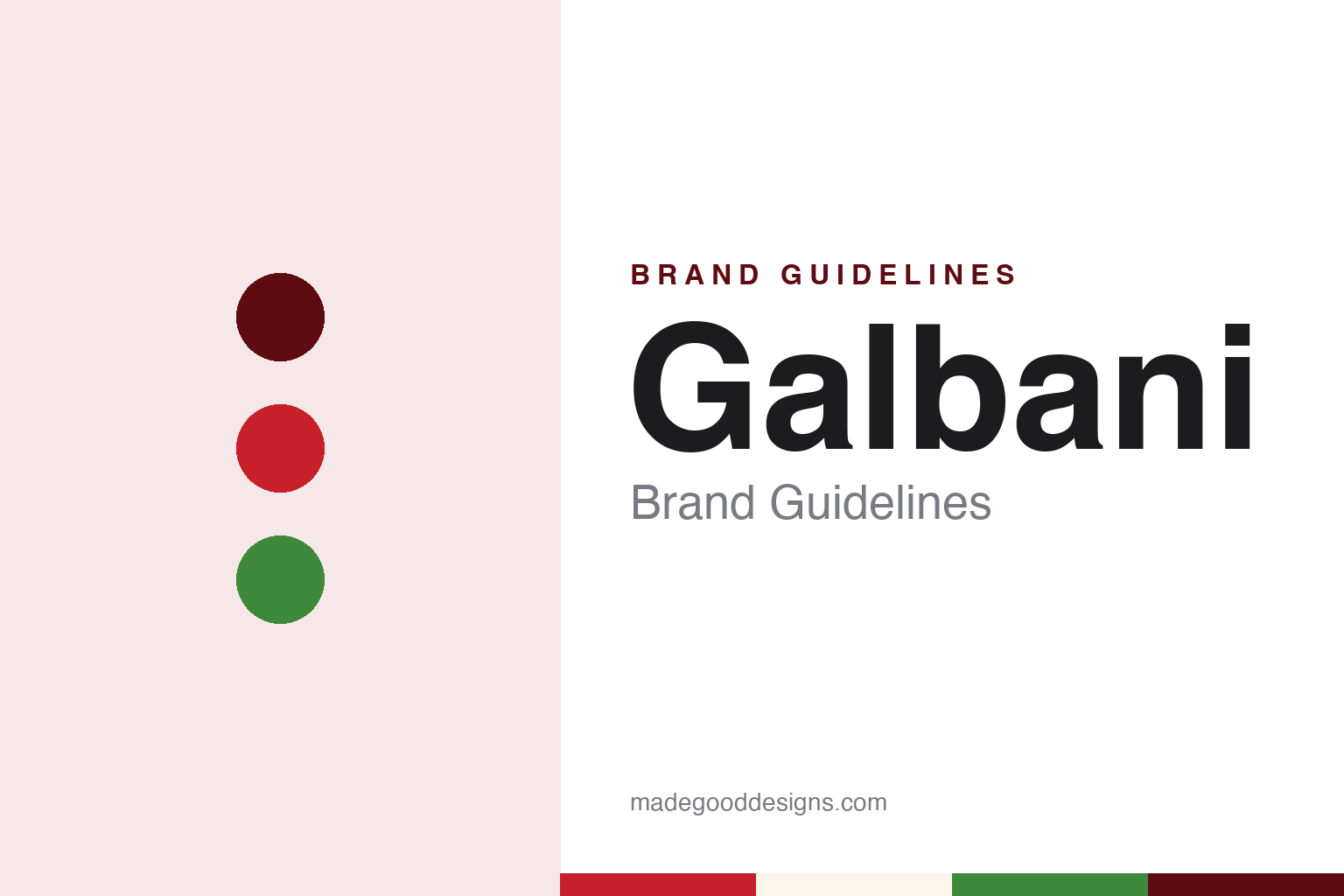
Two constants: a Galbani oval red, field green and cream palette and a traditional serif register. Abstract homage — not a Galbani product or mark; no pack, label or logo is reproduced.
Ballabio to Melzo
A Valsassina dairy that set out to rival French cheese.
Galbani began in 1882 at Ballabio, at the mouth of the Valsassina valley above Lecco, in Lombardy. Its founder was Egidio Galbani. Sources differ on who Davide Galbani was. Italian Wikipedia, drawing on the Italian culture ministry’s portal of business archives, says Egidio founded the dairy with his brother Davide. The company’s own timeline says Egidio named his dairy the “Caseificio Davide Galbani” in honour of his father, and the Museo del Marchio Italiano, an online museum of Italian trademarks, also calls Davide his father, though it dates the “Caseificio Davide Galbani” name to 1915, at Melzo. The business later moved to Maggianico, near Lecco.
Its first cheese was a robiola, a soft cheese that Italian Wikipedia likens to brie. At a time when Italian dairy was mostly artisanal and sold locally, the Galbanis took their cue from the French cheeses then being imported into Italy; the company today calls its robiola the first Italian raw-milk cheese made to compete with French luxury products. Through the 1880s Egidio added other soft cheeses, and from 1892, the archives portal says, the firm won a growing number of prizes and diplomas at exhibitions in Italy and abroad.
In the 1890s Galbani moved much of its production to Melzo, east of Milan, drawn, the archives portal says, by plentiful milk and by the Milan–Venice railway. Italian Wikipedia dates Egidio’s move to a Melzo farmstead to 1896 and a proper factory there to 1900, while the company dates its first large Melzo dairy to 1910. Melzo remained the company’s main production site for decades. Building of a plant at Certosa di Pavia began in 1922, and Italian Wikipedia credits Galbani’s success partly to its fleet of small delivery vans and its network of depots, which reached Italy’s many small grocers.
Colour
Bel Paese, a map of Italy and a Manzoni heroine.
Galbani’s first big success was Bel Paese, launched in 1906. The name, “beautiful country,” came from Il Bel Paese, the 1876 popular-science book by the Lecco geologist and abbot Antonio Stoppani. Italian Wikipedia says Galbani had noticed that the “luxury” cheeses in Italy’s best delicatessens were all French, and wanted one that could match them; the Museo del Marchio Italiano adds that Stoppani was a friend of the Galbani family.
The wrapper was the brand’s first real piece of design. According to the archives portal, Galbani had the label show Stoppani’s portrait together with an image of Italy, picking out the places that mattered to the company — Ballabio, Maggianico, Melzo and its plants — in what the portal calls a clever piece of advertising. The Museo del Marchio Italiano describes the label as a map of Italy with the abbot’s portrait and the cheese’s full name, and notes that a portrait of Dante was considered and then dropped. The same portal says Galbani’s wrappers of the period showed pastoral scenes of the Valsassina, with a young woman in local costume — hair pins, apron and clogs — in an explicit reference to Lucia Mondella, the heroine of Manzoni’s I promessi sposi, and that the firm advertised early through catalogues aimed at shopkeepers.
New formats followed. In 1924–25, the portal says, Galbani introduced boxes of crustless cheese portions, the formaggini, which quickly caught on. The company’s timeline adds the Crescenza Certosa in the 1930s, a move into cured meats in 1936 with the purchase of the Melzese salami maker, and Santa Lucia, launched in 1956, which it calls the first industrially made mozzarella. By the late 1920s exports took between 30% and 50% of output, mainly to Germany, France and the United States, where Galbani sold through the network of the Mattia Locatelli trading company, the portal says.
Typography
Design and documentation.
The seven brands in this group are food brands, and all of them come from Spain or Italy: Fontaneda, Carbonell, Hojiblanca, Galbani, Star, Ponti and Bauli. Spanish and Italian food brands in general sit at many different points in the trade, from family firms that still carry a founder’s surname to names that now belong to much larger food groups, and a single brand can be sold everywhere from a village shop to a supermarket shelf abroad.
A food brand’s identity is usually carried less by a single product than by a pack, a name and the meal or occasion it promises, because the company behind the name may have changed hands, moved its factory or grown far beyond the town where it started. That makes the questions behind each name worth asking plainly: who started it, who owns it now, and where its products are actually made and packed.
Each guide separates what independent sources record from what the company says about itself — its founding story, its owners over time, where its products are made and how its packaging has changed — and marks plainly what rests only on the company’s own word.
Aa
A traditional serif for a brand whose 1996 mark set its name in a serif inside an oval. (Specimen set in Libre Caslon Text, a serif STAND-IN; NOT the Galbani logo.)
Galbani vuol dire fiducia
A script, a red oval and a slogan about trust.
The Museo del Marchio Italiano traces the logo. After the First World War the new company, the Società Anonima Egidio Galbani, used an enamelled plate with lettering typical of the time. The first true mark, in the 1930s, was an oblique calligraphic script whose “G” and “i” ended in oval flourishes; in 1934 the script was set level. In the 1950s the surname went inside a red oval, joined in 1955 by the name of Melzo. A light restyling in 1960, the year the head office moved to Milan, made the oval less elongated and the lettering bolder. In 1996, under Danone, Galbani adopted a new mark designed by Maurizio Di Robilant: it kept the oval but set the name in a serif typeface with two green strokes standing for fields and nature, in colours meant to signal Italian food to buyers abroad.
The slogan “Galbani vuol dire fiducia” — “Galbani means trust” — appeared on all its products, the museum says, and the company links its fame to the years of Carosello, Italian television’s evening advertising showcase, from the late 1950s.
Ownership changed many times. Egidio Galbani left the company in June 1926, when the presidency passed to Achille Invernizzi, and by the 1930s Galbani belonged to a branch of the Invernizzi family of Melzo, Italian Wikipedia says. In 1974 the family sold Galbani to four finance companies in Luxembourg and Liechtenstein whose owners were not disclosed, Italian Wikipedia says, citing la Repubblica. In 1989 Galbani was bought by IFIL and BSN, the group that became Danone, which gradually took the whole company, Il Sole 24 Ore reported at the time. In 2002, Galbani’s 120th year, Danone sold it to the private-equity fund BC Partners, which split production, sales and logistics into separate companies; in 2006 BC Partners sold Galbani to France’s Lactalis, as Il Sole 24 Ore reported that January. Lactalis, owned by the Besnier family and based in Laval, now groups Galbani with Invernizzi, Cademartori, Locatelli and Président in Italy, the company says, and in 2013 it renamed its American Sorrento and Precious cheeses Galbani, English Wikipedia says. Italian Wikipedia lists five Galbani production sites in Lombardy: Melzo, Corteolona, Certosa di Pavia, Casale Cremasco and Introbio.
For a design guide, Galbani shows how a label built on national pride — a map of Italy, a scientist’s portrait — and a single word, trust, can carry a cheese brand through a century of owners. Compare Président, Lactalis’s own cheese brand, and Giovanni Rana, another Italian chilled-food name. For this guide we use an oval red, a field green and a fresh-cheese cream with a serif, an unofficial interpretation; no product or logo is reproduced.
Explore & save
Keep Galbani’s identity on hand — save it to a board in the Made Good inspiration library.
Galbani identity set
Pin the Galbani oval red, field green and cream palette and the traditional serif register to your own board.