Ovaltine Brand Guidelines
The Bern malt drink with two owners.
Aa
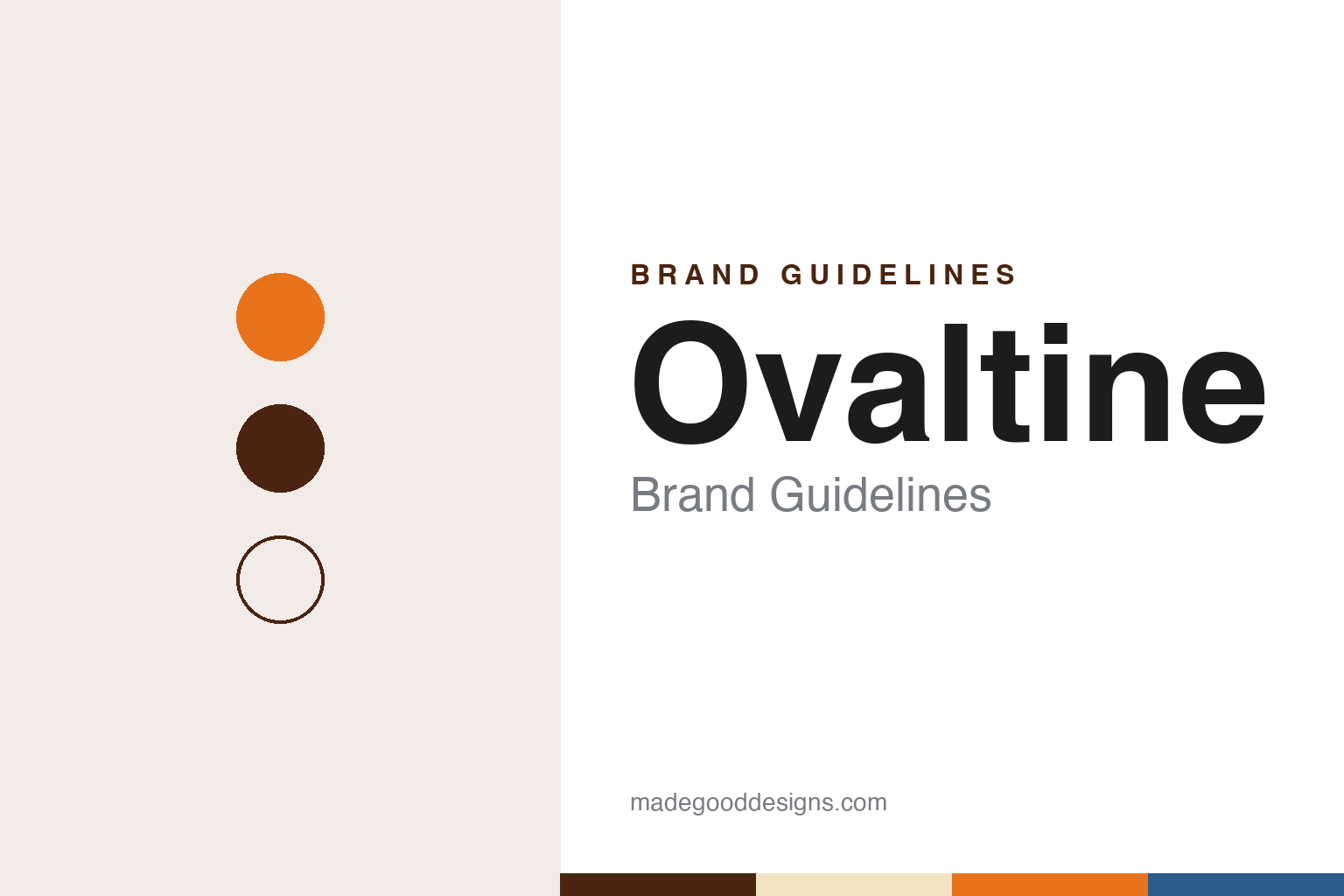
Two constants: a malt orange, cocoa brown and toasted cream palette and a warm display serif register. Abstract homage — not an Ovaltine product or mark; no tin, jar, logo or pack is reproduced.
Ovomaltine
A Bern laboratory, a malt extract and a Latin name.
Ovaltine began in Bern under another name. German Wikipedia says Georg Wander set up a chemical-technical and analytical laboratory in the old town of Bern in 1865, and that his son Albert Wander (1867–1950), a chemist, took the business over in 1897. Working with W. Lanwer, Albert Wander developed a soluble malt extract, and in 1904 the company began producing a malt drink powder from it. He called it Ovomaltine, from ovum, the Latin for egg, and malt, which English Wikipedia says were originally its key ingredients.
The Swiss name is still the Swiss name. In Switzerland, and in Brazil, the drink is sold as Ovomaltine; Britain got it as Ovaltine from 1909, English Wikipedia says. German Wikipedia says the company opened its first sales depots in Italy and England in 1906 and became a joint-stock company, Wander AG, in 1908.
Production soon spread beyond Switzerland. German Wikipedia dates the first Ovomaltine factory outside the country to 1913, at Kings Langley in Hertfordshire; English Wikipedia says Ovaltine was being made in Villa Park, Illinois, for the American market by 1915, and that a factory in Devonport, Tasmania, opened in 1943. At home, the Swiss works moved out of Bern in 1927 to the village of Neuenegg, a short distance to the west, where the drink is still made. German Wikipedia says a new Ovomaltine plant opened at Neuenegg in 1997, and that since 2002 the site has produced all of the Ovomaltine sold in Europe.
Colour
Decoder badges, a radio club and an Art Deco factory.
In the United States, Ovaltine became part of radio history. It sponsored the children’s serial Little Orphan Annie from its early years until 1940, when Quaker’s Puffed Wheat Sparkies took over, English Wikipedia says; the series’ own Wikipedia article dates the start to 1930, the Ovaltine article to 1931. Listeners could send in Ovaltine proofs of purchase for premiums, including shake-up mugs for mixing the drink and, from 1935, a membership badge with a cipher disc for decoding messages read on air. Those messages were usually clues about the next episode rather than advertisements. Jean Shepherd’s story of a boy who decodes one only to find an Ovaltine commercial became a scene in the 1983 film A Christmas Story. Ovaltine also sponsored Captain Midnight on radio from 1938 to 1949 and on television from 1954 to 1956.
Britain had its own club. The League of Ovaltineys was broadcast on Radio Luxembourg from February 1935 until September 1939, English Wikipedia says, and its theme song is remembered as one of the most successful jingles of the period.
The British factory left a landmark. At Kings Langley, English Wikipedia says, the listed factory facade was designed around 1923 by James Albert Bowden in the Art Deco manner, and it is all that remains of the works: the factory was converted into flats and duplexes, with the redevelopment dated to 2002, and the estate’s former Ovaltine Egg Farm became offices. The drink also travelled in other forms. In Hong Kong it is served hot or over ice. In Australia, English Wikipedia says, Ovalteenies are sold as round tablets of compressed Ovaltine, and in Brazil the fast-food chain Bob’s has served Ovomaltine milkshakes since 1959. German Wikipedia says the brand is sold in about 100 countries, under one name or the other, and that recipes differ between markets.
Typography
Design and documentation.
The seven brands in this group make malted drinks, snacks and sauces, and they come from Switzerland, Britain, India, Malaysia and China: Ovaltine, Horlicks, Bournvita, Mamee, Julie’s, Munchy’s and Pearl River Bridge. Brands like these sit at many different points in the trade, from family firms that still carry a founder’s name to labels that now belong to much larger food groups, and a single brand can be sold everywhere from a corner shop to a supermarket shelf far from home.
A food brand’s identity is usually carried less by a single product than by a jar, a packet, a bottle and the name on it, because the company behind the name may have changed hands, moved its factory or grown far beyond the place where it started. That makes the questions behind each name worth asking plainly: who started it, who owns it now, and where its products are actually made and packed.
Each guide separates what independent sources record from what the company says about itself — its founding story, its owners over time, where its products are made and how its packaging has changed — and marks plainly what rests only on the company’s own word.
Aa
A warm display serif for a malt drink with a Latin name. (Specimen set in Fraunces, a serif STAND-IN; NOT the Ovaltine or Ovomaltine logo.)
Ovaltine
From a family firm to Sandoz, then a split.
The Wander family business did not stay independent. German Wikipedia says Wander AG was taken over by the Basel pharmaceutical company Sandoz in 1967. Sandoz merged with Ciba-Geigy in 1996 to form Novartis, and Ovaltine sat in its food and drinks division for the next few years.
The modern split dates from the early 2000s. In October 2002, English Wikipedia says, Associated British Foods bought the Novartis food and drinks division that made Ovaltine; German Wikipedia likewise dates the sale of Wander AG to ABF to 2002. Ovaltine is now a registered trademark of Associated British Foods and is made by Wander AG, which English Wikipedia describes as a subsidiary of Twinings, ABF’s tea business. German Wikipedia says Wander AG is still based in Neuenegg, employs about 300 people and also makes the Caotina chocolate drink and Isostar sports drinks.
The United States is the exception. In 2007, English Wikipedia says, Nestlé acquired Novartis’ medical nutrition division, and with it the rights to Ovaltine in the US. So the same name sits with two unrelated owners: Nestlé in America, Associated British Foods across much of the rest of the world, with the original Swiss product still coming out of Neuenegg as Ovomaltine.
For a design guide, Ovaltine shows how one malt drink can carry two names, a Latin coinage and its English shortening, and stay recognisable across markets and owners. Compare Horlicks, its oldest rival in the malt aisle, and Cailler, another Swiss brand now owned from abroad. For this guide we use a malt orange, cocoa brown and toasted cream with a warm serif, an unofficial interpretation; no product or logo is reproduced.
Explore & save
Keep Ovaltine’s identity on hand — save it to a board in the Made Good inspiration library.
Ovaltine identity set
Pin the Ovaltine malt orange, cocoa brown and toasted cream palette and the warm display serif register to your own board.