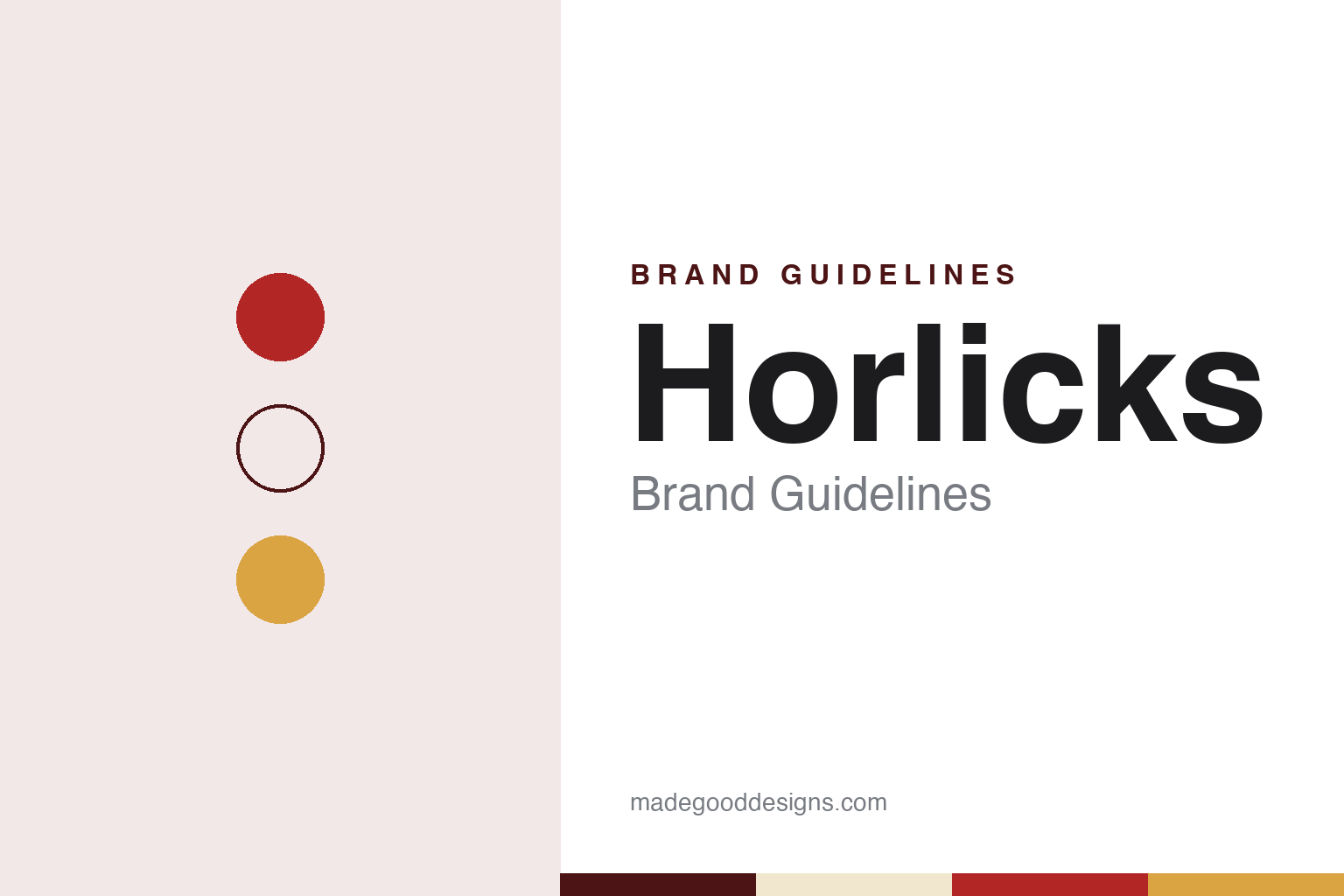
Horlicks Brand Guidelines
Two brothers, malted milk and a split.
Aa
Two constants: a malt red, milk cream and barley gold palette and a Victorian book serif register. Abstract homage — not a Horlicks product or mark; no jar, logo or pack is reproduced.
J & W Horlicks
Two Gloucestershire brothers and an American patent.
Horlicks was born in America to two English brothers. English Wikipedia says William Horlick (1846–1936) emigrated from Ruardean, in Gloucestershire, to the United States in 1869, and that his brother James Horlick, a pharmacist, joined him in 1873. Together they founded J & W Horlicks in Chicago to make a malted milk drink. Within a few years the business moved north to Racine, Wisconsin, for its supply of spring water; the Horlicks article dates the move to 1875, William Horlick’s own Wikipedia article to 1876.
The product was protected early. In 1883 William was granted US patent 278,967 for a malted milk powder to be mixed with hot water, English Wikipedia says. His biography adds that the powder was first sold as “Diastoid” and that the name “malted milk” was trademarked in 1887. New plants followed in Racine in 1902 and 1905, and from 1921 William was company president, a post he held until 1936.
James took the drink back across the Atlantic. In 1890, English Wikipedia says, he returned to London and opened an office to import the American-made product. British production followed in Slough, then in Buckinghamshire, near the railway station: the Slough article says James Horlick opened the purpose-built red-brick factory in 1906, while the Horlicks article dates its completion to 1908, at a cost of £28,000. James was knighted in 1914 and raised to a baronetcy, of Cowley Manor, his brother’s biography says. Aimia Foods, which owns the brand in Britain today, still credits both brothers with inventing the drink more than 150 years ago.
Colour
Polar rations, wartime tablets and an invented condition.
The powder travelled well, and Horlicks made the most of it. English Wikipedia says that around 1909–1910 it became a provision on polar expeditions led by Robert Peary, Roald Amundsen and Robert Falcon Scott. In 1935 the American explorer Richard E. Byrd named the Horlick Mountains, on the edge of the Ross Ice Shelf in Antarctica, after William Horlick in thanks for his support of Byrd’s expedition.
The drink also came in solid form. In the Second World War, English Wikipedia says, Horlicks tablets were supplied to American, British and other troops as a treat, and were packed into lifeboat and life-raft rations and aircrew escape kits.
Its most famous advertising was built on something that did not exist. In 1931, English Wikipedia says, the company developed the “Night Starvation” story to sell Horlicks as a bedtime drink; the encyclopaedia calls it a fictitious condition invented as an advertising gimmick, which a mug of the drink before bed was supposed to relieve.
Horlicks found its largest market in South Asia. English Wikipedia says a factory opened in Punjab, India, in 1960 to make Horlicks from buffalo milk, and a second followed in 1968 to meet local demand, including in what is now Bangladesh. In Malaysia and Singapore, it says, the drink has been sold with the slogan “Taller, stronger, sharper.”
Typography
Design and documentation.
The seven brands in this group make malted drinks, snacks and sauces, and they come from Switzerland, Britain, India, Malaysia and China: Ovaltine, Horlicks, Bournvita, Mamee, Julie’s, Munchy’s and Pearl River Bridge. Brands like these sit at many different points in the trade, from family firms that still carry a founder’s name to labels that now belong to much larger food groups, and a single brand can be sold everywhere from a corner shop to a supermarket shelf far from home.
A food brand’s identity is usually carried less by a single product than by a jar, a packet, a bottle and the name on it, because the company behind the name may have changed hands, moved its factory or grown far beyond the place where it started. That makes the questions behind each name worth asking plainly: who started it, who owns it now, and where its products are actually made and packed.
Each guide separates what independent sources record from what the company says about itself — its founding story, its owners over time, where its products are made and how its packaging has changed — and marks plainly what rests only on the company’s own word.
Aa
A Victorian book serif for a brand born in 1873. (Specimen set in Libre Baskerville, a serif STAND-IN; NOT the Horlicks logo.)
Horlicks
Beecham, GSK, and two new owners.
For half a century Horlicks belonged to the pharmaceutical industry. English Wikipedia says the company was acquired by the Beecham Group in 1969. Beecham became SmithKline Beecham in 1989, and SmithKline Beecham became GlaxoSmithKline in 2000, so the brand passed through each merger.
GSK then sold Horlicks in pieces. In Slough, the Slough article says, the factory site was sold in 2015 and manufacturing there ceased altogether in 2017; the red-brick buildings have since been restored for homes in a development called the Horlicks Quarter. The British brand went the same year: in 2017, English Wikipedia says, the Horlicks UK business was sold to Aimia Foods, a drinks company based in Haydock, Merseyside, which describes Horlicks as one of its own brands and says it manages the range in what it calls the Western territories.
The larger business went east. On 3 December 2018, Unilever announced that it was buying the Indian Horlicks business: its Indian arm, Hindustan Unilever, would acquire GlaxoSmithKline’s Indian consumer business in an all-share merger valued at US$3.8 billion, English Wikipedia says. The deal also covered around 3,800 GSK employees in India, and Hindustan Unilever said it contained no clause guaranteeing that they would be kept on. English Wikipedia says Hindustan Unilever completed the merger with GlaxoSmithKline Consumer Healthcare India in April 2020, after the legal approvals. Since then Horlicks has had two owners: Aimia Foods in Britain and Hindustan Unilever, the Indian arm of Unilever, which makes the drink in India and supplies other markets including Bangladesh, English Wikipedia says.
For a design guide, Horlicks shows how a family surname can become the name of a whole drink, and survive more than a century of changing owners. Compare Ovaltine, the Swiss rival with its own divided ownership, and Bournvita, its competitor in Indian kitchens. For this guide we use a malt red, milk cream and barley gold with a Victorian serif, an unofficial interpretation; no product or logo is reproduced.
Explore & save
Keep Horlicks’s identity on hand — save it to a board in the Made Good inspiration library.
Horlicks identity set
Pin the Horlicks malt red, milk cream and barley gold palette and the Victorian book serif register to your own board.