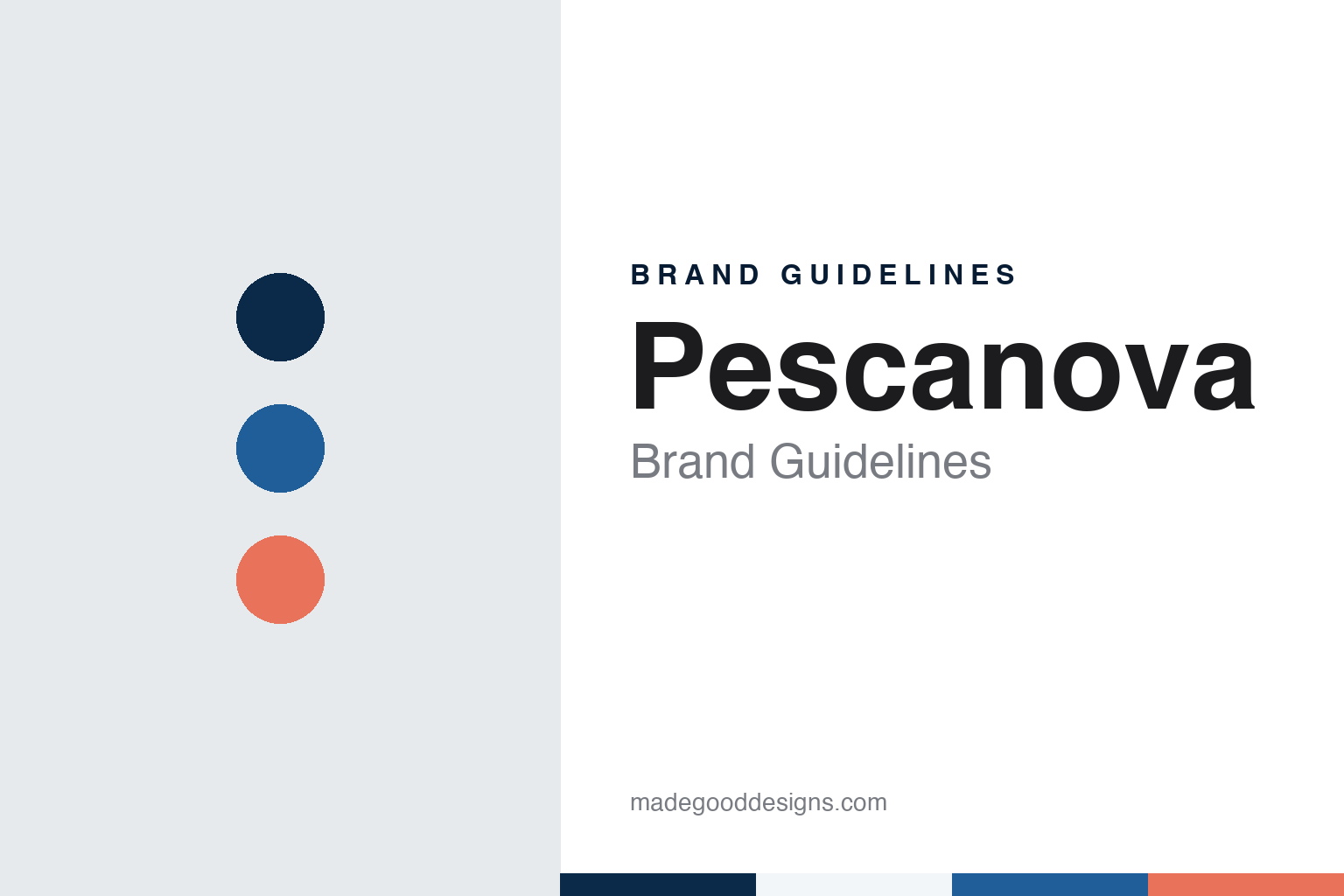
Pescanova Brand Guidelines
The Vigo freezer-ship pioneer behind Rodolfo Langostino.
Aa
Two constants: an ocean navy, trawler blue and prawn coral palette and a confident maritime sans register. Abstract homage — not a Pescanova product or mark; no pack, logo or character is reproduced.
Freezer ships from Vigo
Refrigeration men, a fisheries lawyer and a ship called Lemos.
Pescanova was founded in Vigo, Galicia’s great fishing port, in June 1960. Spanish Wikipedia, citing the Vigo business site VigoEmpresa, says the idea came from José Fernández López, who set the company up with his brothers. José and his brother Antonio already knew industrial refrigeration: they had founded the cold-storage businesses Frilugo in 1941 and Frigsa in 1951. Less familiar with fishing, José turned to the lawyer Valentín Paz Andrade, an adviser to the UN’s Food and Agriculture Organization and editor of the trade magazine Industrias Pesqueras. Fernández López chaired the first board, with Paz Andrade as vice-chairman.
The company’s idea was to freeze fish at sea. Pescanova built large freezer ships that processed and deep-froze the catch on board, so they could work grounds far from Spain. The first, the Lemos, was built in 1961 by the ASCON yard at Meira, across the Vigo estuary, and sailed for the hake grounds off Argentina, Brazil and Uruguay, returning to Vigo with its holds full. The very first freezer trawler had been the British Fairtry, built in Aberdeen some years earlier, Spanish Wikipedia notes. In 1963 Pescanova added the stern trawlers Vimianzo and Villalba, which hauled their nets over the stern rather than the side, and in 1964 a former transatlantic liner, converted into the factory and mother ship Galicia, sailed for South African waters to process the catch of the fleet working there.
As coastal states extended their fishing limits to 200 miles, Pescanova set up joint ventures with local partners in countries including Mozambique, Uruguay, Morocco and Cameroon, Spanish Wikipedia says. In 1977 the founder’s son, Manuel Fernández de Sousa-Faro, became chairman, and in 1985 the company was listed on the Madrid stock exchange. Processing plants followed in Galicia, at Porriño and Arteixo, and in the 1990s the group moved into aquaculture, farming salmon in Chile, turbot in northern Spain and prawns in southern Spain.
Colour
A slogan, a cartoon prawn and a captain.
In Spanish shops Pescanova is a frozen and chilled seafood brand: its Spanish website groups its range into shellfish, fish, cephalopods and breaded fish. Its best-known piece of advertising is a slogan, “Lo bueno sale bien” — roughly “good things turn out well” — created in the 1980s, Faro de Vigo reported in 2024; the brand’s Spanish website still carries it. Spanish Wikipedia, citing that report and earlier press, names the characters the brand has used in its campaigns: a cartoon prawn, Rodolfo Langostino, and a captain and a ship’s boy, the Capitán and Grumete Pescanova.
Rodolfo came back after the restructuring. In December 2015 the new board brought in the chef Pepe Rodríguez, a judge on the Spanish MasterChef, to cook alongside the prawn in recipe spots, La Voz de Galicia reported. Later Christmas campaigns paired Rodolfo with the former Spain football coach Vicente del Bosque in 2018, as El País reported, and with the bald man of Spain’s Christmas Lottery adverts in 2019, according to La Vanguardia. In December 2020 the pop group Mecano lent its voice to a Pescanova advert, ABC reported, and the singer Antonio Orozco fronted a summer campaign in 2021, Faro de Vigo reported. In 2017 the Spanish media association AMPE gave a silver award for best television campaign to the company’s Christmas advert of the year before, El Correo Gallego reported.
Typography
Design and documentation.
The seven brands in this group are all food brands, and all of them come from Spain: Calvo, Isabel, Cola Cao, Nocilla, ElPozo, Campofrío and Pescanova. Spanish food brands in general sit at many different points in the trade, from family firms that still carry a founder’s surname to names that now belong to much larger food groups, and a single brand can be sold everywhere from a neighbourhood shop to a supermarket shelf.
A food brand’s identity is usually carried less by a single product than by a pack, a name and the meal or snack it promises, because the company behind the name may have changed hands, moved its factory or grown far beyond the town where it started. That makes the questions behind each name worth asking plainly: who started it, who owns it now, and where its food is actually made and packed.
Each guide separates what independent sources record from what the company says about itself — its founding story, its owners over time, where its food is made and how its packaging and advertising have changed — and marks plainly what rests only on the company’s own word.
Aa
A confident maritime sans for a brand built on freezer ships. (Specimen set in Barlow, a sans STAND-IN; NOT the Pescanova logo.)
Nueva Pescanova
Insolvency, a refounding and a Galician bank.
The old company collapsed in 2013. In March 2013 Pescanova filed for pre-insolvency protection, El Mundo reported, and it went on into formal insolvency proceedings in Pontevedra, weighed down by debt. Fernández de Sousa left the chairmanship. The proceedings ended on 23 May 2014, after creditors approved an agreement, El Mundo and La Voz de Galicia reported. In October 2020 Spain’s Audiencia Nacional sentenced Fernández de Sousa to eight years in prison for accounting fraud at the company, La Voz de Galicia reported.
The rescue created a new company. In September 2015 shareholders approved a plan that refounded the business as Nueva Pescanova, with the creditor banks taking about 80% of it, Spanish Wikipedia says, citing Faro de Vigo; the old listed company, Pescanova S.A., kept a small stake. In December 2015 the banks chose Ignacio González, then head of Campofrío, as chief executive, La Voz de Galicia reported. In 2017 Nueva Pescanova ordered seven fishing vessels from the Armón yard in Vigo, Faro de Vigo reported; the first, Lalandii, launched in March 2019, was the company’s first new-build in more than three decades, the same paper said, and the series went to its fleets in Namibia and Mozambique.
Control then passed to a single bank. In 2020 the Galician bank Abanca bought the stakes held by CaixaBank and Banco Sabadell, taking more than 80% of Nueva Pescanova, and named José María Benavent chairman, Spanish Wikipedia says, citing La Voz de Galicia. The group is based at Chapela, in Redondela, on the Vigo estuary. It says it sells in about 70 countries and runs 15 processing plants. Spanish Wikipedia lists plants in Spain, among them Chapela, Arteixo, Porriño, Catarroja and Paterna, and in France, Ireland, Namibia, Argentina and Peru, alongside prawn farms in Ecuador, Guatemala and Nicaragua and a fishing fleet working southern-hemisphere grounds. In November 2021 the group opened the Pescanova Biomarine Center, an aquaculture research centre at O Grove, Faro de Vigo reported.
For a design guide, Pescanova shows how a slogan and a cartoon prawn can carry a seafood brand through a collapse and a change of owner. Compare Young’s, the Grimsby seafood brand, and Calvo, the Galician tuna brand. For this guide we use an ocean navy, a trawler blue and a prawn coral with a sans, an unofficial interpretation; no product or logo is reproduced.
Explore & save
Keep Pescanova’s identity on hand — save it to a board in the Made Good inspiration library.
Pescanova identity set
Pin the Pescanova ocean navy, trawler blue and prawn coral palette and the confident maritime sans register to your own board.