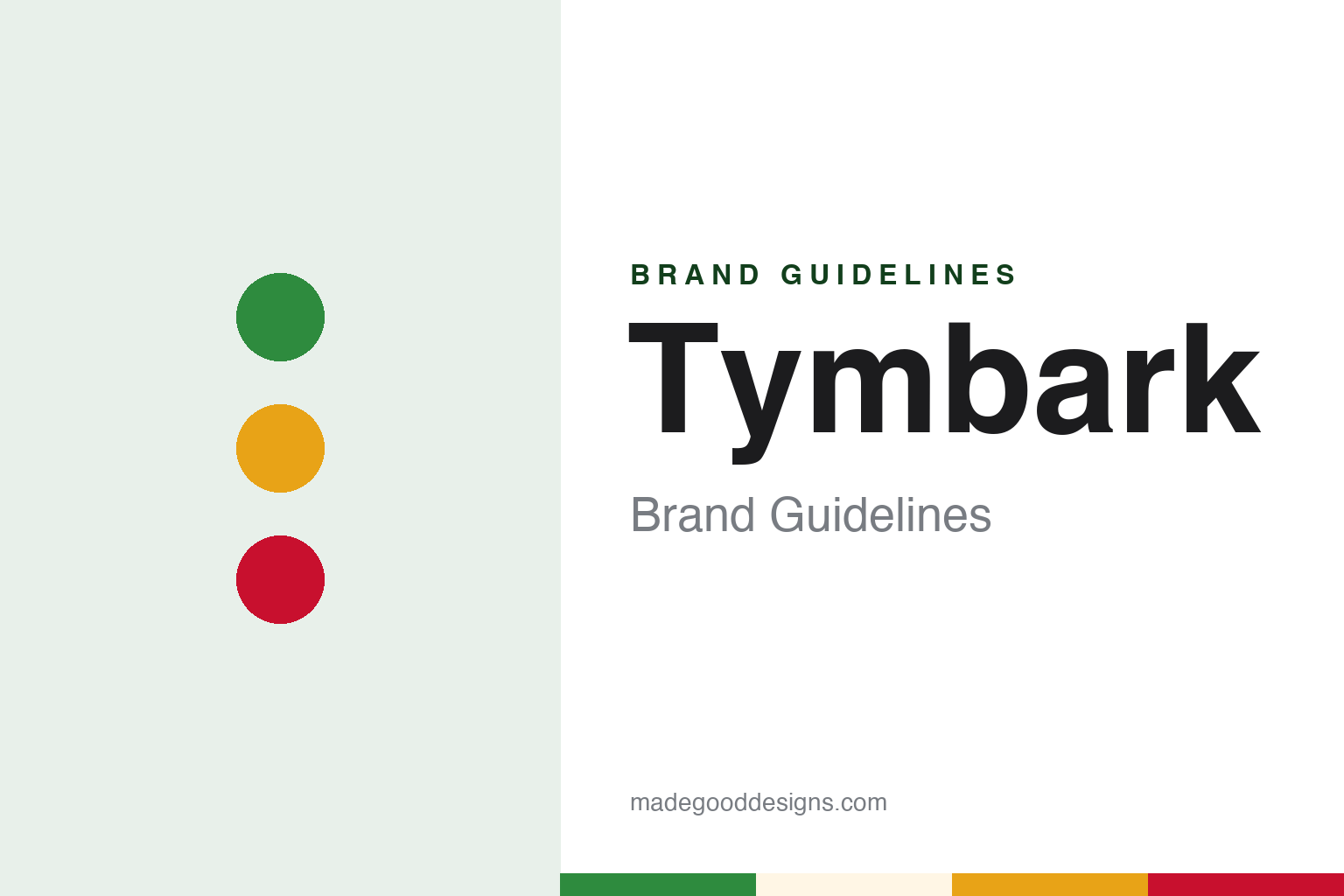
Tymbark Brand Guidelines
The village juice with messages under the cap.
Aa
Two constants: an orchard green, apple red and juice amber palette and a friendly rounded sans register. Abstract homage — not a Tymbark product or mark; no bottle, cap, logo or label is reproduced.
A cooperative in the hills
A village, a fruit growers’ cooperative and an engineer.
Tymbark is named after a place. The village of Tymbark lies in the hills of the Małopolska region of southern Poland, between Kraków and Nowy Sącz, and it was there that the business behind the brand began as a cooperative of local growers. Polish Wikipedia says the Podhalańska Spółdzielnia Ogrodnicza, the Podhale Horticultural Cooperative, was registered on 4 November 1935, and that the company itself dates its founding to 1936; the chief initiator, it says, was the engineer Józef Marek. English Wikipedia calls the body the Tymbark Fruit Growers Cooperative and also gives 1936 as the year it was established.
The cooperative’s early years were overtaken by war. Polish Wikipedia says that under German occupation it kept working, supplying vegetables, fruit and preserves to the Rada Główna Opiekuńcza, the Polish welfare council allowed to operate in occupied Poland, and that its managers protected local people from deportation for forced labour in Germany by employing them in harvesting and production. Several of its staff, the same source says, belonged to the underground Home Army, and the cooperative supported partisan units in the area.
After the war the business followed the path of most Polish industry. Polish and English Wikipedia say it was nationalised in 1950 and run as a state enterprise for the next four decades. Polish Wikipedia credits the Tymbark plant with developing, in 1967, the first Polish recipe for a blackcurrant juice. In 1995, after the end of communist rule, it was converted into a state-owned company, the step that preceded its sale.
Colour
A cap that talks back.
The thing most Poles associate with Tymbark is not on the label but under the cap. Polish Wikipedia says that since 1993 Tymbark drinks in glass bottles have carried caps printed on the inside with a short message, and that the first of them read “Uszy do góry” — “ears up,” the Polish way of saying “chin up.” English Wikipedia says the inscriptions began with eight phrases and grew to 490; Polish Wikipedia puts the number of variants created since at about a thousand.
The owner treats the caps as the brand’s signature. On its website Maspex calls them the drinks’ “znak rozpoznawczy” — their mark of recognition — and describes the “unique, cult” caps as messages that amuse, motivate and express feelings, through which, it says, Tymbark is constantly present in consumers’ lives. The company also says Tymbark is the clear sales leader in Polish juices, nectars and drinks, and one of the brands Polish consumers most often recommend to family and friends.
Tymbark has also been tied to sport for young people. English Wikipedia says that in 2007 the brand began “Z podwórka na stadion” (“From the Backyard to the Stadium”), a children’s football tournament for the Tymbark Cup, which by 2011 had involved about 85,000 Polish children; Polish Wikipedia names Tymbark as its main sponsor and says the company sponsored the ice-hockey club Podhale Nowy Targ from 1998. Outside Poland, English Wikipedia says, the drinks have been sold under other names — Relax in the Czech Republic and Slovakia, TopJoy in Hungary and Queen’s in Bulgaria.
Typography
Design and documentation.
The seven brands in this group all make food or drink, and all of them come from Central Europe — from Poland, Hungary, Croatia and the Czech Republic: Prince Polo, Tymbark, Hortex, Pick, Podravka, Vegeta and Kofola. Food and drink brands from the region in general sit at many different points in the trade, from names that began in state enterprises to names that now belong to much larger food groups, and a single brand can be sold everywhere from a village shop to a supermarket shelf.
A food or drink brand’s identity is usually carried less by a single product than by a pack, a name and the meal or snack it promises, because the company behind the name may have changed hands, moved its factory or grown far beyond the town where it started. That makes the questions behind each name worth asking plainly: who started it, who owns it now, and where its products are actually made and packed.
Each guide separates what independent sources record from what the company says about itself — its founding story, its owners over time, where its products are made and how its packaging has changed — and marks plainly what rests only on the company’s own word.
Aa
A friendly rounded sans for a brand that speaks from under the cap. (Specimen set in Nunito Sans, a sans STAND-IN; NOT the Tymbark logo.)
Tymbark
A village name inside a Wadowice group.
Tymbark has belonged since 1999 to Maspex, the food group based in Wadowice, south-west of Kraków. English Wikipedia dates Maspex to 1990 and names Krzysztof Pawiński as the central figure in building it. Maspex’s own acquisition history lists, for 1999, the Anin business and the Tymbark company together with the Tymbark brand. Four years earlier, in 1995, Maspex had bought Polska Żywność of Olsztynek, with the Kubuś brand. The group has since grown largely by buying other names: Lubella in 2003, Agros Nova (with Łowicz, Krakus, Kotlin and Tarczyn) in 2015, the vodka maker CEDC with Żubrówka and Soplica in 2022, the Czech Becherovka maker Jan Becher in 2023 and Moldova’s Purcari Wineries Group in 2025. Maspex says it has made 22 acquisitions, 12 of them outside Poland.
The company behind the drinks today is Tymbark-MWS. Maspex says its products are made in 18 plants, ten of them in Poland, and it lists the village of Tymbark among those Polish sites, alongside Olsztynek, Tychy, Wadowice and others. Its account of the Olsztynek plant, which it runs as a branch of Tymbark-MWS, says the factory was built between 1975 and 1985 as “Jagódka,” that the Kubuś juice was first produced there in 1994, and that it now makes Tymbark products as well as Kubuś, Caprio, Tarczyn and the export brands Relax and TopJoy, filling plastic bottles, cartons, pouches and glass. Maspex also says the Olsztynek plant processes fruit and vegetables for the whole group.
Tymbark’s identity therefore rests on two things that have outlasted every change of owner: the name of a small village in the Małopolska hills, and a gesture of a few printed words inside a cap.
For a design guide, Tymbark shows how a village name and a message under a cap can make a mass-market juice feel personal. Compare Hortex, another Polish juice and frozen-food name, and Kofola, the Czech and Slovak soft drink. For this guide we use orchard green, apple red and a juice amber with a rounded sans, an unofficial interpretation; no product or logo is reproduced.
Explore & save
Keep Tymbark’s identity on hand — save it to a board in the Made Good inspiration library.
Tymbark identity set
Pin the Tymbark orchard green, apple red and juice amber palette and the friendly rounded sans register to your own board.