Hamé Brand Guidelines
The Babice cannery whose name came with a red bear.
Aa
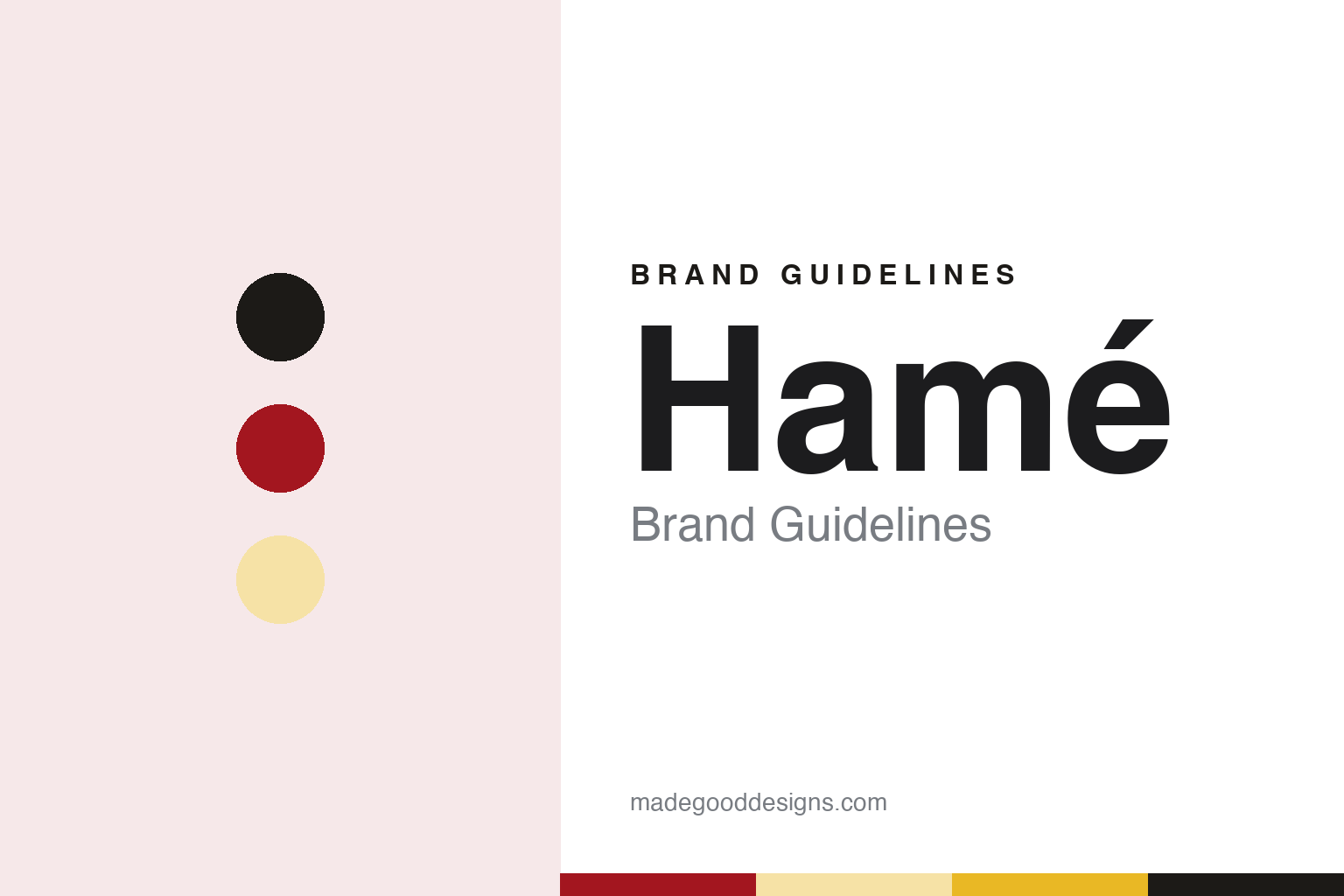
Two constants: a Hamé red and yellow palette and a Friendly sans register. Abstract homage — not a Hamé product or mark; no tin, logo or label is reproduced.
A workshop in Babice
Jams, juices and a Brno canner.
Hamé is a Czech food brand whose range includes pâtés, ketchups, jams, meat preserves and ready meals, and its story starts in a Moravian village. The company says that in 1922 a tradesman from neighbouring Huštěnovice set up a canning workshop in Babice, near Uherské Hradiště in south-eastern Moravia, making fruit marmalades, povidla plum butter and juices, as well as spirits. Czech Wikipedia also dates the workshop to 1922.
In 1933, the company says, the Babice works was acquired by Biochema, a canning company from Brno, which brought the HAMÉ trade name with it; Czech Wikipedia gives the year of the purchase as 1932. Biochema was later turned into a state enterprise, and the company describes that enterprise as the direct predecessor of the modern firm, Hamé s.r.o.
The company’s headquarters later moved from Babice to Kunovice, also near Uherské Hradiště, Czech Wikipedia says, and in 2015 the newspaper Lidovky.cz still described Hamé as based in Kunovice. By 2014 the company described itself as one of the largest Czech food producers, with an output of about 100,000 tonnes of finished products and a range that had grown far beyond the jams and juices of the Babice workshop to include ketchups, pâtés, meat preserves, vegetable products, compotes, baby food, baguettes and sandwiches.
Colour
An Irish word and a red bear, by the company’s account.
The origin of the name is the part of the story Hamé tells most fully, and it is the company’s own account. It says the name arose after the First World War, together with a logo showing a red bear in a yellow field. After Czechoslovakia was founded, it says, Biochema built up export contacts and began shipping its products to an unusual market for a Czech canner — Great Britain and, above all, Ireland.
For its fruit juices, ketchups and marmalades, the company says, Biochema wanted a name that would present them to Irish customers as natural and full of strength, “as if from a home pantry,” and chose HAMÉ, which it says means “home” in Old Irish. That etymology is given here as the company’s explanation. The bear, the company goes on, was chosen as the largest and strongest beast in Europe, and was red rather than brown because brown bears were then common in the forests and a red one seemed jollier and more cuddly. Success abroad, it says, then led the firm to introduce the bear brand at home, where it quickly became popular.
The bear has since been retired. The company says that, as Hamé grew through acquisitions and exports from a small canning workshop into a food company with plants in several countries, it abandoned the bear logo and introduced a new, more modern Hamé logo, in use since 2013. The same year, by its account, Hamé became the main partner of Czech biathlon.
Its packs have also been imitated. Czech Wikipedia, citing a 2013 company statement, says the Russian canner Ruzkom sold pâté in tins with a similar design under the name Наше (“Naše”, meaning “ours”), with the M of Hamé turned into the Cyrillic letter Ш, and that a Russian court ruled for Hamé in 2013. In September 2017 the Czech news site iDNES.cz reported further Russian lookalikes of Hamé pâtés.
Typography
Food brands of Eastern and Central Europe.
The seven brands in this group all make food, and they come from Poland, Ukraine, Russia, Austria and Hungary, Croatia, the Czech Republic and Serbia: Sokołów, Roshen, Krasny Oktyabr, Kotányi, Kraš, Hamé and Bambi. Food brands in general sit at many different points in the trade, from family firms that still carry a founder’s surname to names that now belong to much larger food groups, and a single brand can be sold everywhere from a corner shop to a supermarket shelf.
A food brand’s identity is usually carried less by a single product than by a pack, a name and the meal or treat it promises, because the company behind the name may have changed hands, moved its factory or grown far beyond the town where it started. That makes the questions behind each name worth asking plainly: who started it, who owns it now, and where its food is actually made and packed.
Each guide separates what independent sources record from what the company says about itself — its founding story, its owners over time, where its food is made and how its packaging has changed — and marks plainly what rests only on the company’s own word.
Aa
A friendly sans — a bear-red name. (Specimen set in Inter Tight, a sans STAND-IN; NOT the Hamé logo.)
Hamé
From Nordic Partners to Orkla.
The modern company changed hands twice in under a decade. The Czech weekly Týden reported that Hamé had been owned since 2008 by the Icelandic investment company Nordic Partners. On 11 December 2015, Lidovky.cz reported that Norway’s Orkla had signed an agreement to buy Hamé from Decapterus, a holding company registered in Luxembourg, subject to approval by competition authorities. At the time, the newspaper said, Hamé employed about 2,400 people in ten plants and held leading positions in the Czech and Slovak markets for pâtés, ready meals, canned vegetables, jams and baby food; its best-known brands were Hamé, Májka, Znojmia and Otma.
The company dates its entry into the Orkla group to 2016. In 2018 Orkla decided to merge it with its other Czech food business, Vitana, and on 3 February 2020, the company says, the integration was completed and a new legal entity, Orkla Foods Česko a Slovensko, was formed, based in Prague. Since then Hamé has been a trade brand rather than a company; the logos on its website are marked as the property of Orkla Foods Česko a Slovensko.
Hamé says its products are exported to about 40 countries on five continents. In 2014 its website listed seven plants in the Czech Republic and two abroad, in Caracal in Romania and in Bogoljubovo in Russia; a later company page named Prešov in Slovakia alongside Bogoljubovo. Its current brand family also includes Otma, Znojmia, Májka, Veselá pastýřka and Vasco da Gama.
For a design guide, Hamé shows how a mascot can carry a brand for generations and still be retired when the business outgrows it. Compare Kalev, the Estonian confectioner also owned by Orkla, and Panda, the Finnish liquorice maker in the same group. For this guide we use a bear red, a field yellow and ink with a sans, an unofficial interpretation; no product or logo is reproduced.
Explore & save
Keep Hamé’s identity on hand — save it to a board in the Made Good inspiration library.
Hamé identity set
Pin the Hamé red and yellow palette and the Friendly sans register to your own board.