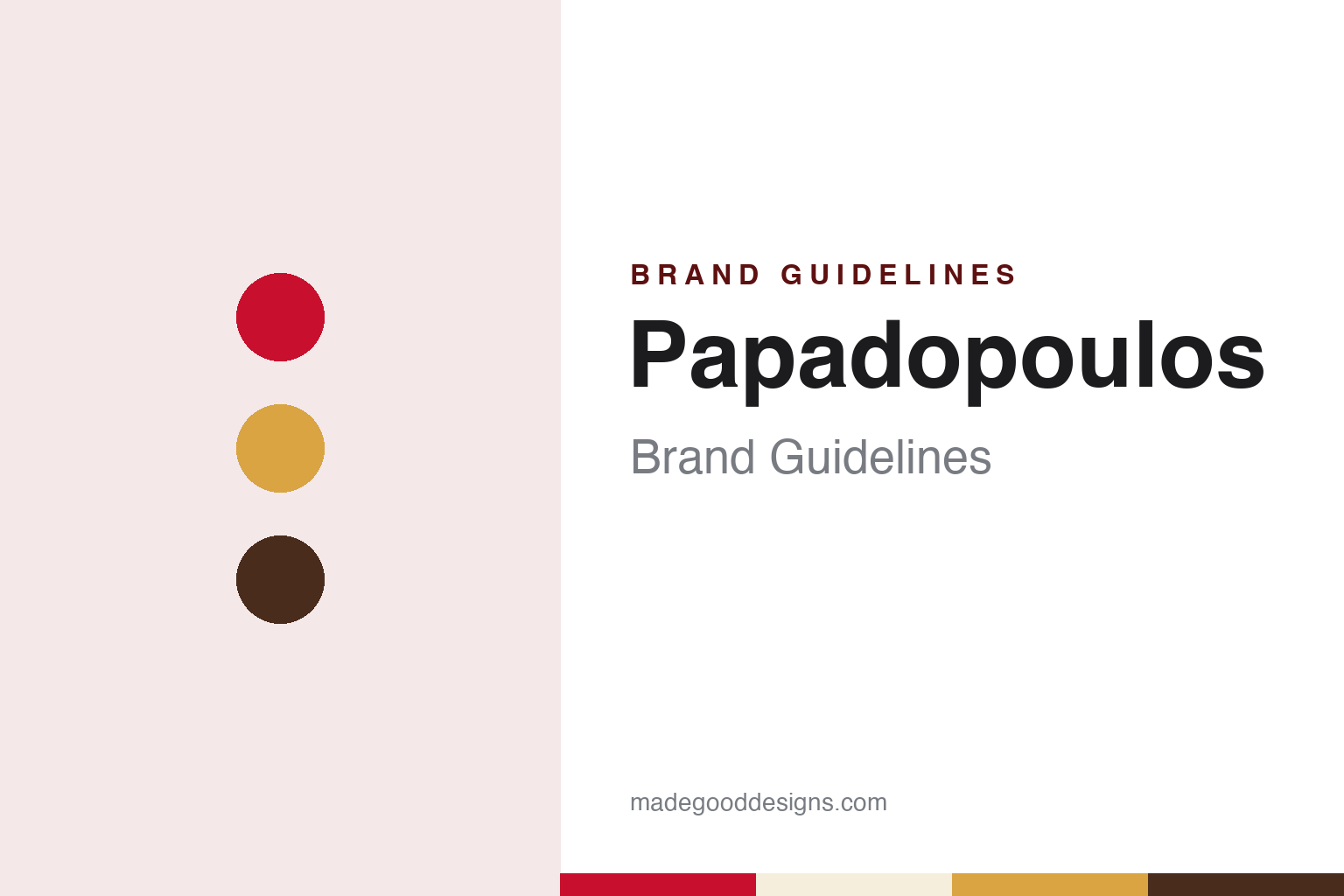
Papadopoulos Brand Guidelines
The refugee family oven behind Greece’s Petit-Beurre.
Aa
Two constants: a Pi red, Petit-Beurre gold and wafer cocoa palette and a sturdy humanist sans register. Abstract homage — not a Papadopoulos product or mark; no pack, logo or biscuit is reproduced.
From Istanbul to Piraeus
A family oven, a wooden mould and a ship that stopped in Piraeus.
Papadopoulos is a Greek biscuit maker whose story starts outside Greece. English Wikipedia says the company was founded in Athens in 1922 and traces its origins to Istanbul in 1916, with Evangelos Papadopoulos and his family. The company’s own history says the first Papadopoulos biscuit was baked in the family oven in Constantinople and stamped with a simple wooden mould. Greek Wikipedia gives the full name of the business as the Evangelos I. Papadopoulos biscuit and food industry, a Greek société anonyme founded in Athens by the Papadopoulos family.
The move to Greece came in the year of the Asia Minor catastrophe. The company says that in 1922 Evangelos, his mother and his brothers left Istanbul on a ship bound for Marseille. When it called at Piraeus, the port of Athens, the family found that biscuits were almost unknown in Greece, and decided to stay. They settled in refugee housing provided by the state near Lycabettus Hill, bought a small oven and started again: the mother kneaded and baked Petit-Beurre biscuits and her children sold them in bulk. The company dates the first Papadopoulos Petit-Beurre to that 1922 kitchen.
The range grew in the 1930s. The company says three of its most important brands, Miranda biscuits, Sandwich Biscuits and Cream Crackers, reached the market in 1931 and 1933. In 1938 it opened its first small factory, on Thessalonikis Street in Athens, equipped with new Greek-made machinery. During the Second World War, it says, Petit-Beurre, Miranda and the sandwich biscuits were packed in large tins, and Cream Crackers were eaten by Greek soldiers as dry rations. The first large modern factory followed on Petrou Ralli Avenue in Athens; the company dates it to 1952 on its timeline and to 1957 on its centenary page.
Colour
A red Pi, four children and a wafer roll for export.
The company’s best-known mark dates from 1972. Its timeline says the logo, a red “Π”, the Greek letter P, was designed that year together with figures of Evangelos Papadopoulos’ four children; its centenary page describes the redesign as adding the four children in the shape of a paper chain of people. The same page says the company’s logos have changed often over the decades, and that its commercials, package designs, posters, slogans and jingles were created by many people, among them several artists.
That material became an exhibition when the company turned 100. The company says it opened its historical archive to the public for the first time in a show called Papadopoulos 100, hosted at the Benaki Museum in Athens, and made a centenary film with 42 leading actors, about 100 extras and some 200 period costumes. A letter on the same page is signed by Ioanna Papadopoulou as President and CEO.
The product that carries the brand abroad arrived in 1978. Caprice is a crisp rolled wafer with a hazelnut and cocoa cream filling; the company describes it as a Viennese wafer and calls it its number-one export product worldwide. Later variants include a dark chocolate version, a vanilla version and a cappuccino version. A campaign called “Feel the roll” built its advertising around the moments of opening a box, sharing the rolls and finding the last one. The older biscuits have been extended too: the company says chocolate-coated versions of Petit-Beurre, Miranda and the sandwich biscuits followed later, and it still calls Petit-Beurre a biscuit made to the same recipe as the first.
Typography
Design and documentation.
The seven brands in this group all make food, and all of them come from Greece, Switzerland or France: Lacta, Allatini, Papadopoulos, Minerva, Zweifel, Ragusa and Francine. Food brands from these three countries sit at many different points in the trade, from family firms that still carry a founder’s surname to names that now belong to much larger food groups, and a single brand can be sold everywhere from a corner shop to a supermarket shelf.
A food brand’s identity is usually carried less by a single product than by a pack, a name and the meal or snack it promises, because the company behind the name may have changed hands, moved its factory or grown far beyond the town where it started. That makes the questions behind each name worth asking plainly: who started it, who owns it now, and where its products are actually made and packed.
Each guide separates what independent sources record from what the company says about itself — its founding story, its owners over time, where its products are made and how its packaging has changed — and marks plainly what rests only on the company’s own word.
Aa
A sturdy humanist sans with full Greek support, for a brand whose mark is a Greek letter. (Specimen set in Fira Sans, a sans STAND-IN; NOT the Papadopoulos logo.)
Papadopoulos
Four factories, rusks, bread and a family at the top.
Papadopoulos grew from one Athens plant into four. The company says a second factory opened in Thessaloniki in 1973, a third followed in Volos as demand rose, and a fourth began operating at Oinofyta, north of Athens, in 1996. English and Greek Wikipedia both list the same four sites: Athens, Thessaloniki, Volos and Oinofyta. The company says it has more than 1,600 employees.
The range has moved well beyond biscuits. In 1989 the company entered bakery products with Krispies rusks, and the Oinofyta plant made its first rusks under the Goldies name in 1996, the same year it brought Digestive wholegrain biscuits to the Greek market; Goldies was later relaunched as Papadopoulos Rusks. In 2013 the company began selling packaged sliced bread and launched its first cereal bars, and a gluten-free line followed in 2016. Greek Wikipedia lists its best-known biscuits in Greece as Petit-Beurre, Miranda, the sandwich biscuits, Caprice and Digestive, alongside bread, rusks, breadsticks and cereal bars. English Wikipedia gives the company motto as “A world of taste and care.”
Abroad, Papadopoulos works through a network of distribution partners. Its export page lists around 70 countries, from Albania to Vietnam, and names Caprice as its most international product, with Digestive Bars, Krispies, Goldies and Mini Pick crackers among the others it promotes. The figure varies across the company’s own pages, which also give more than 60 countries; English Wikipedia says 40. Greek Wikipedia describes the company as founded by the Papadopoulos family, and Ioanna Papadopoulou signs its centenary letter as president and CEO.
For a design guide, Papadopoulos shows how a single Greek letter and a drawing of a family can stand for a biscuit maker for more than half a century. Compare Allatini, another long-established Greek biscuit name, and LU, the Nantes maker of the original Petit Beurre. For this guide we use a Pi red, a Petit-Beurre gold and a wafer cocoa with a humanist sans, an unofficial interpretation; no product or logo is reproduced.
Explore & save
Keep Papadopoulos’s identity on hand — save it to a board in the Made Good inspiration library.
Papadopoulos identity set
Pin the Papadopoulos Pi red, Petit-Beurre gold and wafer cocoa palette and the sturdy humanist sans register to your own board.