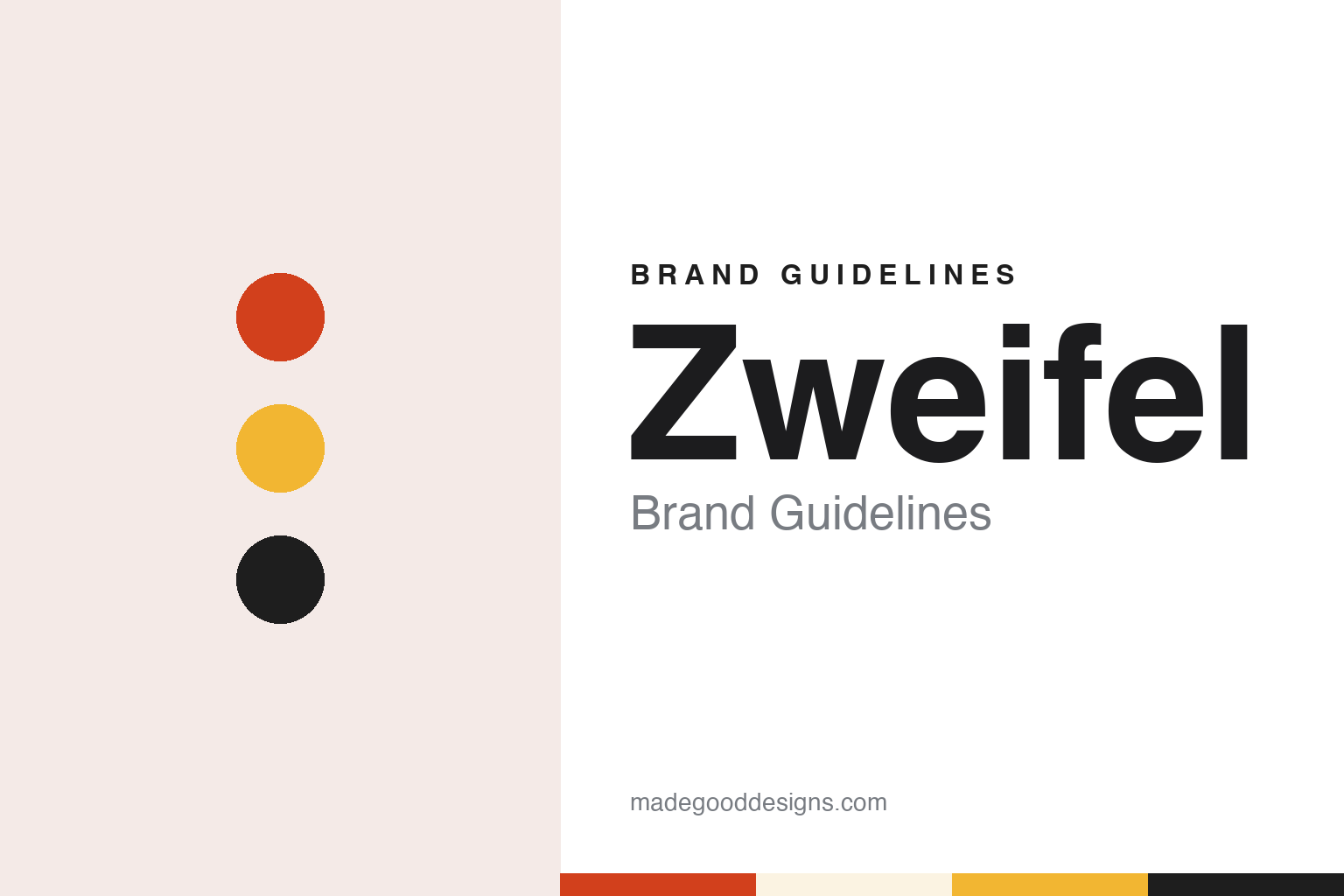
Zweifel Brand Guidelines
The Zurich cider family behind Switzerland’s paprika chips.
Aa
Two constants: a paprika red, potato gold and fryer black palette and a heavy grotesque sans register. Abstract homage — not a Zweifel product or mark; no pack, logo or chip is reproduced.
Cider first
A wine trade, a cider press and a cousin’s farm.
Zweifel started out selling drink, not snacks. The company says the brothers Emil and Paul Zweifel, from Höngg, now part of Zurich, set up a wine and drinks trade in 1898, and soon found that their most profitable product was their own cider. German Wikipedia, which calls the original firm Gebrüder Zweifel, says the business both grew and traded wine and pressed fruit juice; as vine disease spread, it turned increasingly to sour cider, added sweet, unfermented cider from 1929, and by 1946–47 ran what it describes as the most modern juice plant in Europe. Competition from American soft drinks such as Coca-Cola pushed the family to diversify again, and in the 1950s it moved into mineral water and potato chips.
The chips came from a relative. According to the company’s family history, Hans Meier, a cousin of Heinrich Zweifel senior, had been frying potato chips since the early 1950s on his farm at Katzenrüti, near Rümlang north of Zurich, in a huge field-kitchen pan. The Zweifel family later took over his chip production and moved it into their cider works in Höngg. German Wikipedia, citing the Swiss Archiv für Agrargeschichte, tells the same story.
In 1958 the chips went on sale for the first time under the Zweifel name, the company says. The man who built the business was Hans-Heinrich Zweifel, of the founders’ family; German Wikipedia says he developed it from 1958, and the Tages-Anzeiger reported in December 2008 that he was stepping down as chairman of the board.
Colour
A friendly dragon, ten vans and a secret paprika.
Production soon outgrew the pan. In 1960, the company says, Zweifel installed its first fully automatic fryer in Höngg, a machine nicknamed the “friendly dragon,” which turned out 180 kilograms of chips an hour. By 1966 the chips business had its own separate accounts and was processing about 1,000 tonnes of potatoes a year, the magazine Transhelvetica reported in 2025, as cited by German Wikipedia.
Two things from that decade still define the brand. In 1962, the company says, Hans-Heinrich Zweifel set up the Frisch-Service, a fleet of ten Volkswagen vans that delivered fresh chips across Switzerland every week. And in 1964 came the paprika chips; the company says the recipe has never changed and remains a secret.
In 1970 Zweifel opened a new factory at Spreitenbach, in the canton of Aargau west of Zurich, which German Wikipedia describes as the main production site and which the company says was renovated in 2019. The raw material is Swiss. German Wikipedia says the company uses around 27,000 tonnes of potatoes a year, grown almost entirely for it by more than 250 Swiss farmers; the company’s own pages say that over the long run more than 90% of its potatoes come from more than 300 Swiss farmers. It names Figaro and Lady Claire among the processing varieties it uses, chosen for high starch and low sugar, buys its rapeseed oil from the Swiss family firm Florin and takes its salt from the Saline de Bex in the canton of Vaud. German Wikipedia puts its share of the Swiss chips and snacks market at 55% in 2021. Zweifel has at times had to import some potatoes, the BauernZeitung reported in 2022, while still qualifying to use the Swiss cross under the country’s Swissness rules. In 2017 the company switched its frying oil from sunflower to rapeseed, SRF reported at the time.
Typography
Design and documentation.
The seven brands in this group all make food, and all of them come from Greece, Switzerland or France: Lacta, Allatini, Papadopoulos, Minerva, Zweifel, Ragusa and Francine. Food brands from these three countries sit at many different points in the trade, from family firms that still carry a founder’s surname to names that now belong to much larger food groups, and a single brand can be sold everywhere from a corner shop to a supermarket shelf.
A food brand’s identity is usually carried less by a single product than by a pack, a name and the meal or snack it promises, because the company behind the name may have changed hands, moved its factory or grown far beyond the town where it started. That makes the questions behind each name worth asking plainly: who started it, who owns it now, and where its products are actually made and packed.
Each guide separates what independent sources record from what the company says about itself — its founding story, its owners over time, where its products are made and how its packaging has changed — and marks plainly what rests only on the company’s own word.
Aa
A heavy grotesque sans for a snack brand from Zurich. (Specimen set in Archivo Black, a sans STAND-IN; NOT the Zweifel logo.)
Zweifel
Still family-owned, now with a new name.
Zweifel has stayed wholly in the family across three generations, German Wikipedia says. For 29 years the company was run by managers from outside the family, until Christoph Zweifel became chief executive in 2020, SRF reported in 2026. German Wikipedia treats the wine business, Zweifel 1898, based in Zurich, as the older part of the family group. It replanted vineyards and opened a winery in the late 1960s, closed the old Höngg plant for good in 1983, and since then the family has been the sole producer of Zurich’s Stadtwein, the wine from the city’s own vineyards, German Wikipedia says; today it also imports wines and spirits.
The chips company has widened its range beyond the potato. In 2022 it bought Berger, a maker of bakery snacks based in Münsingen, near Bern, Blick reported, and in September 2024 it changed its name to Zweifel Chips & Snacks AG, the trade site foodaktuell reported. The company says it now employs more than 500 people and makes more than 10,000 tonnes of chips and snacks a year.
For a design guide, Zweifel shows how a single flavour, delivered fresh by van and made from Swiss potatoes, can carry a family name for almost seven decades. Compare Tyrrells, the Herefordshire farm crisp, and Kambly, another Swiss family snack maker. For this guide we use paprika red, potato gold and fryer black with a heavy grotesque sans, an unofficial interpretation; no product or logo is reproduced.
Explore & save
Keep Zweifel’s identity on hand — save it to a board in the Made Good inspiration library.
Zweifel identity set
Pin the Zweifel paprika red, potato gold and fryer black palette and the heavy grotesque sans register to your own board.