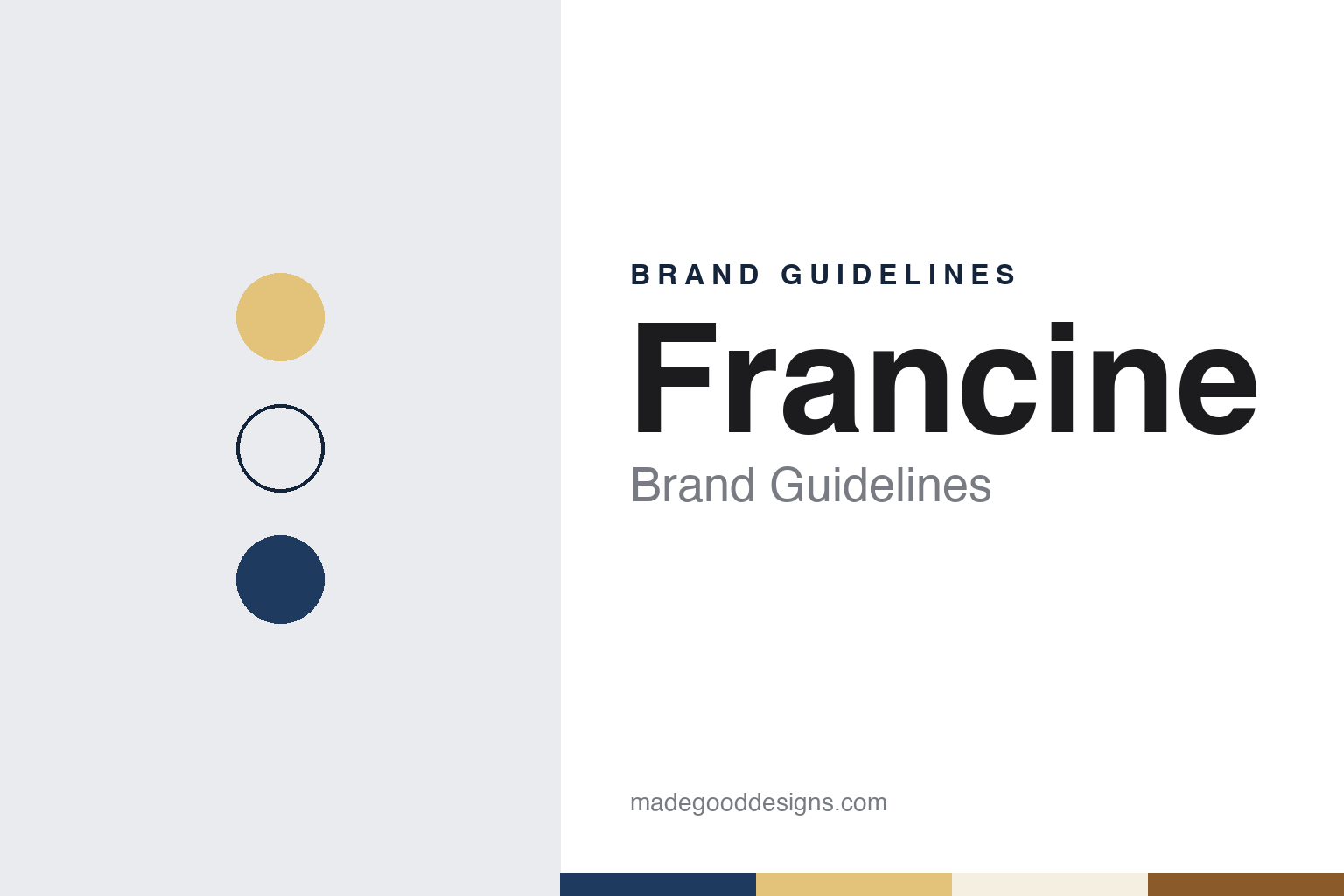
Francine Brand Guidelines
France’s flour brand, named for “France” and “farine” in 1965.
Aa
Two constants: a navy, wheat and flour-white palette and a kitchen serif register. Abstract homage — not a Francine product or mark; no pack, logo or label is reproduced.
France and farine
Eight millers and one national name.
Francine is a French flour brand, and its name is its origin story. The company says it was created in 1965, when eight large regional French flour mills decided to pool their know-how behind a single brand: a flour of consistent quality that shoppers could recognise and find anywhere in France. The name, the company and French Wikipedia both say, is a contraction of “France” and “farine”, the French word for flour.
One of those millers was in Marseille. French Wikipedia lists the Marseille miller Alain Storione among the founders, and its article on him, citing the Dictionnaire historique des patrons français (Flammarion, 2010), credits him with creating Francine flour; that article dates the creation to 1964. Marseille’s tourism guide, in its entry on the Grands Moulins Storione, a family mill it says has stood in the city since 1885, also calls the Storione mill a founder of the Francine brand in 1964. The company and the brand’s other histories give 1965, the year from which it counted its sixtieth anniversary in 2025.
The Storione family is better known in France for another bakery name. The same sources credit the Marseille mill with Banette, a branded baguette and bakery concept launched in the early 1980s. French Wikipedia and the Marseille guide both record that the Storione brothers sold their mill to the Champagne Céréales cooperative group in the late 1980s, after which it became part of that group’s milling business.
Colour
Fluid flour, crêpe batter and the box.
Francine’s early range was simple. According to a brand history published by the French food-industry site Pour nourrir demain in November 2023, the first product was a plain wheat flour in 1965, followed by Farine Fluide, a fluid flour, in 1968. In 1970 the brand added a range of ready preparations led by a crêpe batter mix, “Ma pâte à crêpes”; the company says Francine was the first brand to put a crêpe preparation on the French market.
The 1980s brought flours for home bread-making and what the company calls the first flour in a box on the market, Farine Suprême, sold in a carton rather than a paper bag to make it easier to keep. In 1997, the same history says, the brand set up a Comité Chandeleur, which runs an event called “Crêpes en Fête” each February around Candlemas, the French crêpe day. An organic flour followed in 2009, and later a Label Rouge T65 wheat flour.
The company says its organic and Label Rouge flours are made in its own regional workshops and mills from French wheat, and today lists more than thirty products, from wheat, spelt and buckwheat flours to bread flours, baker’s yeasts and batter, cake and pizza mixes.
The brand’s look has been refreshed several times. The Pour nourrir demain history records a new logo in 2015, with the signature “Des bonnes idées en cuisine” (good ideas in the kitchen); a 2017 press campaign around home cooking, “Le fait maison, c’est forcément bon”; a redesign of the preparations range in 2018; and, in 2019, a new visual world and the signature “On se retrouve en cuisine” — “see you in the kitchen” — which the brand still uses. For its sixtieth anniversary in 2025 the company says Francine returned to television with a new advertisement tracing flour from the wheat field to the plate.
Typography
Design and documentation.
The seven brands in this group all make food, and all of them come from Greece, Switzerland or France: Lacta, Allatini, Papadopoulos, Minerva, Zweifel, Ragusa and Francine. Food brands from these three countries sit at many different points in the trade, from family firms that still carry a founder’s surname to names that now belong to much larger food groups, and a single brand can be sold everywhere from a corner shop to a supermarket shelf.
A food brand’s identity is usually carried less by a single product than by a pack, a name and the meal or snack it promises, because the company behind the name may have changed hands, moved its factory or grown far beyond the town where it started. That makes the questions behind each name worth asking plainly: who started it, who owns it now, and where its products are actually made and packed.
Each guide separates what independent sources record from what the company says about itself — its founding story, its owners over time, where its products are made and how its packaging has changed — and marks plainly what rests only on the company’s own word.
Aa
A warm, generous serif for a flour brand named after France itself. (Specimen set in Fraunces, a serif STAND-IN; NOT the Francine logo.)
Francine
A Paris miller and a farmers’ cooperative.
Francine changed hands in 2012, when, French Wikipedia says, it was bought by Grands Moulins de Paris, then part of the Nutrixo milling business of the Vivescia group; its former owner is given as France-Farine. The brand describes the move as its full integration into Grands Moulins de Paris, which it calls a centenarian miller.
Grands Moulins de Paris has a long history of its own. French Wikipedia says the company was founded by a group of millers on 5 April 1919, at the initiative of Ernest Vilgrain, and built a large industrial mill on the Seine in Paris’s 13th arrondissement that began working in 1921. The Vilgrain family controlled it until 1989, when the construction group Bouygues bought it, Le Monde reported at the time; Bouygues sold it to investors in 1998, Libération reported. The Paris mill closed in 1996, its work moved to mills outside the city, and the main building was converted into a university campus. Today the company is based in Ivry-sur-Seine and belongs to Vivescia, the Reims-based grain cooperative formed in 2012 by the merger of Champagne Céréales and Nouricia, which French Wikipedia says has about 9,000 farmer members. Francine is its consumer brand, alongside bakery names such as Campaillette and Copaline. The company puts it plainly: the brand belongs to the cooperative’s farmers.
The brand remains a supermarket leader. French Wikipedia, citing the trade magazine LSA in June 2025, gives Francine a 34.3% share of flour sold in French supermarkets and hypermarkets that year.
For a design guide, Francine shows how a coined name — two everyday words folded into a woman’s first name — can carry a staple product for sixty years through new owners, new packs and new signatures. Compare Homepride, the British flour brand of Fred the flour grader, and Panzani, another French pantry name. For this guide we use a mill navy, a wheat gold and a flour white with a serif, an unofficial interpretation; no product or logo is reproduced.
Explore & save
Keep Francine’s identity on hand — save it to a board in the Made Good inspiration library.
Francine identity set
Pin the Francine mill navy, wheat gold and flour white palette and the kitchen serif register to your own board.