Panzani Brand Guidelines
Jean Panzani’s clear cellophane bag and France’s Italian-accented pasta.
Aa
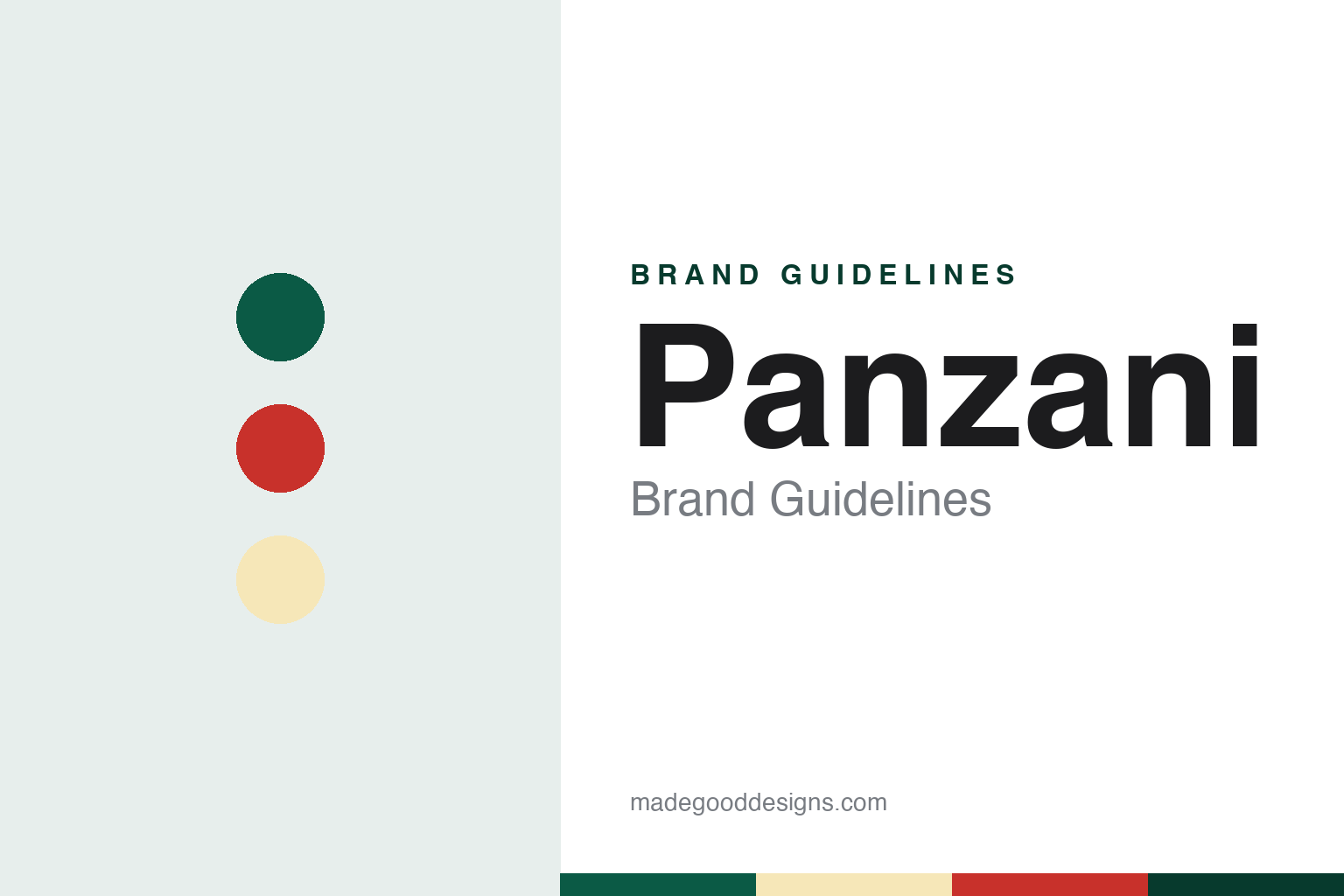
Two constants: a Panzani green, red and durum yellow palette and a rounded sans register. Abstract homage — not a Panzani product or mark; no pack, logo or advertisement is reproduced.
Pasta Panzani
An attic, a shoe factory and a see-through bag.
Panzani is a French brand with an Italian name. In 2021 the regional daily Sud Ouest headlined that Panzani pasta was born not in Italy but in the Deux-Sèvres, in western France. Its founder was Jean Panzani, born Giovanni, and the company’s own accounts of him differ. The brand website says he was born Italian in 1911, took French nationality in 1925 and called himself Jean; the group’s corporate website calls him a descendant of a Tuscan family, born in France to Italian parents; French Wikipedia says he was an accountant of Italian origin, naturalised in 1929. We note the differences rather than choose between them.
He began with fresh pasta. French Wikipedia, citing a history of the Deux-Sèvres, says that in December 1940 he started making artisanal fresh pasta in the attic of his parents-in-law’s house in Niort; the brand website places the attic in Parthenay and says he delivered the pasta by bicycle, and the group website dates the first fresh pasta to 1941. In June 1946, French Wikipedia says, he bought a former shoe factory in Parthenay and turned it into a dry-pasta works, selling under the brand name Francine in paper bags. Citing Le livre des marques (1993), it says he became the first French maker with a continuous press, producing 30 tonnes a day.
The Panzani name came in 1950. With the end of ration cards in 1949, French Wikipedia says, brands that recalled rationing fell out of favour, and Francine became Pasta Panzani. Pasta was then usually sold in card or metal boxes of 250 grams, the same article says; Panzani introduced a 500-gram bag of transparent cellophane, which, the company says, let shoppers see the pasta before they bought it. Tinned tomato sauces followed in 1952, the company says.
Colour
Barthes, mergers and Don Patillo.
Panzani advertised from the start, and one of its advertisements became a set text. In 1964 the critic Roland Barthes analysed a Panzani advertisement in his essay “Rhétorique de l’image,” published in the journal Communications, French Wikipedia says. English Wikipedia, citing design and photography textbooks that discuss the essay, says Barthes read the advertisement as an attempt by the French brand to come across as Italian.
The business also grew by merger. In the 1960s, as supermarkets spread in France, Jean Panzani, then head of the pasta makers’ trade association, urged the industry to consolidate, French Wikipedia says. Panzani merged with Pâtes La Lune in 1960 and with the Marseille company Regia-Scaramelli in 1964. The combined Régia-Panzani became the leading pasta maker in France, the company says, with more than 90,000 tonnes. With Regia-Scaramelli came the Saint-Just semolina mill in Marseille, which made Panzani a miller as well as a pasta maker — a semoulier-pastier, in the company’s phrase. In 1967 the headquarters moved from Parthenay to Lyon, where it has stayed.
The best-remembered advertising came next. In 1975 Panzani launched campaigns with the actor André Aubert as Don Patillo, a character modelled on Don Camillo, the priest made famous on screen by Fernandel, and the slogan “Des pâtes, des pâtes, oui mais des Panzani !” French Wikipedia says the campaign ran until 1997; the company says the character accompanied its advertising for 25 years. In 2009 the agency Asap turned another song associated with Fernandel, “Félicie aussi,” into “Panzani aussi,” the trade weekly Stratégies reported. For the brand’s 70th anniversary in 2020, the company says, the old slogan came back.
Typography
Design and documentation.
The seven brands in this group all make pasta, and they come from Italy, France, Spain and the United States: Buitoni, Panzani, Lustucru, Pastas Gallo, Ronzoni, Mueller’s and Felicetti. Pasta makers and brands in general sit at many different points in the trade, from family firms that still carry a founder’s surname to names that now belong to much larger food groups, and a single brand can be sold everywhere from a corner shop to a supermarket shelf.
A pasta brand’s identity is usually carried less by a single product than by a pack, a name and the meal it promises, because the company behind the name may have changed hands, moved its factory or grown far beyond the town where it started. That makes the questions behind each name worth asking plainly: who started it, who owns it now, and where its pasta is actually made and packed.
Each guide separates what independent sources record from what the company says about itself — its founding story, its owners over time, where its pasta is made and how its packaging has changed — and marks plainly what rests only on the company’s own word.
Aa
A rounded sans for a brand the company calls French with an Italian accent. (Specimen set in Nunito, a sans STAND-IN; NOT the Panzani logo.)
Panzani
From Danone to Ebro to CVC.
Panzani has changed hands several times. It joined Gervais Danone — in 1973 according to the brand website and French and English Wikipedia, in 1971 according to the group website — and French Wikipedia says it was merged with Danone’s Milliat Frères pasta business. In 1973, the group says, it set up a research centre for cereals and pasta, CRECERPAL, in Marseille. In 1997 Danone sold Panzani, together with William Saurin, to the investment arm Paribas Affaires Industrielles, later PAI Partners, Capital reported. PAI sold William Saurin and other brands in 2001 but kept Panzani, which in 2002 bought the rice, fresh-products and couscous businesses of Lustucru, French Wikipedia says. In 2005 the Spanish group Ebro Puleva, now Ebro Foods, bought Panzani, Les Echos reported.
Ebro later split it. In July 2021 Ebro announced exclusive talks to sell Panzani’s dry pasta, couscous, sauces and semolina business — the Panzani, Ferrero, Regia, Zakia and Le Renard brands, with their plants and mills — to a fund managed by CVC Capital Partners for €550 million; the rice and fresh-pasta businesses, including Lustucru, stayed with Ebro, the trade magazine LSA reported. The sale was completed at the end of December 2021, Just Food reported. The group now describes itself as an independent French company; it moved its Lyon headquarters to the Part-Dieu district in August 2023, and its chief executive is Albert Mathieu.
Panzani says its pasta is made in France, at plants in Nanterre and Marseille that serve the north and south of the country, from semolina milled at Gennevilliers and at two Marseille mills, using French durum wheat grown within 400 kilometres of the mills; a plant at Vitrolles makes couscous. Those are company statements. In May 2023 the brand introduced a new identity designed with the agency Team Créatif. The company says it restored the historic shape and colours of the logo, which echo the founder’s Italian origins, set the logo at a slant, added a “Blé 100% français – fabriqué en France” label to the pasta, and kept the transparent bag of the 1950s.
For a design guide, Panzani shows a brand the company itself calls “deliciously French with a tasty Italian accent,” from the clear bag of 1950 to the advertisement Barthes analysed in 1964. Compare Lustucru, the French pasta brand whose rice and fresh lines it once owned, and Buitoni, another pasta name begun by a family business. For this guide we use a deep green, a tomato red and a durum yellow with a rounded sans, an unofficial interpretation; no product or logo is reproduced.
Explore & save
Keep Panzani’s identity on hand — save it to a board in the Made Good inspiration library.
Panzani identity set
Pin the Panzani green, red and durum yellow palette and the rounded sans register to your own board.