Mueller’s Brand Guidelines
The 1867 New Jersey pasta brand once owned by a law school.
Aa
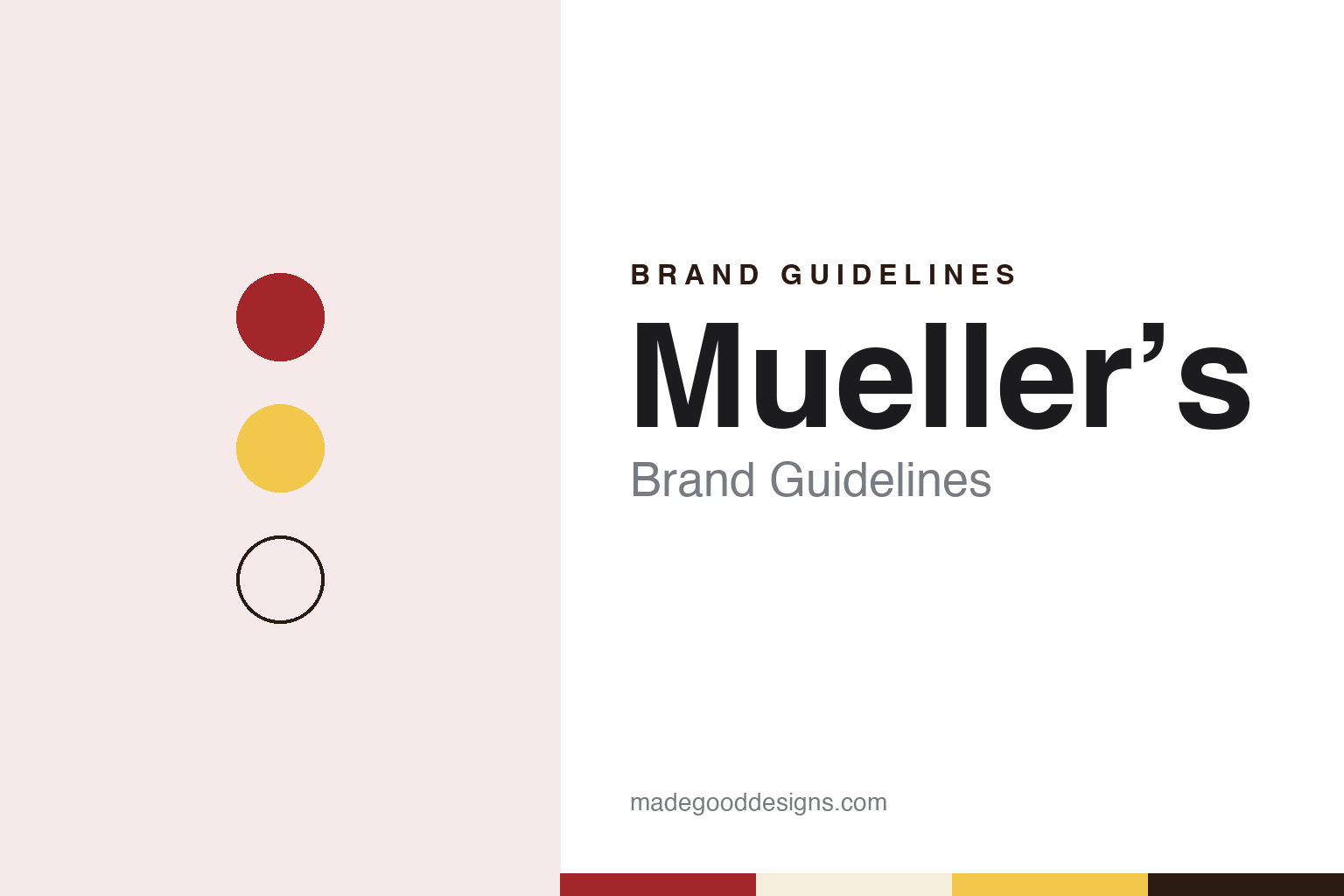
Two constants: a Mueller’s red, egg-noodle yellow and cream palette and a sturdy American sans register. Abstract homage — not a Mueller’s product or mark; no pack or logo is reproduced.
C.F. Mueller Company
A German immigrant’s egg noodles in New Jersey.
Mueller’s dates itself to 1867. The brand’s website says that in that year Christian Mueller, a German immigrant, set out to perfect homemade egg noodles in his kitchen in New Jersey, and that they were so popular with his neighbours that he was soon delivering bundles of pasta to doorsteps and local restaurants. About two decades later, the company says, he opened his first pasta kitchen in Newark, and by 1890 Mueller’s noodles were on shelves across the north-eastern United States. Today the brand still uses the year as its signature, calling itself “Original American Pasta. Since 1867.”
The business became the C.F. Mueller Company, after its founder, Christian F. Mueller. English Wikipedia says the company built one of the largest and most advanced pasta factories in the United States, on Baldwin Avenue in Jersey City, New Jersey, and that at its height Mueller’s macaroni was the largest-selling pasta brand in America. The range on the company website today runs from long and short cuts to noodles, baking shapes and protein pasta.
The brand’s own story is short on dates between the 1890s and the Second World War. What they do record is the unusual way the company changed hands after the war.
Colour
A macaroni company owned by a law school.
From 1947 to 1976, English Wikipedia says, Mueller’s belonged to the New York University School of Law. The court record sets out how. According to the 1951 judgment of the United States Court of Appeals for the Third Circuit in C.F. Mueller Co. v. Commissioner, a Delaware corporation was organised on 21 August 1947 for the benefit of NYU’s School of Law, and on 28 August it acquired all the stock of the C.F. Mueller Company, then a New Jersey business making and selling macaroni and allied products. The idea was that the pasta profits would fund the law school without paying income tax.
The tax authorities disagreed. The Tax Court ruled in 1950 that the macaroni profits were taxable, but on 20 June 1951 the Third Circuit reversed that decision, holding that the company was exempt for the years in question. By then the argument had already changed the law: the court noted that Congress, in the Revenue Act of 1950, had set a new rule for tax years beginning after 31 December 1950. That change created what is now known as the unrelated business income tax, which taxes charities on profits from businesses unrelated to their purpose. English Wikipedia’s article on the tax uses the Mueller’s case to explain why Congress introduced it, out of concern that tax-exempt owners had an unfair advantage over ordinary businesses.
NYU sold the company in the 1970s. English Wikipedia says McKesson bought Mueller’s in 1977, and that CPC International took it over in 1983. When CPC spun off its food businesses as Bestfoods in 1997, Mueller’s went with them, and in 2000 the Anglo-Dutch group Unilever agreed to buy Bestfoods.
Typography
Design and documentation.
The seven brands in this group all make pasta, and they come from Italy, France, Spain and the United States: Buitoni, Panzani, Lustucru, Pastas Gallo, Ronzoni, Mueller’s and Felicetti. Pasta makers and brands in general sit at many different points in the trade, from family firms that still carry a founder’s surname to names that now belong to much larger food groups, and a single brand can be sold everywhere from a corner shop to a supermarket shelf.
A pasta brand’s identity is usually carried less by a single product than by a pack, a name and the meal it promises, because the company behind the name may have changed hands, moved its factory or grown far beyond the town where it started. That makes the questions behind each name worth asking plainly: who started it, who owns it now, and where its pasta is actually made and packed.
Each guide separates what independent sources record from what the company says about itself — its founding story, its owners over time, where its pasta is made and how its packaging has changed — and marks plainly what rests only on the company’s own word.
Aa
A sturdy American sans for a grocery-shelf staple. (Specimen set in Libre Franklin, a sans STAND-IN; NOT the Mueller’s logo.)
Mueller’s
From American Italian Pasta to Winland Foods.
Unilever did not keep the pasta. On 5 October 2000, Just Food reported, the American Italian Pasta Company of Kansas City agreed to buy Mueller’s from Bestfoods, then merging with Unilever; the report said AIPC had already been making Mueller’s pasta since 1998. Just Food reported in November 2000 that the purchase had been completed. (English Wikipedia’s article on the C.F. Mueller Company dates AIPC’s ownership from 2001, but the contemporary reports and its article on AIPC give 2000.) At the time AIPC ran pasta plants in Excelsior Springs, Missouri, Columbia, South Carolina, and Kenosha, Wisconsin, as well as one in Italy.
AIPC itself then changed hands several times. English Wikipedia says Ralcorp bought it in 2010, ConAgra Foods took over Ralcorp in 2013, and TreeHouse Foods acquired the private-brands business that included the pasta in 2016. In October 2022 TreeHouse sold the pasta business, including Mueller’s, as part of a larger divestment to the European investment group Investindustrial, which named the new company Winland Foods, according to a PR Newswire announcement of 3 October 2022. Winland, based in Oak Brook, Illinois, makes pasta, sauces, dressings and other foods under its own brands and for retailers’ own labels. In September 2025 Investindustrial combined Winland with the Italian food maker La Doria to form a group called Windoria, Just Food reported.
Where is Mueller’s made today? The brand’s website does not say, and the sources we checked do not tie it to a particular plant. Winland’s pasta plants include one in St. Louis, Missouri, where the company announced a US$38.5 million expansion in April 2026, Milling Middle East & Africa reported, but no source we found names the factories behind Mueller’s.
For a design guide, Mueller’s shows how a founding year can serve as a brand’s main claim long after the founding family has gone. Compare Ronzoni, another century-old pasta brand from the New York area, and Banza, a newer American pasta label. For this guide we use a deep red, an egg-noodle yellow and a cream with a sans, an unofficial interpretation; no product or logo is reproduced.
Explore & save
Keep Mueller’s’s identity on hand — save it to a board in the Made Good inspiration library.
Mueller’s identity set
Pin the Mueller’s red, yellow and cream palette and the sturdy American sans register to your own board.