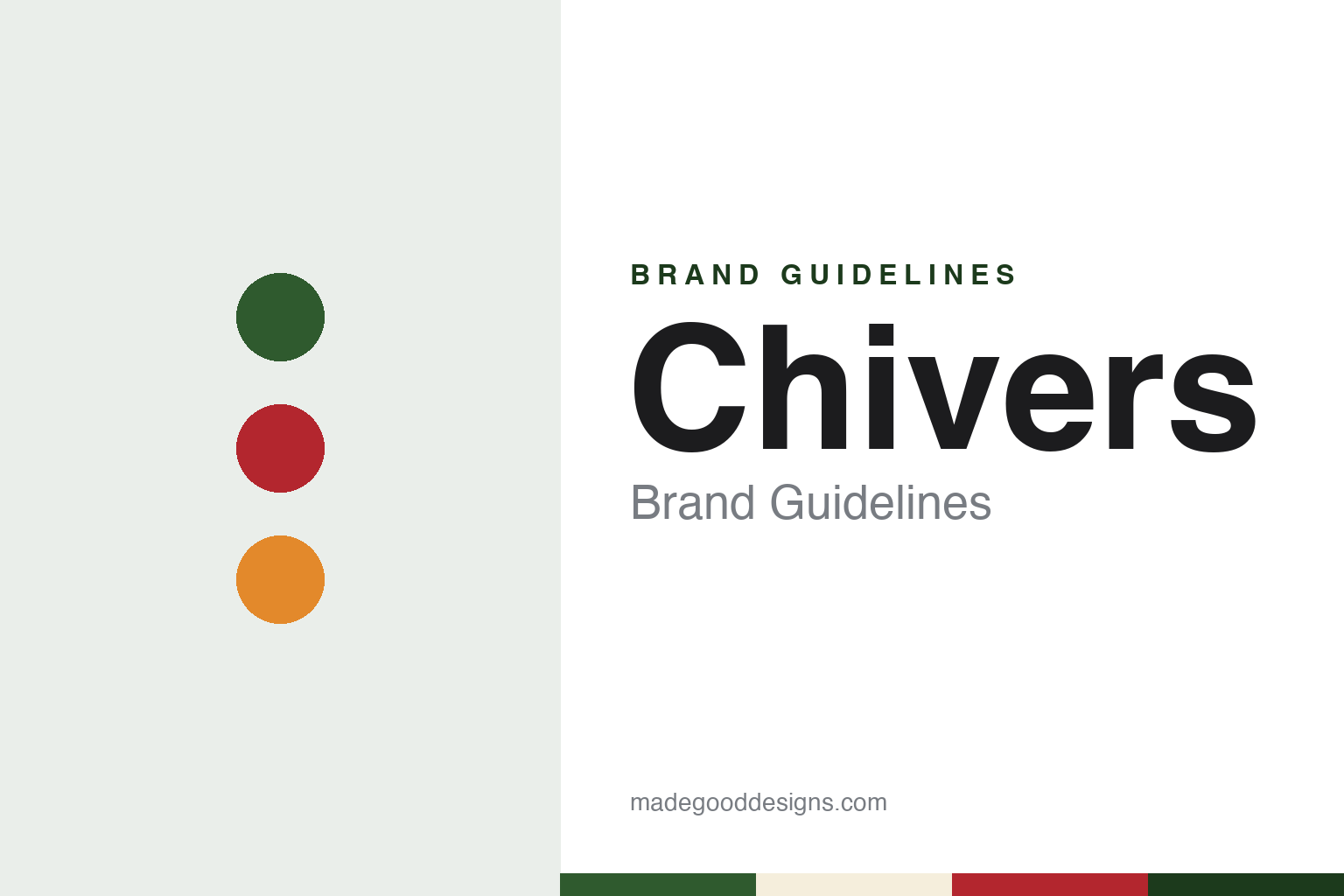
Chivers Brand Guidelines
The Histon fruit growers’ jam and the name that moved to Ireland.
Aa
Two constants: a Chivers orchard green, jam red and marmalade orange palette and a traditional book serif register. Abstract homage — not a Chivers product or mark; no jar, label or logo is reproduced.
The Orchard Factory
A fruit-growing family, a railway and a barn in Impington.
Chivers began as a family of fruit growers in Histon, a village just north of Cambridge. English Wikipedia says the family moved there from neighbouring Cottenham early in the 19th century, and that in 1850 Stephen Chivers (d. 1907) bought an orchard beside the new railway line, which had opened to passengers in 1847, and built up a business sending fruit by rail. In 1870, it says, he sent his teenage sons William and John to open a distribution centre in Bradford, where they found that most of their fruit was being bought by jam makers.
In 1873, after an exceptional harvest, the family made its first jam in a barn at Impington. The Victoria County History of Cambridgeshire, the standard local history, records that this experiment led Stephen Chivers to buy land next to Histon station in 1874 and build a small factory, the Victoria Works; English Wikipedia dates the works to 1875. The Victoria County History adds that Chivers claimed his was the first jam factory in England run by a fruit grower.
The range grew quickly. English Wikipedia says marmalade was added within a decade and a clear dessert jelly in 1889, followed by lemonade, mincemeat, custard powder and Christmas puddings, and that canning began in 1895. The firm was registered as a company in 1901, the year it began exporting, and the works was renamed the Orchard Factory around 1910. By 1939, English Wikipedia says, Chivers employed more than 3,000 people, had further factories at Montrose, Newry and Huntingdon, and farmed almost 8,000 acres to supply its own fruit.
Colour
Stone jars, glass jars and a patent lid.
Much of what is documented about Chivers’ design concerns its containers rather than its labels. English Wikipedia says the Victoria Works first packed jam in stone jars holding two, four or six pounds, and that glass jars were first used in 1885; the Museum of Cambridge gives the same sequence, from stone jars to glass in 1885 and to cans in 1895. The works engineer Charles Lack, appointed in 1896, built machinery that the Victoria County History credits with keeping Chivers ahead of its rivals, including automatic filling machines in 1901 and vacuum caps in 1924.
By the late 1940s the company was selling its preserves on the strength of the jar itself. At the British Industries Fair of 1947, according to the exhibitor listing reproduced by Grace’s Guide, Chivers showed its jams, jellies and Olde English Marmalade “in jars sealed with Chivers’ patent replaceable metal cover.” The Museum of Cambridge, which holds Chivers material, recalls the advertising line “For Jams and Jellies, Choose Chivers!”, and the East Anglian Film Archive keeps a 1931 film of the firm’s fruit farming, jam making and canning, From the Orchard to the Home.
The family ran the business as a farming enterprise first. English Wikipedia says that after the First World War, under Stanley Chivers, its farms were organised to feed the factory, with poultry kept in the orchards and their eggs used for lemon curd; the Victoria County History describes the same integrated system.
Typography
Design and documentation.
The seven brands in this group all make jam or marmalade, and all of them come from Britain: Tiptree, Mackays, Hartley’s, Robertson’s, Duerr’s, Frank Cooper’s and Chivers. British jam and marmalade brands in general sit at many different points in the trade, from family firms that still carry a founder’s surname to names that now belong to much larger food groups, and a single brand can be sold everywhere from a village shop to a supermarket shelf.
A preserves brand’s identity is usually carried less by a single product than by a jar, a label and the breakfast table it promises, because the company behind the name may have changed hands, moved its factory or grown far beyond the town where it started. That makes the questions behind each name worth asking plainly: who started it, who owns it now, and where its jam and marmalade are actually made and packed.
Each guide separates what independent sources record from what the company says about itself — its founding story, its owners over time, where its preserves are made and how its jars and labels have changed — and marks plainly what rests only on the company’s own word.
Aa
A traditional book serif for a Victorian preserves house. (Specimen set in Libre Baskerville, a serif STAND-IN; NOT the Chivers logo.)
Chivers
From Schweppes to Hartley’s in Britain, and to Drogheda in Ireland.
Chivers lost ground after 1945, the Victoria County History says, as it lost its pre-war market lead and failed to install modern equipment. In 1959 the factory and farms were taken over by Schweppes, which had also bought Hartley’s that year; English Wikipedia says the Chivers family bought back most of the farms in 1961. Grace’s Guide, citing The Times, says Schweppes formed a subsidiary called Chivers-Hartley in 1964 to combine the two brands, and the Histon factory became part of Cadbury Schweppes from 1969. In 1986 the group’s foods division, including the Chivers Hartley business at Histon, was bought by its managers; English Wikipedia says the resulting Premier Brands was acquired by Hillsdown Holdings in 1990, the company that later became Premier Foods. The old Victorian works was demolished, a new factory was built at the rear of the site, and the land became a business park.
In Britain the name then faded from the jam aisle. English Wikipedia says Premier Foods stopped using the Chivers name on its jam and marmalade in 2004, selling them as Hartley’s, which continued to be made at Histon. When Premier sold Hartley’s, Robertson’s and the Histon factory to Hain Celestial for £200 million in October 2012, the brands named in Hain’s filing did not include Chivers.
In Ireland the name had a separate life. The Irish arm, Chivers Ireland, was founded in 1932, The Irish Times reported in 1999, when its managers bought it from Hillsdown; it then had a factory at Coolock, Dublin, and a fruit-preparation plant at Enniscorthy. Premier Foods bought it back in 2007, the Irish Examiner reported, and in December 2011 sold its four Irish brands, Chivers among them, to the Boyne Valley Group, a family-controlled company based near Drogheda, for €41.4 million, RTÉ and The Irish Times reported. Boyne Valley still sells Chivers jams, marmalades, jellies and lemon curd, says its jelly pots are produced in Drogheda, and gives 1932 as the year Chivers manufacturing began.
For a design guide, Chivers shows how a single name can split along a border: retired in Britain, kept alive in Ireland. Compare Hartley’s, its long-time stablemate at Histon, and Robertson’s, another preserves name that passed through Premier Foods. For this guide we use an orchard green, a jam red and a marmalade orange with a serif, an unofficial interpretation; no product or logo is reproduced.
Explore & save
Keep Chivers’s identity on hand — save it to a board in the Made Good inspiration library.
Chivers identity set
Pin the Chivers orchard green, jam red and marmalade orange palette and the traditional book serif register to your own board.