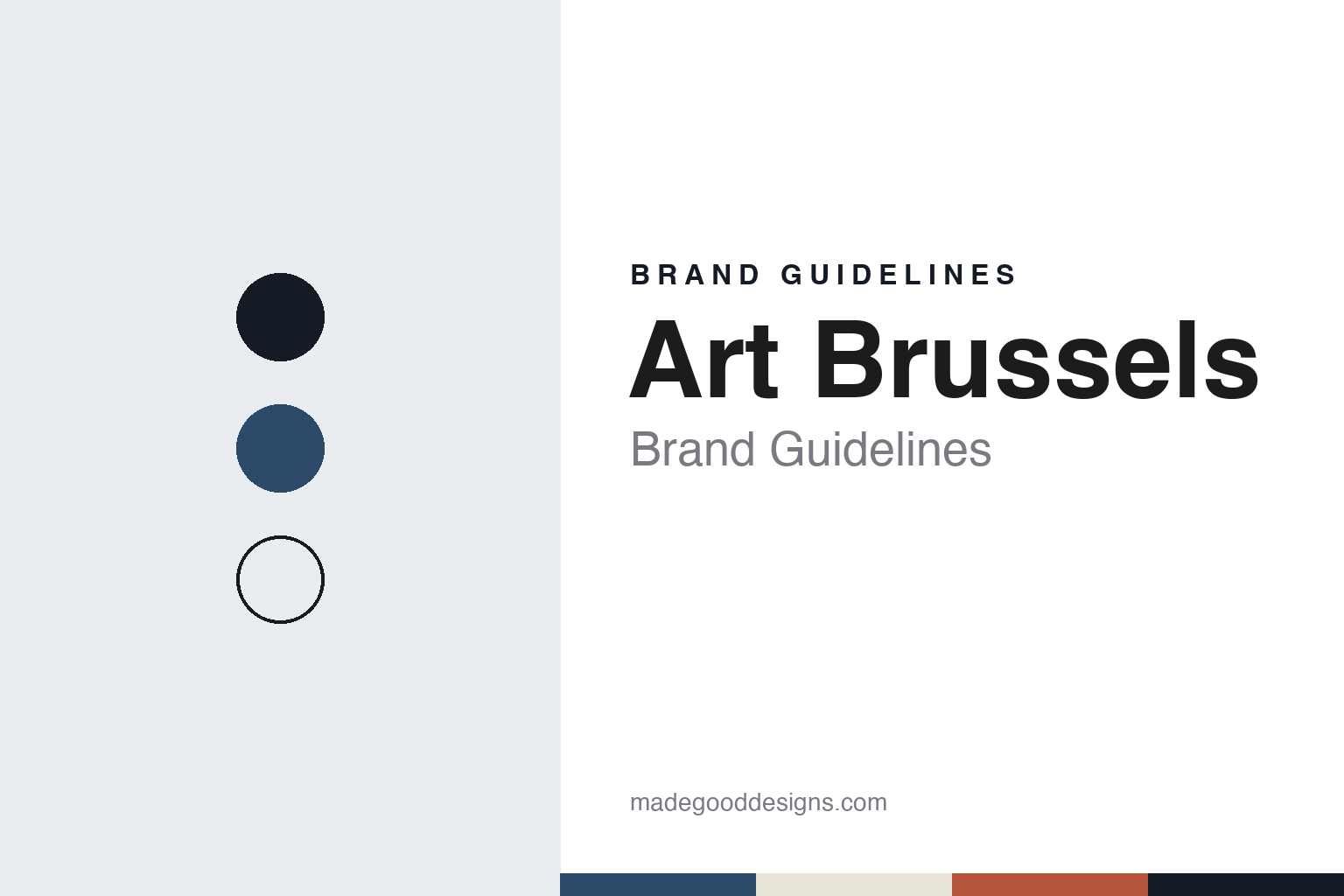
Art Brussels Brand Guidelines
The 1968 gallery fair that moves between Heysel and Tour & Taxis.
Aa
Two constants: a canal blue, stone and brick rust palette and an exhibition serif register. Abstract homage — not an Art Brussels asset; no logo, poster or artwork is reproduced.
Foire d’Art Actuel
A dealers’ fair that began with eleven galleries.
Art Brussels began in 1968. The fair says it was founded by the Association of Galleries based in Brussels and was first called the Foire d’Art Actuel / Actuele Kunstmarkt, a name given in both of Belgium’s main languages. The Art Newspaper, writing for the fiftieth anniversary in April 2018, reported that the first fair opened with 11 dealers and had shown contemporary art from the start.
In its early decades it was a smaller, local affair. The fair’s own history says it was organised as a biennial, moved between different venues across Belgium and kept a mainly local focus. That changed in 1997, when, the fair says, the exhibition company Artexis, which now trades as Easyfairs, took it over. Under the new organiser it was renamed Art Brussels, became an annual event and settled at Brussels Expo, the exhibition grounds at Heysel in the north of the city.
Heysel remained its home for almost two decades. La Libre Belgique reported in April 2016 that the last Heysel edition, in 2015, had shown about 190 galleries, and that the fair then left the Heysel plateau for Tour & Taxis, a former industrial site close to the city centre. The 2016 edition was deliberately smaller, with 141 galleries from 28 countries, the paper said.
Tour & Taxis gave the fair a different setting. The Art Newspaper described the building as an industrial customs house built in 1904, and La Libre noted that the roofs and glazing had been left visible, giving the halls the air of a giant loft. The fair stayed there from 2016 to 2022, according to its own history, and in 2023 it went back to Brussels Expo.
Colour
Prime, Solo, Discovery and a look back to 1968.
Art Brussels is organised in sections, and their names have become part of how the fair presents itself. In 2016 La Libre described the Prime section for established galleries, a Solo section of 24 single-artist presentations, the Discovery section for emerging galleries placed near the entrance, and a new Rediscovery section for artists active between 1917 and 1987, with 14 galleries. Today the fair lists Prime, Solo, Discovery and ’68 Forward, a section named after its founding year that looks at artistic developments since 1968.
Discovery has been central to the fair’s description of itself. In 2018 The Art Newspaper counted 33 galleries in that section and 147 dealers overall, and noted that the share of Belgian galleries had risen from 18 per cent the year before to 32 per cent. Apollo, reporting on the same edition, gave 147 galleries from 32 countries, with Discovery limited to works made between 2015 and 2018, and described eight large sculptures installed outside the entrance and a curated exhibition, “Mystic Properties,” within the fair.
The fair has also leaned on curators. La Libre reported in 2016 that Katerina Gregos had served as artistic director for four editions and was stepping down to return to exhibition-making, and that the managing director, Anne Vierstraete, intended to work with guest curators project by project rather than appoint a successor. For its 2026 edition the fair introduced a section called Horizons, for large-scale works, curated by a senior curator at Kanal–Centre Pompidou, the Brussels museum project linked to the Centre Pompidou, the fair says.
The fair says it brings together around 150 galleries each year. Apollo reported that 759 artists were on show in 2018, 93 per cent of them living, and that 22 of the stands that year were solo presentations, many of them built around performance.
Typography
How contemporary art fairs present themselves.
Contemporary art fairs usually present themselves through a short name that does most of the work. Some take the city outright, as Art Cologne does; others join a coined word to the city, as ARCOmadrid does with ARCO and, for its Portuguese sibling, ARCOlisboa. The name stays fixed while much around it changes from one edition to the next, and editions are counted: ARCOmadrid held its 45th in March 2026 and Art Cologne its 59th in November 2026.
Behind many fairs stand trade-fair companies and galleries. ARCOmadrid is organised by IFEMA MADRID, and Art Cologne’s press releases come from Koelnmesse, while both fairs trace their beginnings to gallerists: Juana de Aizpuru in Madrid in 1982, and a Cologne dealers’ association in 1967. At both fairs the exhibitors are chosen by a committee or advisory board, and both are held in the exhibition halls of their organisers, IFEMA in Madrid and the fairgrounds at Cologne-Deutz, so the venue becomes part of the fair’s picture.
Inside the halls, fairs divide themselves into named sections. A main programme for established galleries sits beside sections for younger galleries, such as ARCOmadrid’s Opening, for galleries under eight years old, or Art Cologne’s NEUMARKT, and beside curated programmes with their own themes and curators. At these two fairs the section names are written in capitals or set off with punctuation — GALLERIES, ART + OBJECT, Profiles | Latin American Art — so that they read as titles in their own right.
The material the fairs publish follows a steady pattern: exhibitor lists by city and country, hall plans, programmes of talks and special exhibitions, and headline figures for each edition. Themed projects change from edition to edition — ARCOmadrid named its 2026 project ARCO2045 — while the name, the organiser and the city stay constant, which keeps a fair recognisable across decades.
Aa
An exhibition serif for a fair named after its city. (Specimen set in Fraunces, a serif STAND-IN; NOT the Art Brussels logo.)
Art Brussels
Back at Brussels Expo since 2023.
The return to Heysel came with a change of leadership. In April 2023 La Libre introduced Nele Verhaeren as the new general director, ahead of the 39th edition, held at Brussels Expo from 20 to 23 April 2023. She told the paper she had joined the fair in June 2006, when she was the only full-time member of its team, and had worked for years alongside the previous directors; the handover had originally been set for 2021 and was postponed. She also described Art Antwerp, a smaller sister fair launched by the same team, which was preparing its third edition for December 2023.
In the same interview she gave the 2023 figures as 152 galleries from 32 countries and explained the move to Brussels Expo as a matter of access. The fair took what it called the site’s emblematic halls and set up two opposite entrances: one through Hall 6, where younger galleries in the Discovery section were grouped, and one through Palais 5, with the more established galleries.
The fair’s identity is built on the city name rather than a coined word, and its section names — Prime, Solo, Discovery, ’68 Forward — carry much of its structure from one edition to the next. Its venues have shaped how it looks: the exhibition palaces at Heysel on one side, and the brick and glass of the old customs warehouses at Tour & Taxis on the other.
For a design guide, Art Brussels shows how a fair can keep one name and one set of section titles while its organiser, venue and scale change around it. Compare Art Cologne, the German fair The Art Newspaper set beside it in its 2018 anniversary report, and Centre Pompidou. For this guide we use a canal blue, a pale stone and a brick rust with a serif, an unofficial interpretation; no product or logo is reproduced.
Explore & save
Keep Art Brussels’s identity on hand — save it to a board in the Made Good inspiration library.
Art Brussels identity set
Pin the Art Brussels canal blue, stone and brick rust palette and the exhibition serif register to your own board.
Source & notes
Frequently Asked Questions
What font can I use to match the Art Brussels look?
This guide describes Art Brussels’ type as “An exhibition serif for a fair named after its city”. Its type specimen is set in Fraunces from Google Fonts as a stand-in; Fraunces is not Art Brussels’ own lettering.
What colours are in the Art Brussels palette?
This guide’s Art Brussels palette is Canal blue #2E4A6B, Hall ink #151B24, Customs-house stone #E9E4DA, Brick rust #B4553A and Paper #F7F5F0. The tones are the guide’s own unofficial interpretation, not official Art Brussels hex codes.
When was Art Brussels founded?
Art Brussels was founded in 1968 (as Foire d’Art Actuel), in Brussels, Belgium.
Who founded Art Brussels?
Art Brussels was founded by Association of Galleries based in Brussels in 1968 (as Foire d’Art Actuel).