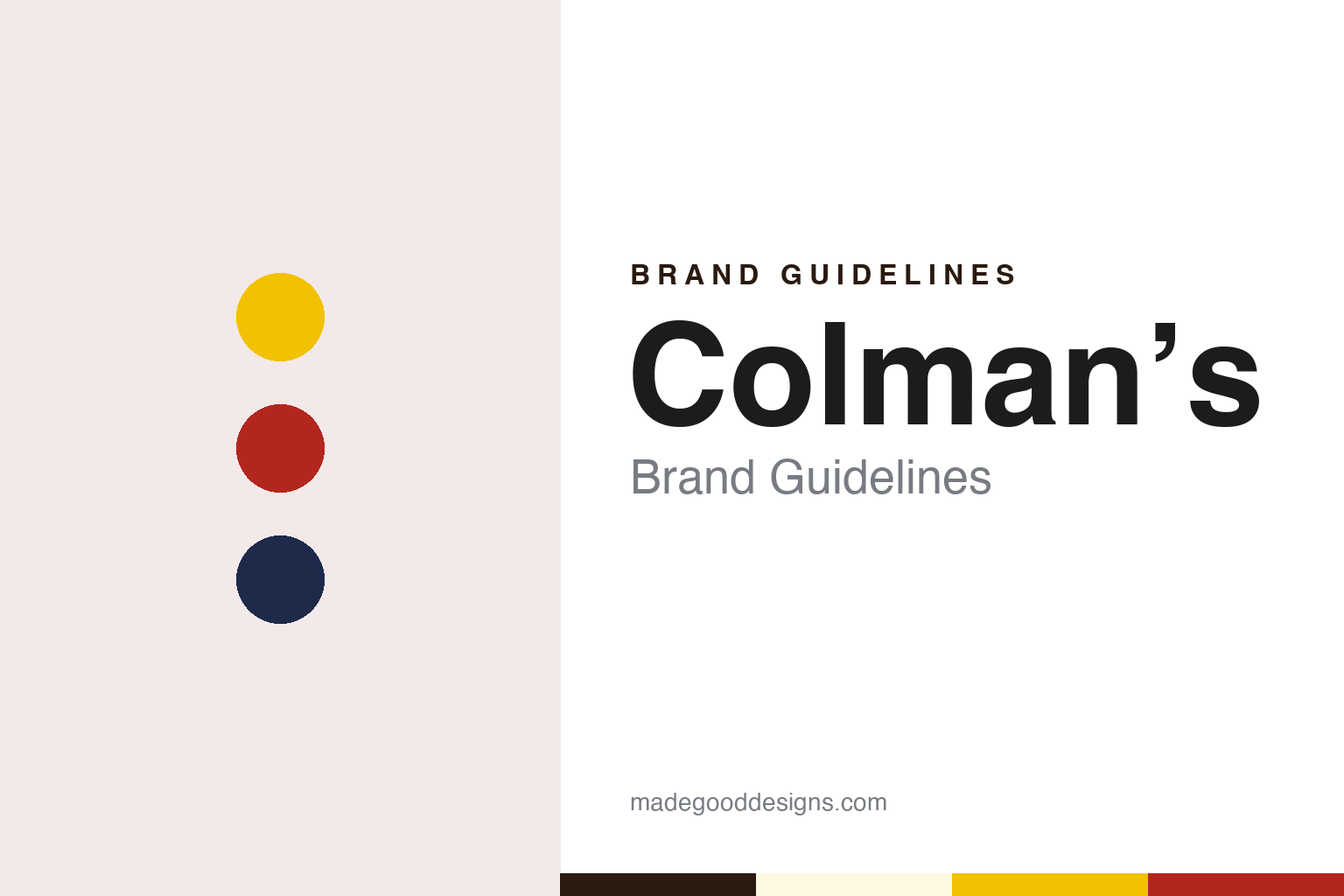
Colman’s Brand Guidelines
A Norfolk mill, a yellow tin and two centuries of English mustard.
Aa
Two constants: a mustard yellow, bull red and navy palette and a condensed poster sans register. Abstract homage — not a Colman’s product or mark; no tin, jar, label or logo is reproduced.
A mill on the Tas
A miller, a nephew and a works by the river.
Colman’s dates itself to 1814. That year, according to the historian Carole Rawcliffe’s Norwich since 1550 as cited by English Wikipedia, the Norfolk miller Jeremiah Colman bought the mustard business of one Edward Ames and moved it to a water mill at Stoke Holy Cross, on the River Tas a few miles south of Norwich, where he began crushing mustard seed. English Wikipedia says he blended brown and white mustard seed.
The firm became a family partnership. Having no children of his own, Colman took his nephew James into the business in 1823, and the company traded as J. & J. Colman; by 1829 it was selling mustard in London, Rawcliffe writes. Colman himself served as Mayor of Norwich in 1846. Jeremiah James Colman, of the next generation of the family, joined the partnership in 1851 and led the firm’s expansion.
That expansion moved the business into Norwich. In 1850, the National Heritage List for England records, J. & J. Colman bought land beside the River Wensum from the Norfolk Railway Company; a mustard mill went up there between 1854 and 1856, followed by flour and starch mills, granaries and a counting house, and by 1862 the move from Stoke Holy Cross was complete. The site, Carrow Works, grew to about 40 acres and gave the brand its address for the next century and a half. English Wikipedia, citing a company history archived from the former Colman’s Mustard Shop website, says the firm opened a school for employees’ children in 1857 and employed a nurse for its staff from 1864.
Colour
A yellow pack, a bull’s head and the Mustard Club.
The brand’s look is older than most of its rivals. From 1855, English Wikipedia says, citing the same company history, the firm introduced its yellow packaging and a bull’s-head logo, and in 1866 it received a Royal Warrant as mustard maker to Queen Victoria.
Colman’s also grew by buying competitors. In 1903 it took over the rival London mustard maker Keen Robinson & Co., which brought with it the Robinsons barley-water business; Keen’s production moved to Norwich in 1925, and in 1926 Colman’s and Reckitt together bought the American mustard company R. T. French, English Wikipedia says. French’s, the bright-yellow American mustard, later went its own way and now belongs to McCormick; see our French’s guide.
Advertising made the name a household word. In the 1920s the crime novelist Dorothy L. Sayers, then a copywriter at the S. H. Benson agency, worked on the Colman’s account with the artist John Gilroy, and the pair created “The Mustard Club” campaign, according to Barbara Reynolds’s 1997 biography of Sayers. Later slogans included “Come on Colman’s, light my fire,” English Wikipedia says.
In 1938 J. & J. Colman merged with Reckitt & Sons to form Reckitt & Colman. In 1995 Reckitt & Colman sold its Colman’s of Norwich food business, together with Robinsons soft drinks, to Unilever, The Independent and The Times reported at the time. For many years Colman’s also had a shop of its own: the Colman’s Mustard Shop traded in Norwich from 1973, moving to the city’s Royal Arcade in 1999, until it closed in April 2017, the Eastern Daily Press reported.
Typography
Design and documentation.
The seven brands in this group all make mustard, and they come from four countries: Maille, Colman’s, Amora, Edmond Fallot, Develey, Thomy and Löwensenf, from France, Britain, Germany and Switzerland. Mustard brands in general sit at many different points in the trade, from family firms that still carry a founder’s surname to names that now belong to much larger food groups, and a single brand can be sold everywhere from a specialist shop to a supermarket shelf.
A mustard brand’s identity is usually carried less by a single product than by a jar, a name and the table it promises, because the company behind the name may have changed hands, moved its factory or grown far beyond the town where it started. That makes the questions behind each name worth asking plainly: who started it, who owns it now, and where its mustard is actually milled and packed.
Each guide separates what independent sources record from what the company says about itself — its founding story, its owners over time, where its mustard is made and how its packaging has changed — and marks plainly what rests only on the company’s own word.
Aa
A condensed poster sans for a mustard sold in yellow since the 1850s. (Specimen set in Oswald, a sans STAND-IN; NOT the Colman’s logo.)
Colman’s
Leaving Carrow, a Norfolk mill and a sale.
Production left Norwich within the last decade. After the drinks maker Britvic said in December 2017 that it would leave the shared Carrow site, Unilever announced in January 2018 that Colman’s would leave the city, moving production to Burton upon Trent in Staffordshire and to Germany, BBC News reported; about 113 people worked there, and the closure was confirmed that March. The last jar of mustard came off the Norwich line on 24 July 2019, its best-before date replaced by a farewell line to the city, the BBC reported, and the Carrow site closed for good on 22 May 2020. Homes England, the government housing agency, announced in March 2026 that it had acquired the site.
The mustard seed did not leave Norfolk. In May 2019 Unilever agreed a ten-year supply deal with English Mustard Growers, a collective of local farmers, ITV News Anglia reported, and in 2020 a new mustard mill for Colman’s opened on a greenfield site at Honingham, near Norwich, built by the milling engineers Henry Simon, the trade title World Grain reported. The mill is run as a partnership between the milling company Condimentum, Unilever and the growers.
Another change of owner is now under way. On 31 March 2026 Unilever agreed to combine its foods business with McCormick, which already owns French’s. In August 2026 Unilever said it had decided “to market the Colman’s brand and assets to potential buyers” to address potential competition concerns arising from the deal, Sky News reported and Food Manufacture and Just Food followed up; bankers from Rothschild were asked to find a buyer. Food Manufacture said Colman’s holds more than half of the UK mustard market. No buyer had been announced at the time of writing.
For a design guide, Colman’s shows how a yellow pack and a bull’s head, both dating from the 1850s, can outlast a factory, two parent companies and a change of town. Compare French’s, the American mustard Colman’s once co-owned, and Maille, its French stablemate at Unilever. For this guide we use mustard yellow, a bull red and a navy with a condensed sans, an unofficial interpretation; no product or logo is reproduced.
Explore & save
Keep Colman’s’s identity on hand — save it to a board in the Made Good inspiration library.
Colman’s identity set
Pin the Colman’s mustard yellow, bull red and navy palette and the condensed poster sans register to your own board.