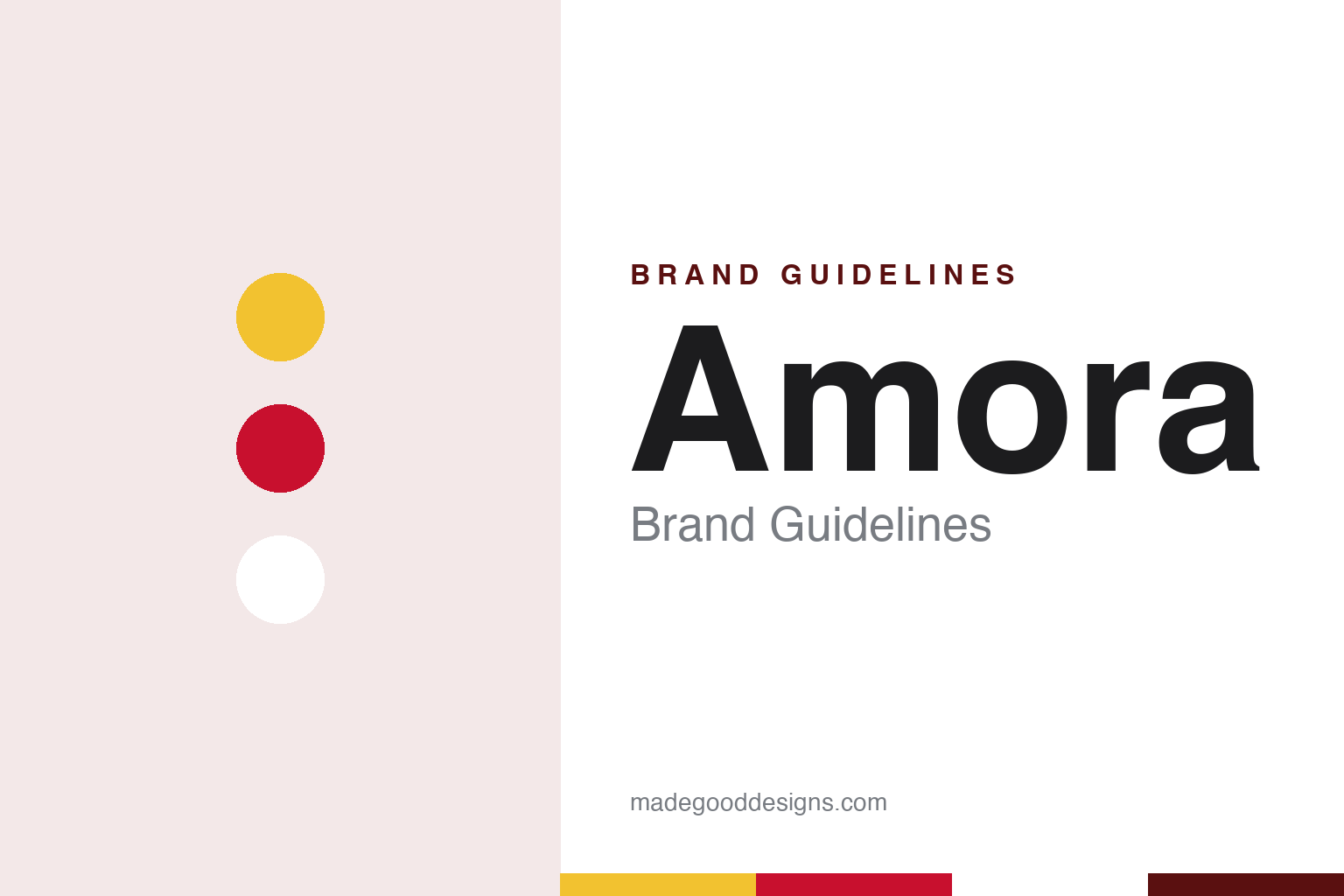
Amora Brand Guidelines
The Dijon mustard in a glass you keep.
Aa
Two constants: a mustard yellow, red and white palette and a rounded grocery sans register. Abstract homage — not an Amora product or mark; no jar, glass or logo is reproduced.
A name from 1919
A Dijon trademark, a new owner and a glass jar.
Amora is a Dijon name. French Wikipedia traces the business back through a line of Dijon vinegar and mustard makers to François Naigeon, who became a master vinegar-maker in 1703. The brand itself dates from 23 September 1919, when Armand Bizouard, a descendant of that mustard-making family, registered the Amora trademark at the Dijon commercial court, the business site Le Quotidien des Entreprises reported in 2026. A popular story, repeated by the brand-history site La Maison de la Com’, says the name came from a remark made on tasting the mustard: “C’est un amour de moutarde, ce sera Amora!” — “it’s a love of a mustard, it will be Amora.”
According to French Wikipedia, Bizouard never really put the name to use. In 1931 he sold his company to Raymond Sachot, who registered the trademark again in 1934 and began selling mustard under it in glass jars. Unilever Food Solutions’ French site describes Amora as having been “in the hearts of the French since 1934.”
Sachot built the company into an industrial business. In 1939, French Wikipedia says, he bought three Burgundy firms — the gingerbread maker Philbée, the Dijon mustard maker Mouillard and the Meursault firm Jacquemin — and grouped them as SAB, Spécialités alimentaires bourguignonnes. From the 1950s the range spread from mustard into vinaigrettes, ketchup, mayonnaise and gherkins. In 1963 SAB merged with Brochet Frères, Vandamme and Francorusse to form Générale Alimentaire.
Colour
The jar that became a drinking glass.
Amora’s most distinctive design idea is not a logo but a container. The trade magazine LSA credits Sachot with launching the first Amora glasses in 1934, taking mustard out of the traditional stoneware pot. Once empty and washed, the jar became a tumbler, and the verre à moutarde, the mustard glass, became a fixture of French kitchen cupboards. La Maison de la Com’ dates the reusable-glass idea as a deliberate marketing move to the 1950s and lists the shapes it took over the years: plain table glasses, stemmed glasses, long-drink glasses and glasses printed with television themes.
Decoration is what made the glasses collectable. According to LSA, decorated designs appeared from the 1950s, and in 1964 Amora issued a series illustrating La Fontaine’s fables, which shoppers bought as a set of twelve. A frosted-and-gold range was sold as “Givror,” from givre and or. From the mid-1970s the brand turned to television, printing its glasses with cartoon heroes of the period such as Goldorak, Albator and Bibifoc, the magazine says.
The name travelled into popular culture in other ways too. French Wikipedia notes that the Asterix album Le Devin jokes about “Amora, goddess of mustard.” In advertising, La Maison de la Com’ records the line “Amora, par amour du goût” — “for the love of taste,” a play on the brand’s name.
The range today runs well beyond Dijon mustard: English Wikipedia lists ketchup, salad dressings, sauces, seasonings, vinegar and other condiments sold under the Amora and Maille names. Not every product has been well received: in August 2018 the consumer group foodwatch criticised a light mustard vinaigrette sold under the Amora name, saying it contained only 0.7% mustard, as French and English Wikipedia both record.
Typography
Design and documentation.
The seven brands in this group all make mustard, and they come from four countries: Maille, Colman’s, Amora, Edmond Fallot, Develey, Thomy and Löwensenf, from France, Britain, Germany and Switzerland. Mustard brands in general sit at many different points in the trade, from family firms that still carry a founder’s surname to names that now belong to much larger food groups, and a single brand can be sold everywhere from a specialist shop to a supermarket shelf.
A mustard brand’s identity is usually carried less by a single product than by a jar, a name and the table it promises, because the company behind the name may have changed hands, moved its factory or grown far beyond the town where it started. That makes the questions behind each name worth asking plainly: who started it, who owns it now, and where its mustard is actually milled and packed.
Each guide separates what independent sources record from what the company says about itself — its founding story, its owners over time, where its mustard is made and how its packaging has changed — and marks plainly what rests only on the company’s own word.
Aa
A rounded grocery sans for a mustard sold in a glass. (Specimen set in Nunito Sans, a sans STAND-IN; NOT the Amora logo.)
Amora Maille
Financiers, Danone, Unilever and one factory.
Amora changed hands many times after 1963. French Wikipedia lists the owners of Générale Alimentaire as the Rothschild group and then, from 1973, the financier Jimmy Goldsmith’s Générale Occidentale, before the business passed to BSN, the group later renamed Danone. Maille, the Dijon mustard house, joined Danone in 1980, and in 1996 Danone brought the two brands together. A year later it sold its condiments arm, and Amora Maille went to the investment firm Paribas Affaires Industrielles. In 1999 Unilever agreed to buy Amora Maille, English Wikipedia says, citing contemporary reports; the company had about 1,000 employees at the time.
Under Unilever, production was concentrated. French Wikipedia says vinaigrette and ketchup lines moved to Turkey and the Czech Republic between 2002 and 2008. In 2008 Unilever announced the closure of the historic Amora factory in Dijon. It shut on 17 July 2009, France 24 reported that day: 86 of its 184 employees were transferred to the company’s plant at Chevigny-Saint-Sauveur, about 9 km away, which the company said would become Europe’s most important condiment production centre. French Wikipedia says the Appoigny plant in the Yonne closed at the same time and that output at Chevigny grew from about 50,000 to more than 90,000 tonnes by 2011. Chevigny is now the only Amora Maille factory in the world, making all the group’s mustard and around 100 million jars a year for some 90 countries, Le Quotidien des Entreprises reported in 2026. Like other Dijon mustards, Amora relies heavily on imported seed: the same report says France buys about 80% of its mustard seed from Canada, and a poor Canadian harvest in 2021 led to empty shelves in 2022.
Another change of ownership is now under way. On 31 March 2026 McCormick & Company and Unilever announced a deal to combine Unilever’s food business with McCormick, CNN and Fortune reported; the French food-industry title RIA listed Amora and Maille among the brands involved. In a filing dated 1 October 2026, McCormick said regulatory approvals were still being sought and that it expected the deal to close by mid-2027. Until then, Amora remains a Unilever brand.
For a design guide, Amora shows how a container can carry a brand: a mustard jar designed to be reused as a glass turned a Dijon condiment into a household object. Compare Maille, its sister brand from the same factory, and Hellmann’s, another Unilever condiment. For this guide we use mustard yellow, a strong red and white with a rounded sans, an unofficial interpretation; no product or logo is reproduced.
Explore & save
Keep Amora’s identity on hand — save it to a board in the Made Good inspiration library.
Amora identity set
Pin the Amora mustard yellow, red and white palette and the rounded grocery sans register to your own board.