ARCOmadrid Brand Guidelines
Madrid’s contemporary art fair, organised by IFEMA since 1982.
Aa
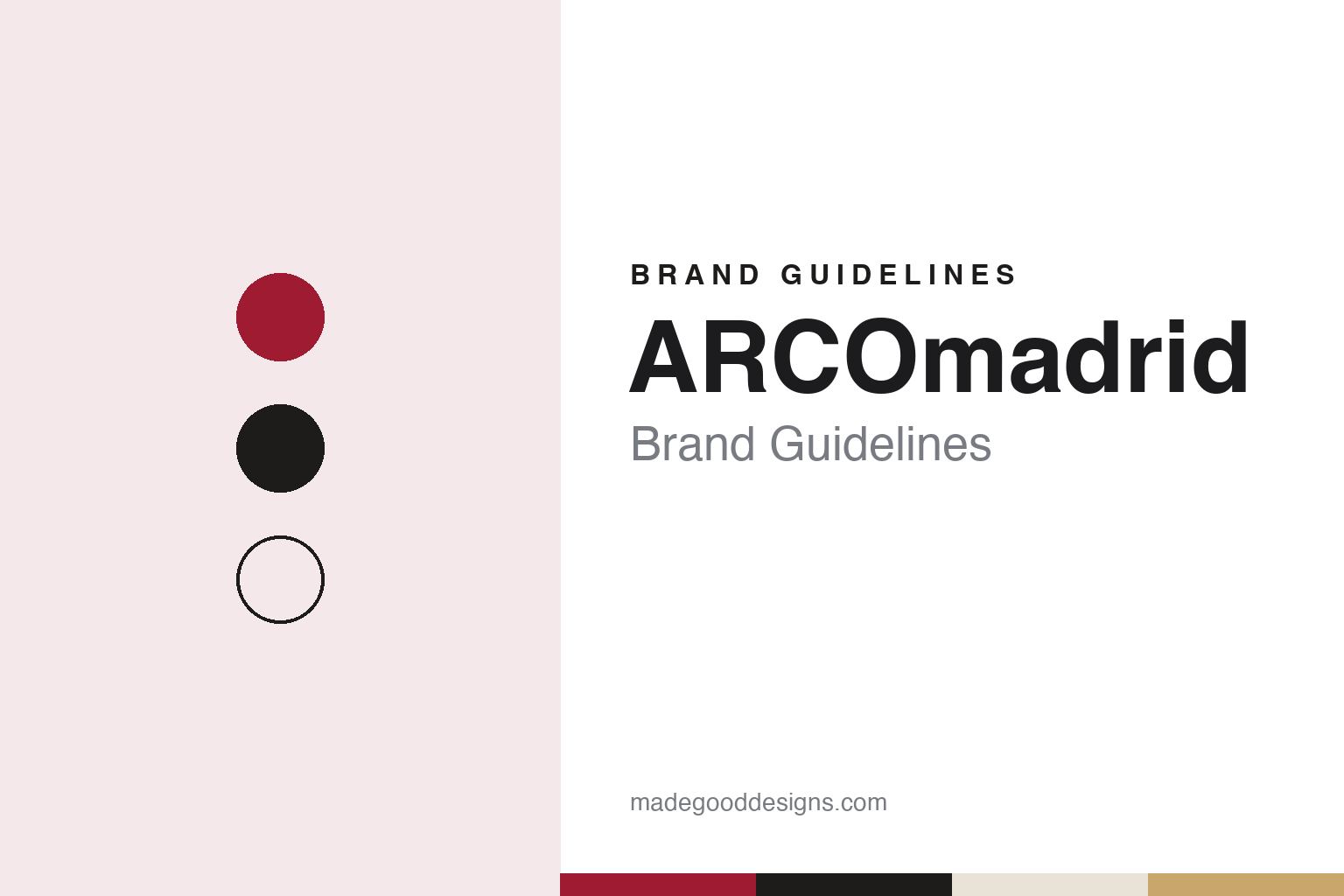
Two constants: a deep red, charcoal and warm stone palette and a compact grotesque sans register. Abstract homage — not an ARCOmadrid or IFEMA asset; no logo, poster or artwork is reproduced.
Feria Internacional de Arte Contemporáneo
A gallery fair in Madrid since 1982.
ARCOmadrid is Spain’s International Contemporary Art Fair — in Spanish the Feria Internacional de Arte Contemporáneo — held each year in Madrid and organised by the city’s trade-fair institution, IFEMA MADRID. Spanish Wikipedia dates the fair to 1982 and describes it as a fair of galleries, set up to gather an offer that runs from the historic avant-gardes through modern and contemporary art to the newest emerging work.
The first edition ran from 10 to 17 February 1982, according to Spanish Wikipedia. It was organised by the gallerist Juana de Aizpuru, from Valladolid, who directed the fair for its first four editions, and it was held in IFEMA’s Palacio de Exposiciones, which at that time stood on the Paseo de la Castellana. The same account puts 264 artists from 14 countries at that opening edition.
The fair has kept to a late-winter or spring slot in the Spanish capital for most of its history. Spanish Wikipedia places the 35th edition, from 24 to 28 February 2016, in halls 7 and 9 of IFEMA, with 221 galleries from 27 countries, and the 37th, in February 2018, in the same two halls. The calendar has moved when it had to: the 40th edition took place from 7 to 11 July 2021, with 130 galleries and exhibitors from 26 countries, before the fair returned to late February in 2022 and to early March in 2024, the same source says.
The organiser has also extended the name beyond Madrid. In 2016 IFEMA opened a sister fair in Portugal, ARCOlisboa, held each May in the Portuguese capital to promote Portuguese art, Spanish Wikipedia says. In March 2021 the fair introduced ARCO E-xhibitions, a digital space where collectors, professionals and the public could browse 3D exhibitions created by galleries taking part in ARCOmadrid and ARCOlisboa.
Colour
Programmes, curators and a Latin American link.
The 45th edition ran from 4 to 8 March 2026 at IFEMA. In a report published on 18 February 2026, the news agency EFE counted 211 galleries from up to 30 countries, with 178 of them in the General Programme; IFEMA’s own release gave 175 galleries in that programme, as did the Catalan art magazine Bonart on 3 March 2026, which also counted 48 galleries across the curated programmes.
The structure of the fair is built around that General Programme, whose galleries and projects are selected by an Organising Committee, IFEMA says; the director at the time, Maribel López, called it “the heart of the fair,” EFE reported. Around it sit curated sections with their own curators. Opening. New Galleries is reserved for galleries with less than eight years of history; in 2026 it presented 19 galleries from 15 countries, according to EFE. Profiles | Latin American Art shows a single artist in each proposal; EFE counted 11 projects from seven countries, among them Brazil, Argentina, Peru and Mexico. IFEMA describes the section as reflecting the fair’s historic relationship with the Latin American art scene, and says that more than 31 per cent of the international participation in 2026 came from Latin America.
Each recent edition has also had a central project. For the 45th, the fair organised ARCO2045: The future, for now, which brought together 17 galleries from eight countries to reflect on possible futures and tentative languages of art, as EFE reported; IFEMA says the project was laid out across two spaces within the fair. EFE also described 38 artist spaces placed behind the stands, where galleries showed more experimental proposals, and noted that the fair’s foundation, Fundación ARCO, holds a collection on deposit at CA2M, the Centro de Arte Dos de Mayo of the Community of Madrid.
IFEMA publishes its own figures for the mix of exhibitors. For 2026 it gave the Spanish share of galleries as 34 per cent and the international share as 66 per cent, and its fair page lists the General Programme galleries by city and country, from Madrid, Barcelona and Seville to São Paulo, Bogotá, Vienna and Berlin.
Typography
How art fairs present themselves.
Contemporary art fairs usually present themselves through a short name that does most of the work. Some take the city outright, as Art Cologne does; others join a coined word to the city, as ARCOmadrid does with ARCO and, for its Portuguese sibling, ARCOlisboa. The name stays fixed while much around it changes from one edition to the next, and editions are counted: ARCOmadrid held its 45th in March 2026 and Art Cologne its 59th in November 2026.
Behind many fairs stand trade-fair companies and galleries. ARCOmadrid is organised by IFEMA MADRID, and Art Cologne’s press releases come from Koelnmesse, while both fairs trace their beginnings to gallerists: Juana de Aizpuru in Madrid in 1982, and a Cologne dealers’ association in 1967. At both fairs the exhibitors are chosen by a committee or advisory board, and both are held in the exhibition halls of their organisers, IFEMA in Madrid and the fairgrounds at Cologne-Deutz, so the venue becomes part of the fair’s picture.
Inside the halls, fairs divide themselves into named sections. A main programme for established galleries sits beside sections for younger galleries, such as ARCOmadrid’s Opening, for galleries under eight years old, or Art Cologne’s NEUMARKT, and beside curated programmes with their own themes and curators. At these two fairs the section names are written in capitals or set off with punctuation — GALLERIES, ART + OBJECT, Profiles | Latin American Art — so that they read as titles in their own right.
The material the fairs publish follows a steady pattern: exhibitor lists by city and country, hall plans, programmes of talks and special exhibitions, and headline figures for each edition. Themed projects change from edition to edition — ARCOmadrid named its 2026 project ARCO2045 — while the name, the organiser and the city stay constant, which keeps a fair recognisable across decades.
Aa
A compact grotesque sans for a one-word name. (Specimen set in Archivo, a sans STAND-IN; NOT the ARCOmadrid logo.)
ARCOmadrid
A one-word name and a change at the top.
The fair’s leadership changed in 2026. EFE and Bonart both named Maribel López as director at the 45th edition in March. On 17 July 2026 IFEMA MADRID announced that Gonzalo Cabrera, its Director of Education and Culture, would take over the direction of ARCOmadrid from October 2026, after López left to become director of the Joan Miró Foundation in Barcelona, as the Catalan daily Ara reported that day and Bonart reported on 18 July. Bonart noted that Cabrera trained in information sciences at the Complutense University of Madrid and had worked in broadcasting and at Telefónica before joining IFEMA.
IFEMA’s announcement stressed continuity in the team behind the fair. It listed staff responsible for relations with Spanish and international galleries, for the curated programmes, for special projects, architecture and sponsorship, for the Forum and professional programme, and for the Guest programme for collectors and art advisers, as well as the head of Fundación ARCO. The organiser said the team would keep the fair’s identity and strategy in place under the new director.
The identity itself rests on the name. IFEMA writes it as a single word, the capitals of ARCO followed by the city in lower case, and uses the same pattern for its Lisbon sibling, ARCOlisboa. The fair’s central projects carry the ARCO name joined to a year: ARCO2045 for the 45th edition. Section titles follow a plain, descriptive style — Opening. New Galleries; Profiles | Latin American Art — with punctuation doing the work of a subtitle. The fair page sets out the edition’s headline figures, its sections and its curators in short blocks, and the General Programme list gives each gallery with its city and country.
For a design guide, ARCOmadrid shows how a fair can build its identity from a short coined name joined to its city, with sections and yearly projects named in the same compact style. Compare Art Cologne, another fair run by a trade-fair company, which opened a Mallorca edition in 2026, and IFEMA, the Madrid institution that organises ARCOmadrid. For this guide we use a deep red, charcoal and warm stone with a sans, an unofficial interpretation; no product or logo is reproduced.
Explore & save
Keep ARCOmadrid’s identity on hand — save it to a board in the Made Good inspiration library.
ARCOmadrid identity set
Pin the ARCOmadrid deep red, charcoal and warm stone palette and the compact grotesque sans register to your own board.
Source & notes
Frequently Asked Questions
What font can I use to match the ARCOmadrid look?
This guide describes ARCOmadrid’s type as “A compact grotesque sans for a one-word name”. Its type specimen is set in Archivo from Google Fonts as a stand-in; Archivo is not ARCOmadrid’s own lettering.
What colours are in the ARCOmadrid palette?
This guide’s ARCOmadrid palette is Fair red #9E1B32, Charcoal #1E1C1A, Warm stone #E9E2D6, Ochre #C9A66B and Paper #F8F6F2. The tones are the guide’s own unofficial interpretation, not official ARCOmadrid hex codes.
When was ARCOmadrid founded?
ARCOmadrid was founded in 1982 (first edition 10–17 February), in Madrid, Spain.