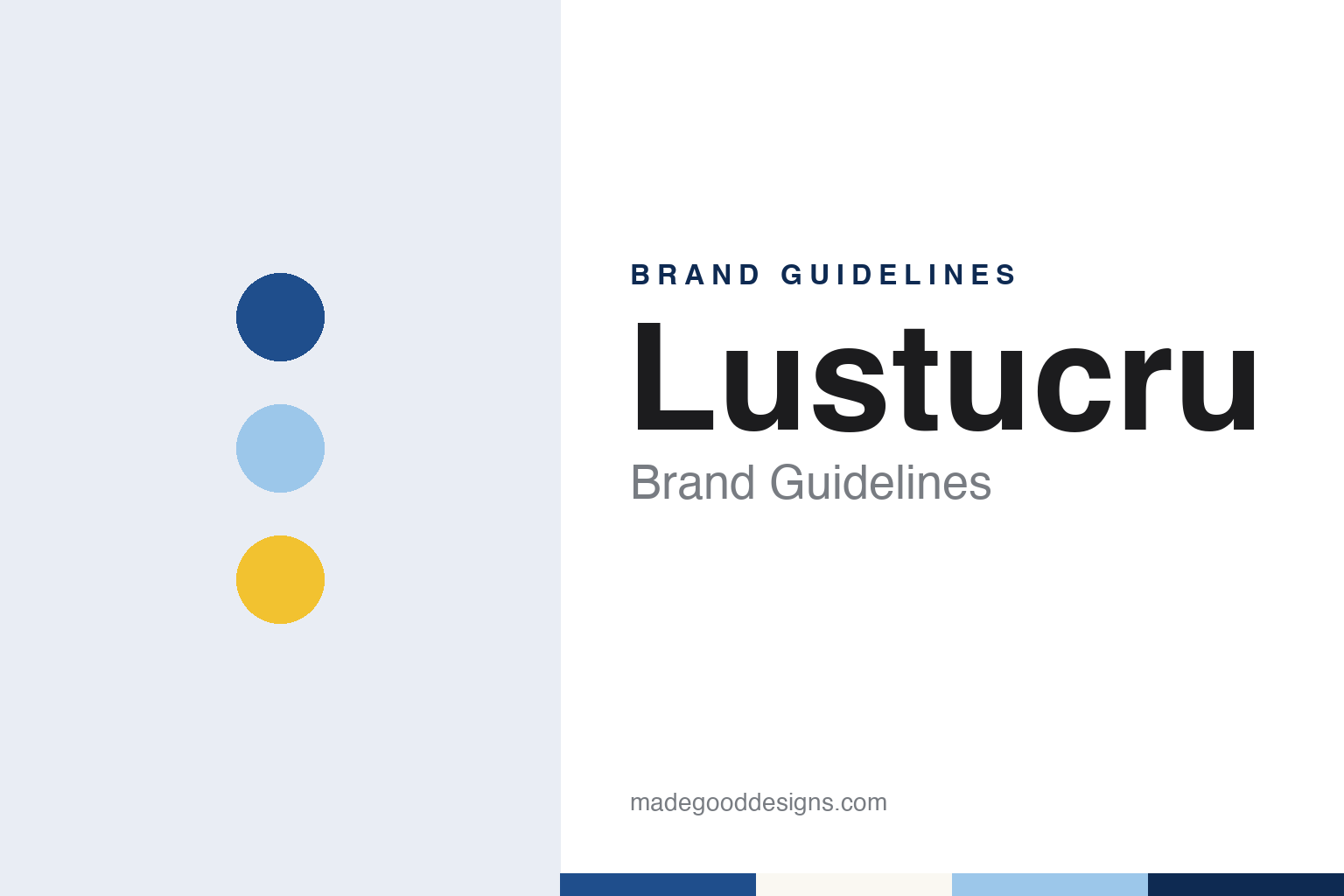
Lustucru Brand Guidelines
The Grenoble egg-pasta brand of the blue checkerboard.
Aa
Two constants: a Lustucru blue, pale blue and yolk yellow palette and a poster-era serif register. Abstract homage — not a Lustucru product or mark; no pack, logo or checkerboard design is reproduced.
Pèr’Lustucru
A Grenoble pasta works, three sons and a poster contest.
Lustucru began in Grenoble. French Wikipedia, citing France 3 and the brand’s own history, says that in 1871 Louis Cartier-Millon, from Bernin in the Isère, bought a small pasta factory on the place de Gordes that had existed since 1824; he made the pasta while his wife, Joséphine, kept the accounts. The brand’s website gives the same year for the purchase. A 2020 history by the French trade association ILEC gives an earlier date, saying Louis Cartier-Millon had been making pasta in Grenoble since 1860, so the sources differ. By 1881, the Journal des Femmes reported, the couple had doubled output to about 500 kilos of pasta a day.
Their three sons all worked in the business. Félix ran it from 1900, Gabriel sold, and the youngest, Albert, looked for customers beyond the Isère and worked on the brand’s image and packaging, French Wikipedia says. At the time pasta was sold loose from sacks and crates; the family moved to cardboard boxes printed with the pasta shape and then the maker’s name. A new, larger factory produced its first pasta in 1910.
The name came out of a poster competition. French Wikipedia and the company date it to 1911; ILEC dates the contest to 1910. It was won by the illustrator Synave with a poster of a pasta box painted in a light and dark blue checkerboard — the damier that, French Wikipedia says, still appears on Lustucru products. The name is credited to the artist Jean-Louis Forain, who at the banquet after the contest sang the old nursery rhyme “C’est la mère Michel,” in which the character Père Lustucru appears. Two brands followed: Mèr’Michel for pasta without eggs and Pèr’Lustucru for egg pasta. The First World War cut the launch short; Mèr’Michel did not survive it, and Pèr’Lustucru later became simply Lustucru.
Colour
Eggs, adverts and a famous cracked-egg line.
After the war the brothers fell out. Gabriel died in 1921, and that year Albert took charge of the factory, French Wikipedia says, while Félix bought a Grenoble chocolate works and created the Cémoi brand. In 1940 Albert handed the business to his sons Jean and Robert. Robert, as chief executive, built a network of poultry farms in the Dauphiné and the Drôme to supply the eggs that egg pasta needed — by 1958, French Wikipedia says, the factory required 180,000 eggs a day, and the aim was to end imports.
Lustucru was an early and busy advertiser. In 1929 it made its own point-of-sale objects, and in the 1930s it sponsored the Lustucru théâtre, a radio gala broadcast live each Wednesday from the Salle Pleyel in Paris. In 1957 it received an “oscar de l’emballage,” a packaging award, for boxes with transparent windows that showed the pasta inside, Le Dauphiné libéré reported in 2021; aluminium-lined and boil-in-the-bag packs followed. The Journal des Femmes says its advertising films won a prize at Venice in 1964 and first and second prizes at Cannes in 1965. Enamel signs, toys and other objects in the blue-and-white checkerboard are now collected, French Wikipedia notes.
Eggs stayed at the centre of the brand. In 1986, according to a 2009 oral history of the Grenoble factory by Hervé Bienfait, published by the Isère heritage service, Lustucru led the French market for fresh-egg pasta with a 45% share. Its best-remembered advertising began in the 1980s: ILEC dates to 1981–1984 a campaign in which a farmer, Germaine, played by the actress Marguerite Dussauchoy, tried to sell the company cracked eggs and was turned away with the line “il n’y a pas d’œufs fêlés chez Lustucru” — “there are no cracked eggs at Lustucru.” In 1984 the adverts had her carried off by aliens, ILEC says, and she returned in 1994 to promote pasta that cooked in three minutes. A 1995 survey, Le Dauphiné libéré reported, placed Lustucru sixth among the French public’s favourite brands.
Typography
Design and documentation.
The seven brands in this group all make pasta, and they come from Italy, France, Spain and the United States: Buitoni, Panzani, Lustucru, Pastas Gallo, Ronzoni, Mueller’s and Felicetti. Pasta makers and brands in general sit at many different points in the trade, from family firms that still carry a founder’s surname to names that now belong to much larger food groups, and a single brand can be sold everywhere from a corner shop to a supermarket shelf.
A pasta brand’s identity is usually carried less by a single product than by a pack, a name and the meal it promises, because the company behind the name may have changed hands, moved its factory or grown far beyond the town where it started. That makes the questions behind each name worth asking plainly: who started it, who owns it now, and where its pasta is actually made and packed.
Each guide separates what independent sources record from what the company says about itself — its founding story, its owners over time, where its pasta is made and how its packaging has changed — and marks plainly what rests only on the company’s own word.
Aa
A poster-era serif for a brand named at a poster contest. (Specimen set in Fraunces, a serif STAND-IN; NOT the Lustucru logo.)
Lustucru
From the Cartier-Millons to Pastacorp — and a split brand.
The family did not keep control. In 1968, ahead of the opening of the Common Market, the Carret family, owners of the Lyon pasta brand Rivoire & Carret, proposed a merger, and a holding company was formed with Rivoire & Carret and Lustucru as subsidiaries, French Wikipedia says. The group opened a large new factory at Chiry-Ourscamp in the Oise in 1971. That year the Carrets sold most of their shares to the Cohen-Skalli family, semolina millers from Marseille, who merged the two companies in 1981 as the RCL group. Years of litigation followed: in 1987 the Cohen-Skallis bought the Cartier-Millon family’s 42%, French Wikipedia says, and in June 1989 France’s Cour de cassation upheld the annulment of a 1987–88 share transfer through which Barilla had tried to acquire a stake in the Rivoire et Carret-Lustucru holding company without the approval its statutes required. Lustucru moved to Marseille, and the Grenoble factory closed in 1989.
The brand was then divided. In 2002 Panzani bought Lustucru and the Taureau Ailé rice brand, but the European Commission required Lustucru’s dry pasta to be left out of the deal, Les Échos reported that May. The Cohen-Skalli family kept the dry pasta and the brand rights in a new company, Pastacorp, and the fresh pasta and rice business uses the name under licence as Lustucru Sélection, French Wikipedia says. Panzani was bought by Ebro Puleva, now Ebro Foods, in 2005. When Ebro sold Panzani to the investment firm CVC in 2021, Lustucru Sélection stayed with Ebro, Le Quotidien des Entreprises reported in July 2026; the same report said Pastacorp, still controlled by the Cohen-Skalli family, took in minority investors in July 2025. Pastacorp revived the Rivoire & Carret brand in 2012, Le Figaro reported.
Pastacorp’s Lustucru website says its pasta is made at its factory in Chiry-Ourscamp, in the Hauts-de-France, from French durum wheat, mainly from the Beauce, milled into semolina at its mill in Rouen, and that its egg pasta uses fresh whole liquid eggs from free-range hens in France. It calls itself a French family business. French Wikipedia shows a new logotype from 2018, and the company says it moved to a 100% paper pack in 2022.
For a design guide, Lustucru shows how one poster competition gave a brand both its name and a pattern it has kept for more than a century. Compare Panzani, the French pasta rival that bought its fresh business, and Cémoi, the chocolate brand founded by Félix Cartier-Millon. For this guide we use a checkerboard blue, a pale blue and a yolk yellow with a serif, an unofficial interpretation; no product or logo is reproduced.
Explore & save
Keep Lustucru’s identity on hand — save it to a board in the Made Good inspiration library.
Lustucru identity set
Pin the Lustucru blue, pale blue and yolk yellow palette and the poster-era serif register to your own board.