Carozzi Brand Guidelines
The Valparaíso pasta maker that became a Chilean food group.
Aa
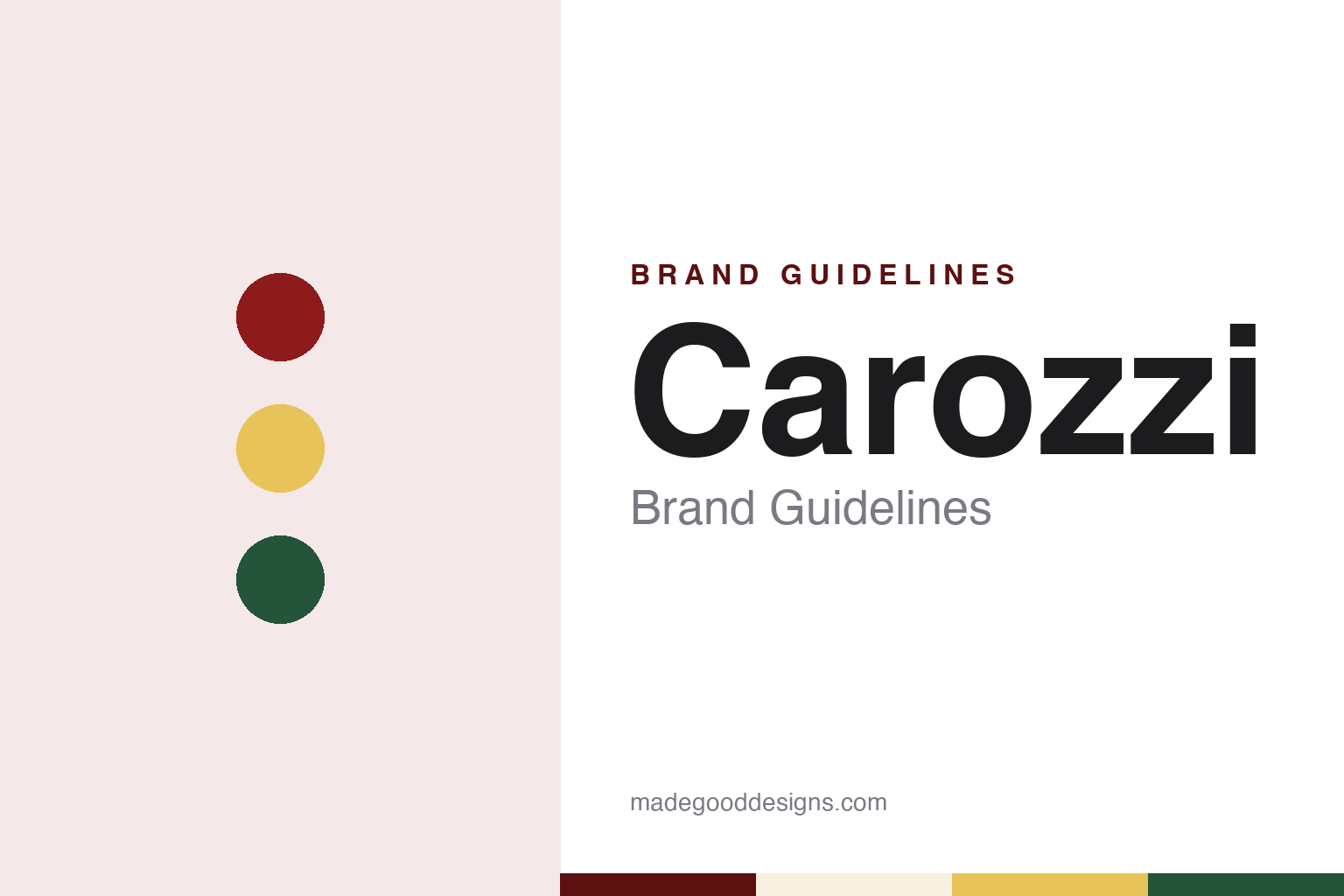
Two constants: a tomato red, durum gold and basil green palette and a sturdy grotesque sans register. Abstract homage — not a Carozzi product or mark; no pack, logo or pasta shape is reproduced.
La Joven Italia
A Tuscan immigrant, a port city and an earthquake.
Carozzi began in Valparaíso, Chile’s great Pacific port, on 29 March 1898. Both the company and Spanish Wikipedia give that date and name the founder as Augusto Carozzi Passani, an Italian immigrant from Tuscany; Spanish Wikipedia places his origins in the province of Massa-Carrara. The first business was called “La Joven Italia, Carozzi y Cía.” — “Young Italy” — and it made pasta.
The company did not stay in the port for long. After the 1906 Valparaíso earthquake, Spanish Wikipedia says, operations moved inland to Quilpué, and the business took the name Compañía Molinos y Fideos Carozzi — the Carozzi Mills and Noodle Company — joining flour milling to pasta making under one roof. Quilpué, in the Valparaíso region, became the company’s base for more than half a century, and in 1948 Carozzi opened housing for its workers there, Spanish Wikipedia says.
The same year, the company says, it launched Chile’s first canned tomato sauce, a step that took Carozzi from the pasta itself to what goes on it. Spanish Wikipedia adds that in the 1950s the company installed its first automatic drying tunnel for long pasta, describing it as one of the first three continuous automatic pasta lines in the world.
On 24 January 1970, Spanish Wikipedia says, citing La Nación two days later, a huge fire destroyed the Carozzi plant in Quilpué, where 60% of the pasta eaten in Chile was made. By then the company already had a second home: in 1965 it had opened a pasta plant in Nos, south of Santiago, which Spanish Wikipedia calls the most modern in South America at the time. Its design brought together three pioneering Chilean architects, Luis Mitrovic, Emilio Duhart and Christian de Groote.
Colour
The De Caso and Bofill families, and a portfolio beyond pasta.
Control of the company changed hands in 1969, when, the company says, the De Caso family took charge and Francisco de Caso Rivera became president. In 1975 the presidency passed to Gonzalo Bofill de Caso, who began taking the company outside Chile and into new categories. The Bofill family has led Carozzi ever since; Spanish Wikipedia names Gonzalo Bofill Velarde as its current president and Grupo Bofill as its controlling shareholder.
Diversification came in stages, according to the company’s own timeline. It added the Costa brand in 1982, taking it into confectionery; Spanish Wikipedia says Costa went on to become one of Chile’s largest chocolate makers. In 1990 it created Agrozzi for tomato paste and fruit pulp. Spanish Wikipedia records the purchase of the Somol flour mill in Osorno in 1988 and of the miller Teófilo Grob in La Unión in the mid-1990s. In 2000, the company says, the acquisition of Ambrosoli made it Chile’s leader in sweets. Breakfast cereals followed in 2006 through Selecta and Compañía Molinera San Cristóbal, and pet food in 2010 with Nutripro and its Master Dog and Master Cat brands.
Ice cream is the newest line. Carozzi bought the Bresler ice-cream business from Unilever Chile in July 2020, Spanish Wikipedia says, and added the San Francisco ice-cream brand in 2022; the company lists both. Today it says it works across 25 product categories and exports to five continents. Its slogan, Spanish Wikipedia notes, is “Compartir hace bien” — “Sharing does good.”
Typography
Design and documentation.
The seven brands in this group all make food or drink, and they come from four South American countries — Argentina, Chile, Peru and Colombia: Arcor, Bagley, Havanna, Carozzi, Costa, Inca Kola and Colombina. South American food and drink brands in general sit at many different points in the trade, from family firms that still carry a founder’s surname to names that now belong to much larger food groups, and a single brand can be sold everywhere from a corner shop to a supermarket shelf.
A food or drink brand’s identity is usually carried less by a single product than by a pack, a name and the treat or staple it promises, because the company behind the name may have changed hands, moved its factory or grown far beyond the town where it started. That makes the questions behind each name worth asking plainly: who started it, who owns it now, and where its products are actually made and packed.
Each guide separates what independent sources record from what the company says about itself — its founding story, its owners over time, where its products are made and how its packaging has changed — and marks plainly what rests only on the company’s own word.
Aa
A sturdy grotesque sans for a pantry-staple maker. (Specimen set in Libre Franklin, a sans STAND-IN; NOT the Carozzi logo.)
Carozzi
Nos, Peru and a South African partner.
Carozzi’s production is concentrated in Chile, with a second base in Peru. Spanish Wikipedia describes the Nos complex, in the commune of San Bernardo in the Santiago Metropolitan Region, as the company’s main site and its headquarters. It lists further Chilean plants for ice cream at Puerta Sur, sweets and chocolate at Reñaca, tomato products at Teno, pet food at Lontué and flour and oats at Victoria, among others.
Peru came through Molitalia, a Lima pasta and flour maker. The company dates its arrival in Peru, with Costa and the Molitalia purchase, to 1996; Spanish Wikipedia, giving more detail, says Carozzi bought 99% of Molitalia’s shares in May 1997. Spanish Wikipedia adds that a Costa biscuit factory, Costaperú, was built in Peru in 1995, and lists Molitalia plants in Los Olivos, Cajamarquilla and Huachipa. In Peru the group sells Costa and Ambrosoli alongside local brands such as Pomarola, Fanny and Todino.
In Argentina, Spanish Wikipedia says Carozzi bought the Argentine confectioner D.R.F. Billiken in 2008 and sold it in 2012, then returned in 2017 with the coffee and snacks brand Bonafide, which in 2018 bought the Vizzolini pasta brand from Molinos Río de la Plata.
For a quarter of a century the group also had a foreign partner. The company says it entered a partnership with South Africa’s Tiger Brands in 1999. In 2025, Spanish Wikipedia says, citing Diario Financiero, Grupo Bofill bought Tiger Brands’ 24.38% stake, ending the 25-year alliance.
For a design guide, Carozzi shows how a single pasta name can anchor a group whose brands run from chocolate to ice cream. Compare Costa, the Chilean chocolate and biscuit brand it owns, and Barilla, the Parma pasta maker. For this guide we use a tomato red, a durum gold and a basil green with a sans, an unofficial interpretation; no product or logo is reproduced.
Explore & save
Keep Carozzi’s identity on hand — save it to a board in the Made Good inspiration library.
Carozzi identity set
Pin the Carozzi tomato red, durum gold and basil green palette and the sturdy grotesque sans register to your own board.