Neilson Brand Guidelines
The Toronto ice-cream maker that went into chocolate, then split in two.
Aa
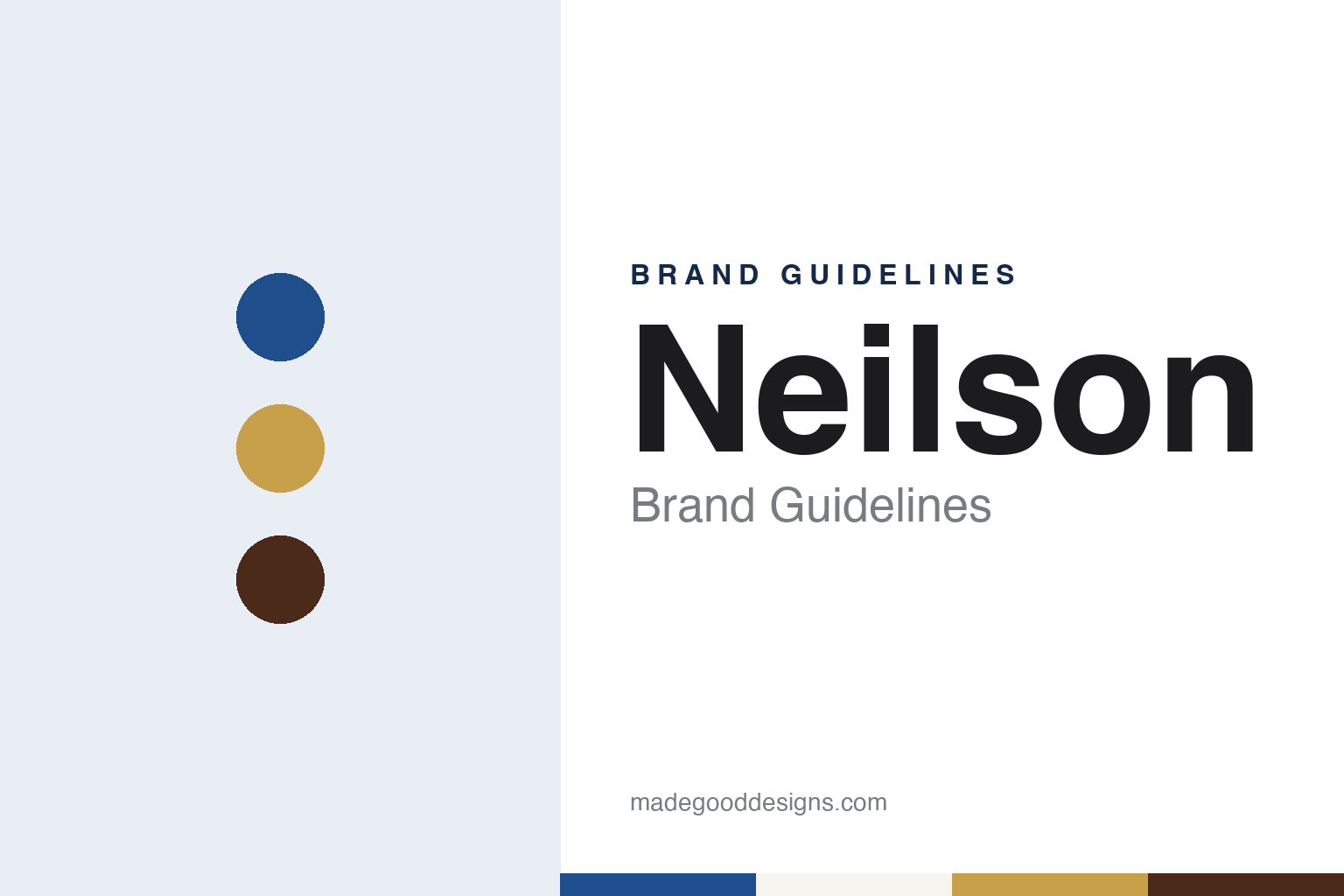
Two constants: a dairy blue, milk white and Jersey gold palette and a clean dairy-carton sans register. Abstract homage — not a Neilson product or mark; no carton, bar or logo is reproduced.
Ice cream on Lynd Avenue
A farm boy from Almonte, a failed shop and a first season of ice cream.
Neilson is now a dairy brand on Canadian milk cartons, but its story covers ice cream, chocolate bars and two separate owners. According to the Dictionary of Canadian Biography, in a 1998 entry by Stephen A. Otto, William Neilson was born in 1844 near Almonte, in what was then Upper Canada, to Scottish settler parents. At 21 he left the family farm to work as a farm-hand near Rochester, New York; around 1867 he returned to Almonte to train as a machinist and later worked for iron-founders in Toronto. Retail ventures in Brockville and Toronto followed, with little success, and the biography records an insolvency in the early 1880s.
In 1890, the biography says, Neilson moved to Toronto and opened a grocery business in Parkdale in the name of his wife, Mary Eva Kaiser. In 1893 he turned to commercial ice-cream making on Lynd Avenue, starting with a few gallons a day and producing about 3,750 gallons in the first season. English Wikipedia describes the early business as a milk retailer that switched to cream and ice cream.
The company’s own account, published today by Neilson Dairy, frames the start around a credo, “Nothing but the best.” It says William Neilson invested the family’s savings in seven cows and some used, hand-cranked ice-cream makers, and that he used only cream rather than milk in his ice cream, which it calls an instant success.
The business grew quickly. A modern factory on Gladstone Avenue in Toronto opened in 1905, and in 1907 the firm was incorporated as William Neilson Limited, the Dictionary of Canadian Biography says. In 1911 it bought a cheese factory in Beachville, Ontario, to process cream. William Neilson died in February 1915, and his son Morden became president.
Colour
Winter work, Jersey Milk and a contest-winning bar.
Chocolate began as a way to fill the winter. Ice-cream sales fell off in the colder months, and the Dictionary of Canadian Biography says Neilson started making chocolate in a modest way in 1908 to give his ice-cream makers work. By 1911 the firm offered a range of chocolates and bars, and by 1914 it was producing more than 560,000 pounds of chocolate a year. The company tells the same story in warmer terms: it says Neilson launched chocolates so that some 25 skilled employees would not sit idle through the winter.
Under Morden Neilson, the company says, William Neilson Ltd. became the largest producer of ice cream in the British Empire and the largest maker of chocolates in Canada. Two of its bars lasted for most of a century. English Wikipedia says the Jersey Milk bar, a solid milk chocolate sold in a white wrapper with gold lettering, was introduced in 1924.
Crispy Crunch followed in 1930. English Wikipedia says it was devised by Harold Oswin, a candy roller in Neilson’s hard-candy room, who won an internal company contest with the idea of peanut butter coated in a mixture of sugar, molasses and vanilla and dipped in chocolate. The bar’s best-remembered advertising came much later. In 1988, English Wikipedia says, marketing director Norm Williams commissioned a repositioning campaign whose line ran “the only thing better than your Crispy Crunch is someone else’s”; the campaign is reported to have lifted the bar from tenth to first place in its market and raised sales volume by 55%.
Neilson also licensed other names. English Wikipedia says the company acquired a licence for Häagen-Dazs ice cream in 1981 and sold it to Ault Foods in 1990.
Typography
Design and documentation.
The seven brands in this group are all food brands, and all of them are Canadian: President’s Choice, Clover Leaf, Maple Leaf, Lantic, Christie, Neilson and Old Dutch. Canadian food brands in general sit at many different points in the trade, from family firms that still carry a founder’s name to names that now belong to much larger food groups, and a single brand can be sold everywhere from a corner store to a national supermarket chain.
A food brand’s identity is usually carried less by a single product than by a pack, a name and the meal or snack it promises, because the company behind the name may have changed hands, moved its factory or grown far beyond the town where it started. That makes the questions behind each name worth asking plainly: who started it, who owns it now, and where its food is actually made and packed.
Each guide separates what independent sources record from what the company says about itself — its founding story, its owners over time, where its food is made and how its packaging has changed — and marks plainly what rests only on the company’s own word.
Aa
A clean dairy-carton sans for a brand that now lives on milk cartons. (Specimen set in Cabin, a sans STAND-IN; NOT the Neilson logo.)
Neilson
Weston, Cadbury, Saputo: how one brand became two.
Neilson left family hands after the Second World War. Neilson Dairy and English Wikipedia’s Neilson Dairy article date the sale to George Weston Limited to 1947; English Wikipedia’s George Weston article gives 1948 and describes William Neilson Limited at the time as Canada’s largest chocolate and ice-cream maker. Under Weston, the company says, it brought all its dairies under the Neilson brand name in 1981.
Weston then made Neilson bigger in chocolate before leaving it altogether. In 1987 it acquired the Canadian operations of Cadbury and merged them with William Neilson Limited, and in 1996 it sold its chocolate operations to Cadbury Schweppes, English Wikipedia says. Neilson’s bars moved with them. Jersey Milk and Crispy Crunch went into Cadbury production, though English Wikipedia says the Neilson name stayed on Jersey Milk packs at least until January 2022. Cadbury was bought by Kraft Foods in 2010 and its Canadian business became part of Mondelēz in 2012, Mondelēz Canada says. Its Gladstone Avenue plant in Toronto, which the company says was built in 1904, makes Caramilk, Mr. Big and other Cadbury chocolate, and Mondelēz lists William Neilson Ltd.’s 1987 purchase of Cadbury Canada’s assets in that plant’s history. English Wikipedia says Jersey Milk was discontinued on 7 July 2025 after a Mondelēz Canada portfolio review.
The dairy took a separate path. In October 2008 Weston announced the sale of Neilson Dairy to Saputo, which completed the purchase that year, English Wikipedia says. Neilson Dairy, still based in Toronto, sells milk, creams, flavoured milk, cottage cheese, sour cream, butter, buttermilk and eggnog, and says its products are made in Canada with milk from Canadian farms. English Wikipedia adds that Neilson licenses the Caramilk and Crispy Crunch names for flavoured chocolate milk, so the two halves of the old company still meet on one carton.
For a design guide, Neilson shows how a single founder’s name can end up on a milk carton and, for decades, on chocolate wrappers made by another company. Compare Laura Secord, the Toronto chocolate shop, and Ganong, the New Brunswick candy maker. For this guide we use a dairy blue, a milk white and a Jersey gold with a sans, an unofficial interpretation; no product or logo is reproduced.
Explore & save
Keep Neilson’s identity on hand — save it to a board in the Made Good inspiration library.
Neilson identity set
Pin the Neilson dairy blue, milk white and Jersey gold palette and the clean dairy-carton sans register to your own board.