Peak Brand Guidelines
The evaporated milk Nigeria has known since 1954.
Aa
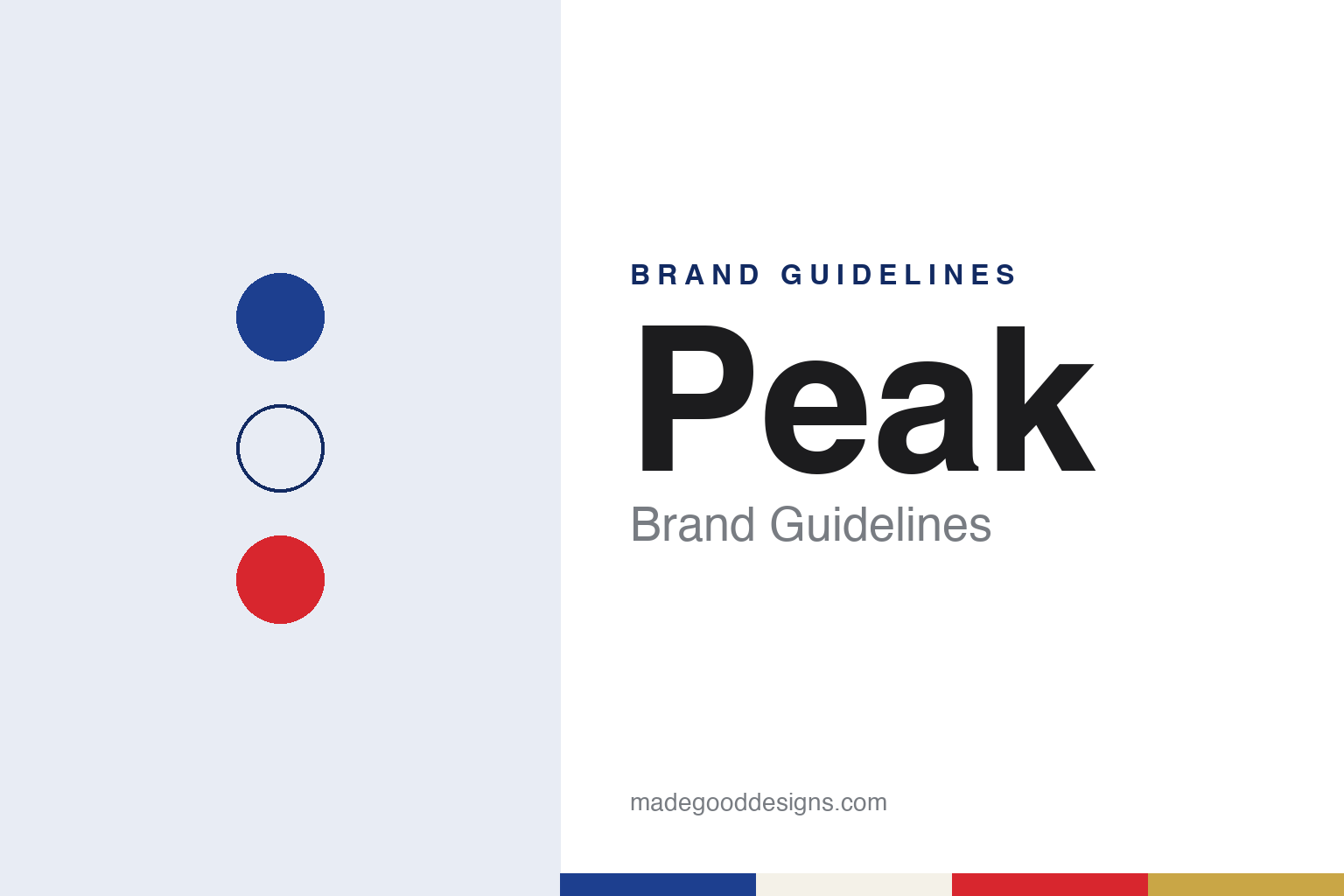
Two constants: a Peak blue, milk cream and tin red palette and a bold geometric sans register. Abstract homage — not a Peak product or mark; no tin, logo or pack is reproduced.
A Dutch milk in a Nigerian tin
From 1954 to a Lagos factory.
Peak is the milk brand of FrieslandCampina WAMCO Nigeria PLC, and the company dates the brand’s arrival on the Nigerian market to 1954. Its own brand profile says Peak was “introduced into the Nigerian market in 1954” and that it pioneered the local manufacture of evaporated milk in Nigeria. The Dutch parent said the same in a June 2015 press release, describing FrieslandCampina WAMCO as “a key player in Nigeria since 1954” and Peak as a brand that “enjoys iconic status in Nigeria.”
The parent is Royal FrieslandCampina of Amersfoort in the Netherlands, a dairy cooperative owned by member farmers. English Wikipedia says it was formed by the merger of Friesland Foods and Campina, completed on 30 December 2008; the company traces its own roots to 1871. Dutch Wikipedia says Friesland Foods, itself the product of a 1997 merger of four Dutch dairy cooperatives, already sold milk abroad under the Peak name, including in West Africa.
Peak is made in Nigeria. A FrieslandCampina page on its Nigerian business, archived at the end of 2010, put its production location in Lagos, at the Ikeja Industrial Estate in Ogba, and said the raw materials were “largely imported from the Netherlands” as milk powder and processed locally into finished products. A 2014 version of the company’s description of the Nigerian unit said the same, and called the business a collaboration between Royal FrieslandCampina and local partners. The 2010 page added a line that sums up how the company sees the brand: “For millions of Nigerians, Peak is milk and milk is Peak.”
Colour
Tins, sachets and a long run of campaigns.
The defining Peak product is evaporated milk in a tin, joined by full-cream milk powder. FrieslandCampina’s descriptions from 2010 and 2014 stress pack size as much as product: because dairy is a relatively expensive purchase for many Nigerians, the company said, Peak was also sold in smaller tins and in sachets. A 2014 FrieslandCampina story explained the thinking. Once opened, a tin of evaporated milk needs refrigeration, and a tin held more than one cup of tea or coffee needs, so the company introduced a sachet holding exactly enough for one cup. It described evaporated milk in sachets as “a technological breakthrough,” and said the sachets were made at the Lagos plant. Alongside Peak, the Nigerian company sells Three Crowns, which FrieslandCampina described in 2014 as a second dairy brand aimed at lower-income households, and the 2015 release also named Friso.
Peak’s own timeline on its website lists the brand’s extensions and campaigns year by year. It records the launch of Peak Gold and the brand’s 50th anniversary in 2005, the “It’s in YOU” campaign in 2007, Peak Chocolate in 2008, a small 35-gram evaporated pack in 2009, Peak UHT milk in 2013, a recipe campaign called PECADOMO in 2016, a heritage campaign and the “Peak Unstoppable” launch in 2017, Peak Yoghurt in 2019, and a #PeakBreakfast campaign in 2019 and 2022. The 60th anniversary was marked with a ceremony on 23 May 2015, FrieslandCampina reported that week, and the brand’s anniversary advertising featured the singer Yemi Alade, according to the Peak timeline.
The line that runs across the brand today is “Reach for your Peak.” The company says Peak has backed the Super Eagles, Nigeria’s national football team, as well as Nigerian Paralympians, and more recently a campaign called Unstoppable Humans of Change, which profiles Nigerians doing social work.
Typography
Design and documentation.
The seven brands in this group all make food, and all of them come from Nigeria, Kenya or Egypt: Peak, Golden Morn, Dangote, Ketepa, Juhayna, Edita and Domty. Food brands from these countries in general sit at many different points in the trade, from family firms that still carry a founder’s surname to names that now belong to much larger food groups, and a single brand can be sold everywhere from a roadside kiosk to a supermarket shelf.
A food brand’s identity is usually carried less by a single product than by a pack, a name and the meal or snack it promises, because the company behind the name may have changed hands, moved its factory or grown far beyond the town where it started. That makes the questions behind each name worth asking plainly: who started it, who owns it now, and where its food is actually made and packed.
Each guide separates what independent sources record from what the company says about itself — its founding story, its owners over time, where its products are made and how its packaging has changed — and marks plainly what rests only on the company’s own word.
Aa
A bold geometric sans for a tin that sits on breakfast tables across Nigeria. (Specimen set in Montserrat, a sans STAND-IN; NOT the Peak logo.)
Peak
A listed Nigerian company, a Dutch majority and a new pack.
FrieslandCampina WAMCO is a Nigerian public company with a Dutch majority owner. In June 2015, Royal FrieslandCampina announced that it had raised its stake in the Nigerian company from 54.58% to 67.61%, buying 13.03% of the shares in a transaction executed on the NASD over-the-counter trading platform, and said Nigeria’s Securities and Exchange Commission had been informed. Its chief executive, Roelof Joosten, cited the size of the Nigerian market and its growth outlook as reasons to keep investing.
The company has since worked to put more Nigerian milk into the supply chain. Its Peak website says the brand runs a dairy development programme with Nigerian farmers, describes a “Grass to Glass” chain from farm to factory, and says it works with dairy farmers across 90 farming communities. English Wikipedia’s article on Shonga Farms, a Nigerian farm, says it supplies raw milk to WAMCO. FrieslandCampina announced in September 2020 that FrieslandCampina WAMCO had completed the purchase of Nutricima’s dairy business, and in October 2020 that it had opened its first centre of expertise for dairy development in Nigeria.
The latest visible change is to the pack. In 2023 Peak introduced what it calls a new pack design framework. The brand says on its website that consumers had told it its visual identity “had started to feel a little old,” and that the new framework keeps the brand’s heritage while adding a set of distinctive visual assets meant to make Peak recognisable across product types and occasions. The company has not published the colours or typefaces behind that system.
For a design guide, Peak shows how a tin and a sachet sized for one cup of tea can make an imported dairy name feel local for seventy years. Compare Golden Morn, Nestlé’s Nigerian breakfast cereal, and Vinamilk, the Vietnamese dairy known for its condensed milk. For this guide we use a Peak blue, milk cream and a tin red with a bold geometric sans, an unofficial interpretation; no product or logo is reproduced.
Explore & save
Keep Peak’s identity on hand — save it to a board in the Made Good inspiration library.
Peak identity set
Pin the Peak blue, milk cream and tin red palette and the bold geometric sans register to your own board.