Dangote Brand Guidelines
The Lagos trader who made sugar a household name.
Aa
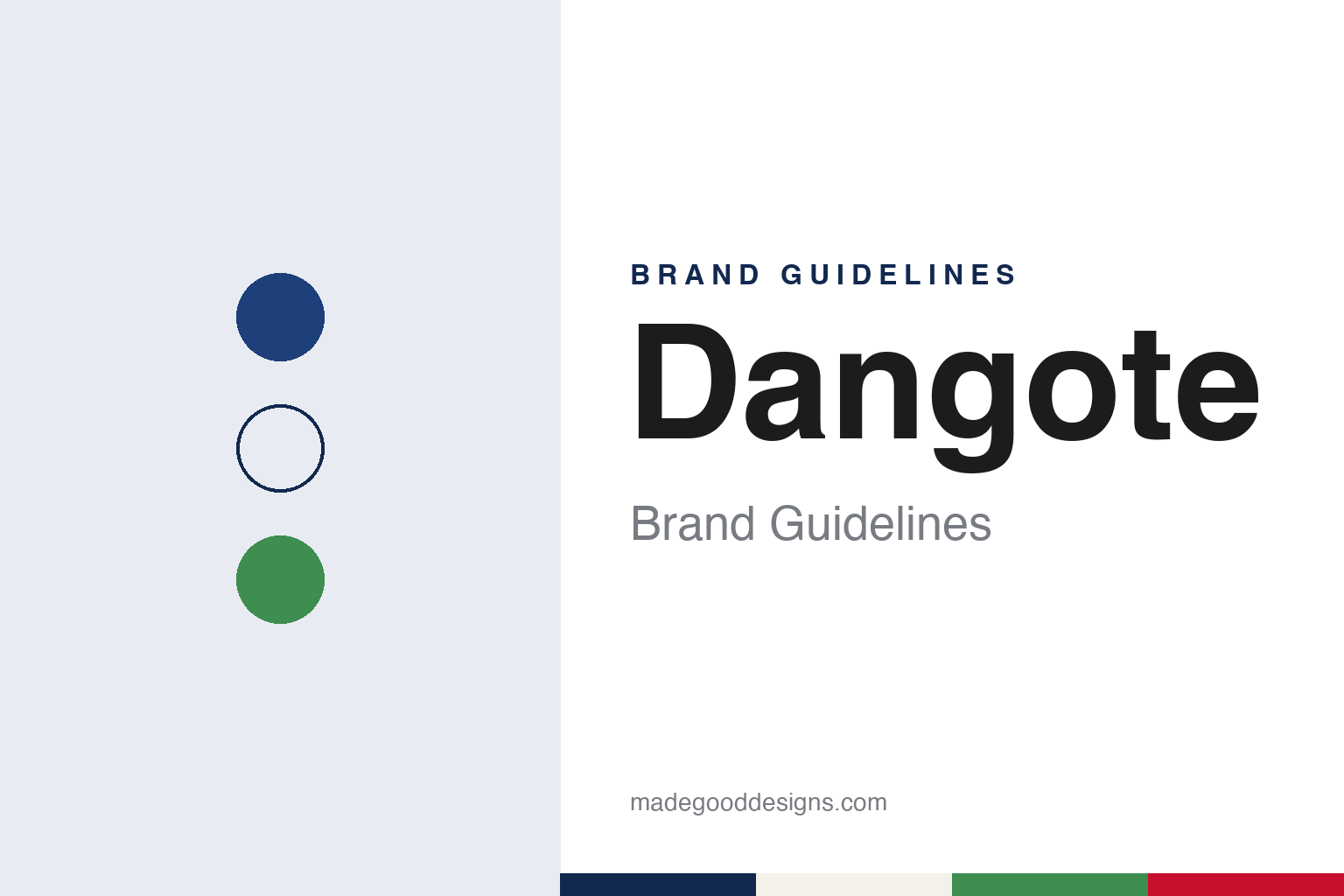
Two constants: a refinery blue, granule white and cane green palette and a sturdy industrial sans register. Abstract homage — not a Dangote product or mark; no pack, logo or product is reproduced.
From trading to refining
A Kano trader, import licences and bulk sugar.
The Dangote name on a bag of sugar or a pack of salt in a Nigerian kitchen goes back to a trading business, not a factory. English Wikipedia says Aliko Dangote started his first venture in Kano in 1977, with a loan from an uncle, and that he first traded in food products; the company itself says he began his business career in 1978, trading in rice, sugar and cement. In 1981, Wikipedia says, he set up two businesses, Dangote Nigeria Limited and Blue Star Services, which imported rice and bulk materials. The group gives 1981 as its founding year, and the English Wikipedia article on the Dangote Group, citing a 2021 allAfrica report, says it began in May 1981 as a trading enterprise importing sugar, cement, rice and other consumer goods for the Nigerian market.
That was an era, Wikipedia notes, when import licences were needed to bring bulk commodities into Nigeria. Citing Corporate Nigeria, a 2006 publication of the Nigerian Investment Promotion Commission, it says that when the licence system ended in 1986, the firm concentrated on bulk imports of salt, sugar and rice and gradually scaled back its cement business.
The move from importing to making came later. The company’s own timeline lists 1992 as its entry into manufacturing, naming textiles and sugar. English Wikipedia, citing the same 2006 publication, says that from 1997, after the textile sector declined, the group focused on making the consumer goods it had been importing, including refined sugar and flour, in competition with imported sugar from Brazil and Europe. A 2015 ThisDay interview cited by Wikipedia says local sugar production began in 1999, and that the push to make more at home led the group into pasta and into flour milling to supply it. Today the group is Dangote Industries Limited, headquartered in Lagos, and it says it has been building since 1981.
Colour
Apapa, a dedicated jetty and four pack sizes.
The best-known food brand in the group is Dangote Sugar, made by Dangote Sugar Refinery Plc, which the parent company calls a household name in Nigerian food and beverages and lists among its quoted companies. According to the refinery’s own website, as archived in 2018, the sugar refinery at the Apapa Wharf port complex in Lagos was commissioned in 2000 with an initial refining capacity of 600,000 tonnes a year, and with its own jetty for berthing large shipments of raw sugar from Brazil. The company said two major upgrades on the same site had raised its refining capacity to 1.44 million tonnes a year, and that the plant generated 16 megawatts of its own power from gas or fuel oil.
On those archived pages the company described its business in plain terms: refining raw sugar into Vitamin A fortified and non-fortified granulated white sugar, and selling its refined grades in 50kg, 1kg, 500g and 250g packages. It said warehouses across the country were served by more than 400 trucks, and in its 2016 business overview it listed among its strengths an “iconic Nigerian consumer brand” and the largest distribution network in Nigeria. Dangote Sugar was also named the largest sugar refiner in sub-Saharan Africa by Ventures Africa in 2015, as cited by English Wikipedia.
The company’s stated aim, in the same 2016 overview, was to move from port-based refining to fully integrated sugar production in Nigeria, growing its own cane on more than 150,000 hectares. Its vehicle for that is Savannah Sugar Company, a cane-growing and milling subsidiary at Numan, in north-eastern Nigeria. In July 2020 Dangote Sugar Refinery’s shareholders approved a merger with Savannah Sugar at an extraordinary general meeting, the company announced, a vote also reported by ThisDay and BusinessDay. The company said the merger formed the next stage of its backward integration plan.
Typography
Design and documentation.
The seven brands in this group all make food, and all of them come from Nigeria, Kenya or Egypt: Peak, Golden Morn, Dangote, Ketepa, Juhayna, Edita and Domty. Food brands from these countries in general sit at many different points in the trade, from family firms that still carry a founder’s surname to names that now belong to much larger food groups, and a single brand can be sold everywhere from a roadside kiosk to a supermarket shelf.
A food brand’s identity is usually carried less by a single product than by a pack, a name and the meal or snack it promises, because the company behind the name may have changed hands, moved its factory or grown far beyond the town where it started. That makes the questions behind each name worth asking plainly: who started it, who owns it now, and where its food is actually made and packed.
Each guide separates what independent sources record from what the company says about itself — its founding story, its owners over time, where its products are made and how its packaging has changed — and marks plainly what rests only on the company’s own word.
Aa
A sturdy industrial sans for a brand that grew out of bulk trading. (Specimen set in Archivo, a sans STAND-IN; NOT the Dangote logo.)
Dangote
Salt, seasoning, flour and a name on every pack.
Sugar is not the only Dangote staple. The group’s salt business is NASCON Allied Industries, which the parent company describes as a member of the Dangote Group and a leading player in salt in Nigeria, with a presence throughout the country; like Dangote Sugar, it is one of the group’s listed companies. A list of the group’s Nigerian businesses on its website, archived in 2019 and cited by English Wikipedia, included Dangote Sugar, Dangote Pasta, NASCON, Dangote Classic Seasoning and Savannah Sugar alongside non-food firms in logistics, packaging and property. The group also names an affiliate, Dangote Rice Limited, whose stated aim is to make Nigeria self-sufficient in rice.
Flour has been a more changeable part of the story. English Wikipedia’s article on the South African food company Tiger Brands says it bought a 65.7% stake in Dangote Flour Mills in October 2012, when the business was Nigeria’s second-largest miller, and sold it back to Dangote in 2015. The Dangote Group’s own website later said the flour business had been turned round and sold, crediting Halima Dangote, an executive director, with leading that work, without giving a date.
Across all of these businesses the brand is the founder’s surname, used for sugar, salt, seasoning and pasta as well as for cement and fuel. The group’s other ventures now include Dangote Cement, which Wikipedia calls the largest cement producer in Africa, and the Dangote Refinery near Lagos, inaugurated in May 2023.
For a design guide, Dangote shows how a single family name can stretch from a 1kg sugar pack to an industrial group without changing. Compare Tate & Lyle, the London cane-sugar refiner, and Peak Milk, another Nigerian kitchen staple. For this guide we use refinery blue, granule white and cane green with a sturdy sans, an unofficial interpretation; no product or logo is reproduced.
Explore & save
Keep Dangote’s identity on hand — save it to a board in the Made Good inspiration library.
Dangote identity set
Pin the Dangote refinery blue, granule white and cane green palette and the sturdy industrial sans register to your own board.