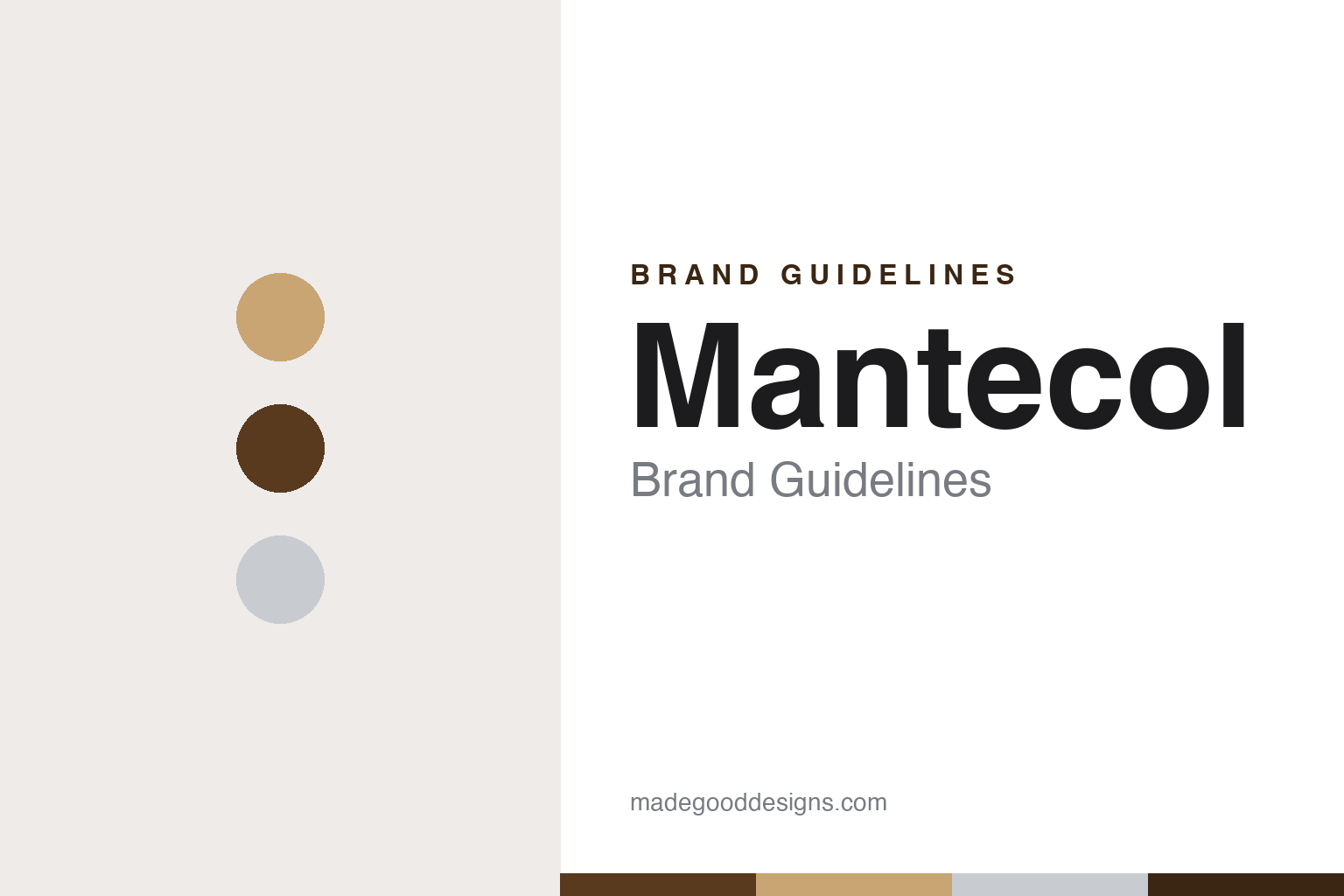
Mantecol Brand Guidelines
The peanut take on halva that Argentina eats at Christmas.
Aa
Two constants: a Mantecol foil, peanut and cocoa palette and a warm display serif register. Abstract homage — not a Mantecol product or mark; no pack, logo or wrapper is reproduced.
A Halva From Peanuts
A pastry student from Chios and a house in Floresta.
Mantecol is an Argentine peanut nougat, a semi-soft bar that Spanish Wikipedia describes as a kind of turrón whose recipe adapts Greek halva. The story of its maker, as Forbes Argentina told it in July 2022, begins with Miguel Georgalos, an immigrant from the Greek island of Chios who had been studying pastry-making in Poland and sailed for South America a month before the German occupation, reaching the port of Buenos Aires in September 1939.
Halva is made from sesame paste. Unable to get the original raw material, Forbes Argentina reported, Georgalos tried peanuts instead, after an attempt with garrapiñada, the sugar-roasted nuts sold on Argentine streets. The result went on sale in 1940, made and sold from the family’s house in the Buenos Aires neighbourhood of Floresta. The name came from a neighbour: the dessert was sold wrapped in aluminium foil, and she remarked that it looked like a block of butter, manteca in Spanish. Spanish Wikipedia gives the same 1940 date and the same halva origin, and says the recipe kept a smaller share of sesame alongside the peanut.
The business grew from there. The family bought the old ground of the football club All Boys, across the street from the house, and built its first plant on it, trading first as La Greco Argentina and later as Georgalos Hnos. In the late 1950s, Forbes Argentina reported, the family looked for land in the province of Córdoba to grow its own peanuts and settled on Río Segundo, which became the company’s base. Spanish Wikipedia adds that Mantecol reached export markets in the 1980s, with shipments to the United States.
Colour
Anteojito’s back cover and a foil-wrapped bar.
Mantecol’s best-remembered advertising came through a friendship. Miguel Georgalos knew Manuel García Ferré, the cartoonist who created the children’s magazine Anteojito, and for years, Forbes Argentina reported, García Ferré gave the company the magazine’s back cover. That partnership produced the brand’s historic jingle, “Por la vida contento voy, saboreando el rico Mantecol” — roughly, “through life I go happy, tasting delicious Mantecol.” Spanish Wikipedia adds that an advertisement paired Mantecol with the character Anteojito himself, and that García Ferré created a “Bandita Mantecol,” a Mantecol band, for the brand.
The product has kept a recognisable form. Spanish Wikipedia, citing the pack, describes the most common format as a bar about ten centimetres long, sealed in vinylised aluminium foil — the same kind of foil wrapping that, in the Forbes Argentina account, gave the brand its name in Floresta. It describes the texture as slightly hard, crunchy and spongy, with a glazed or marbled look: darker veins running through a lighter mass.
Mantecol is sold as a sweet all year, but Spanish Wikipedia notes that it is eaten most between December and February, as part of the Christmas table, and Forbes Argentina called it a fixture of Argentine tables at the year-end holidays. BAE Negocios wrote in 2022 that Mantecol had become a generic name. That standing is one reason its ownership mattered to the family that invented it, and why its return to that family in 2022 was covered by Forbes Argentina, BAE Negocios, Cadena 3 and Clarín.
Typography
Design and documentation.
The seven brands in this group are all food and drink brands, and all of them come from Argentina or Brazil: Quilmes, SanCor, La Serenísima, Terrabusi, Mantecol, Fargo and Piraquê. Food and drink brands in these two countries in general sit at many different points in the trade, from family firms that still carry a founder’s surname to names that now belong to much larger food groups, and a single brand can be sold everywhere from a corner shop to a supermarket shelf.
A food or drink brand’s identity is usually carried less by a single product than by a pack, a name and the meal or snack it promises, because the company behind the name may have changed hands, moved its factory or grown far beyond the town where it started. That makes the questions behind each name worth asking plainly: who started it, who owns it now, and where its products are actually made and packed.
Each guide separates what independent sources record from what the company says about itself — its founding story, its owners over time, where its products are made and how its packaging has changed — and marks plainly what rests only on the company’s own word.
Aa
A warm display serif for a foil-wrapped classic. (Specimen set in Fraunces, a serif STAND-IN; NOT the Mantecol logo.)
Mantecol
Sold in 2001, bought back in 2022.
In January 2001 Georgalos sold the Mantecol brand to Cadbury Stani, the Argentine business of the British confectioner Cadbury. Forbes Argentina reported that the sale was made so the company could pay down much of the debt it had built up and raise capital for new products, and that it kept Georgalos out of the peanut-dessert market for seven years. Cadena 3 reported that Mantecol then made up about 35 per cent of the company’s turnover, and quoted the Georgalos executive Guillermo Rimoldi on the sale: “We cut off our right arm, and we were right-handed.” When the seven years were up, Georgalos launched its own peanut dessert, Nucrem, in 2008.
Cadbury itself changed hands. Kraft Foods bought Cadbury in 2010, and when Kraft split in 2012 its global snacks business became Mondelēz International, the owner of Mantecol for the next decade. Forbes Argentina put the brand’s time in multinational hands at 21 years.
In July 2022 Georgalos bought it back. BAE Negocios reported on 8 July that talks with Mondelez had been kept secret for months, and that the deal also took in the brands Bazooka, Palitos de la Selva, Lengüetazo and Jirafa, and Mondelez’s plant in Victoria, in Buenos Aires province, where Mantecol is made; BAE Negocios added that Mondelez was not leaving Argentina. Forbes Argentina reported that Georgalos would take on the roughly 600 people who worked at the plant, which Spanish Wikipedia identifies as the former Stani factory. Georgalos’s president told Cadena 3 that the only difference between the Mantecol it bought back and the original formula was cocoa added under the previous owner, and that the idea was to keep that difference.
For a design guide, Mantecol shows how a name taken from a wrapper — foil that looked like butter — can carry a product for more than eighty years and through two decades of foreign ownership. Compare Terrabusi, an Argentine biscuit name in Mondelēz’s portfolio, and Cacau Show, a Latin American confectionery brand built in Brazil. For this guide we use foil silver, peanut tan and a cocoa-vein brown with a warm serif, an unofficial interpretation; no product or logo is reproduced.
Explore & save
Keep Mantecol’s identity on hand — save it to a board in the Made Good inspiration library.
Mantecol identity set
Pin the Mantecol foil, peanut and cocoa palette and the warm display serif register to your own board.