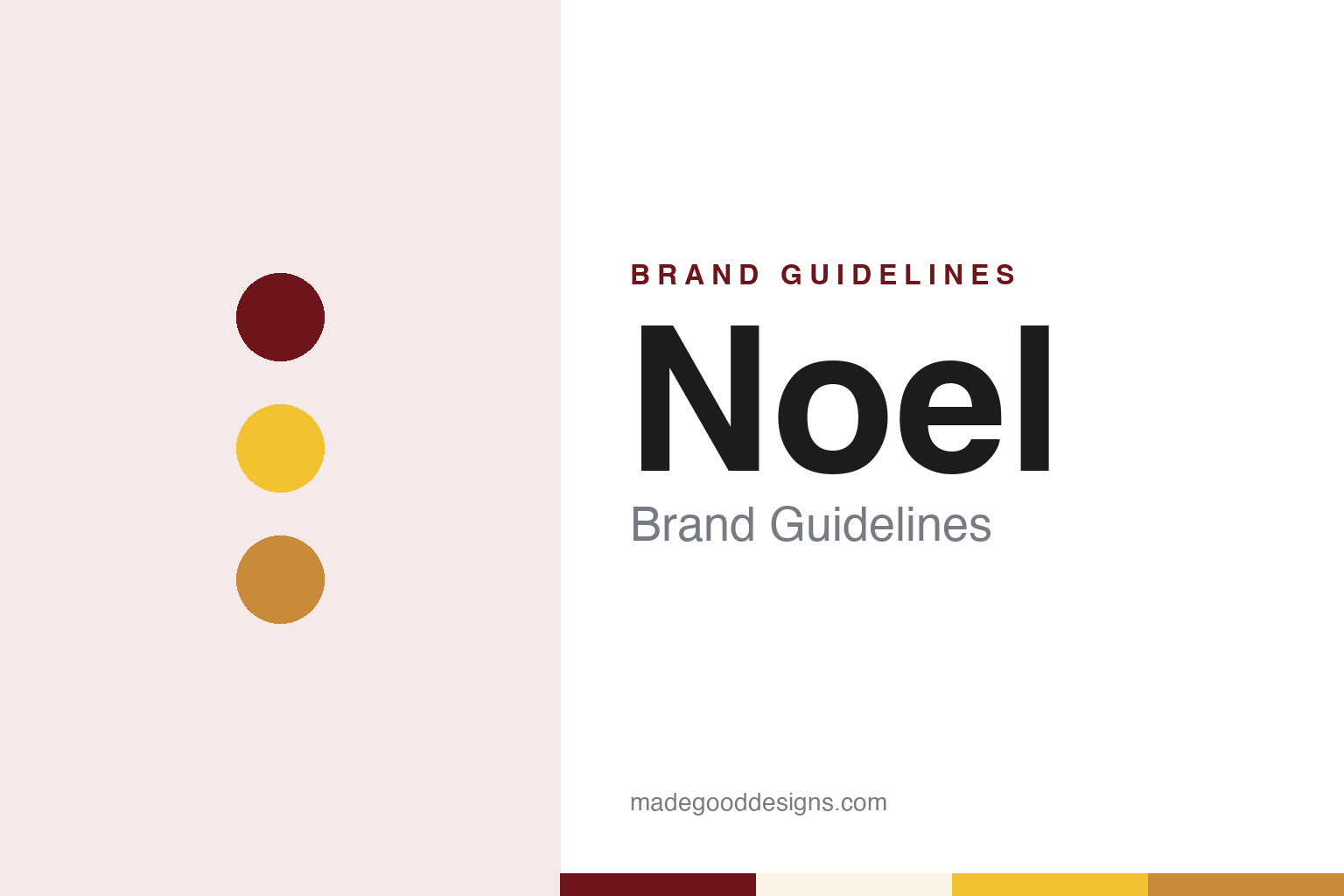
Noel Brand Guidelines
Medellín’s biscuit maker, named by a public contest.
Aa
Two constants: a Christmas red, star yellow and biscuit gold palette and a warm festive serif register. Abstract homage — not a Noel product or mark; no pack, logo or biscuit is reproduced.
Medellín, 1916
A biscuit and sweet factory that let the public choose its name.
Noel began in Medellín in 1916. The company’s own history says it was founded that year as the Fábrica Nacional de Galletas y Confites, a biscuit and confectionery maker with 17 employees, and that its first products included Suizas and Marías biscuits and the first goods packed specially for Christmas. By 1918, it says, it had opened shops in Bogotá, Medellín, Manizales, Barranquilla and Cali. Spanish Wikipedia’s article on Grupo Nutresa also gives 1916, and the company marked its centenary with a press event in Medellín in January 2016.
The name came from the public. In 1924, the company says, it held a public contest to rename the firm, and the winning entry, Noel, was submitted by Marcelina Ospina de Restrepo. The Noel trademark was registered in 1925, and the company took the name Fábrica de Galletas y Confites NOEL in 1932, according to its timeline; Spanish Wikipedia dates the change to 1925. Later names followed: Industrias Alimenticias Noel in 1965 and Compañía de Galletas Noel in 1999.
The early 1930s produced two lasting products. The company says Sultana Noel was launched for Christmas in 1932 and that its saltines, the crackers of the “yellow star,” were born the same year; they were renamed Saltín Noel in 1987. Around the same time Noel merged with the confectioner Dux, and the Compañía Nacional de Chocolates became a shareholder; El Colombiano reported in 2024 that the chocolate company bought in during 1933 by contributing machinery for sweets and Dux biscuits. Frunas fruit sweets followed in 1944, Festival biscuits in 1955 and Ducales in 1981, the company says.
Colour
Tins, rolls and a Christmas show.
Much of Noel’s visual history is packaging. For decades its biscuits were sold in tins; the company’s timeline mentions sealing tinplate tins with adhesive tape to keep the biscuits fresh around 1960, and the El Colombiano writer Ferney Arias Jiménez recalled in 2024 that saltines once came in metal tins that families reused to store rice, maize or shoe polish. In 1975, the company says, it moved from the tin to flexible packaging. In 1990 it introduced a cracker pack it calls the Taco Noel, followed by the Tritaco in 2000 and the lower-cost Taco Día in 2006.
Tins did not disappear. In 1995 Noel set up Litoempaques, a tinplate lithography business that makes decorative tins, according to its history. For the centenary in 2016 it released collectible tins of Saltín Noel, Ducales and Sultana, chosen by consumers, which the company said brought back the advertising history of those brands.
The name also gives Noel a season. Christmas packs go back to 1917, the company says, and in 1988 it staged its first Christmas display in Medellín, “Un Arreglo Navideño,” which won the city tourism office’s Pino de Oro award for the best company façade. From then on Papá Noel became the star of a yearly show, today the Espectáculo de Navidad Noel; the company’s archive describes productions in the 1990s with several stages and dozens of performers. In 2005, the company says, a character called Papá Noel Galletero, a biscuit-making Father Christmas, joined the brand, and in 2007 it opened Mundo Noel, a learning space where children play and learn around biscuits.
Typography
Design and documentation.
The seven brands in this group all make food or drink, and they come from five countries: Alicorp, Noel, Postobón, Guaraná Antarctica, La Costeña, Crown and Maeil, from Peru, Colombia, Brazil, Mexico and South Korea. Food and drink brands in general sit at many different points in the trade, from family firms that still carry a founder’s name to names that now belong to much larger groups, and a single brand can be sold everywhere from a corner shop to a supermarket shelf.
A food or drink brand’s identity is usually carried less by a single product than by a pack, a name and the everyday meal or treat it promises, because the company behind the name may have changed hands, moved its factory or grown far beyond the town where it started. That makes the questions behind each name worth asking plainly: who started it, who owns it now, and where its products are actually made and packed.
Each guide separates what independent sources record from what the company says about itself — its founding story, its owners over time, where its products are made and how its packaging has changed — and marks plainly what rests only on the company’s own word.
Aa
A warm festive serif for a biscuit maker named after Christmas. (Specimen set in Fraunces, a serif STAND-IN; NOT the Noel logo.)
Noel
From a chocolate maker’s partner to the Nutresa biscuit business.
Noel has been tied to the Compañía Nacional de Chocolates since the 1930s. In the early 1960s it bought the meat processor Productos Zenú, Spanish Wikipedia says, a business later separated from the biscuits; in 1978 Noel took part in creating the Grupo Empresarial Antioqueño, the company says. In 1999 the French group Danone took a 30% stake, which Noel bought back in 2005, according to the company’s history. In 2003 Noel and the Compañía Nacional de Chocolates were combined under a new holding company, which was renamed Grupo Nacional de Chocolates in 2006 and Grupo Nutresa in March 2011, Spanish Wikipedia says. Noel belongs to Nutresa’s biscuit business, which also includes Costa Rica’s Pozuelo, bought in 2006, and Abimar Foods in the United States, acquired in 2010 as Fehr Foods, the company said in 2016.
Control of Nutresa changed in February 2024, when the Gilinski family and the Abu Dhabi investment firm IHC Capital Holding took over through a share exchange that ended its cross-holdings with Sura and Argos, El Colombiano reported. Noel’s home plant has been in Medellín’s Guayabal district since 1964, the company says. At its centenary it said it held about 56% of the Colombian biscuit category by value and reached 98% of Colombian households, citing Kantar Worldpanel and Nielsen. The Colombian company is unrelated to Noel, the Argentine food and sweets brand that Spanish Wikipedia says belongs to the Arcor group.
For a design guide, Noel shows how a name chosen by public contest, a yellow-star cracker and a Christmas show can carry one biscuit maker through more than a century. Compare Gamesa, the Monterrey biscuit maker, and Goya, the US food company that Noel says received its first export order in 1985. For this guide we use a Christmas red, a star yellow and a biscuit gold with a warm serif, an unofficial interpretation; no product or logo is reproduced.
Explore & save
Keep Noel’s identity on hand — save it to a board in the Made Good inspiration library.
Noel identity set
Pin the Noel Christmas red, star yellow and biscuit gold palette and the warm festive serif register to your own board.