Postobón Brand Guidelines
The Medellín soda maker behind Manzana Postobón and Colombiana.
Aa
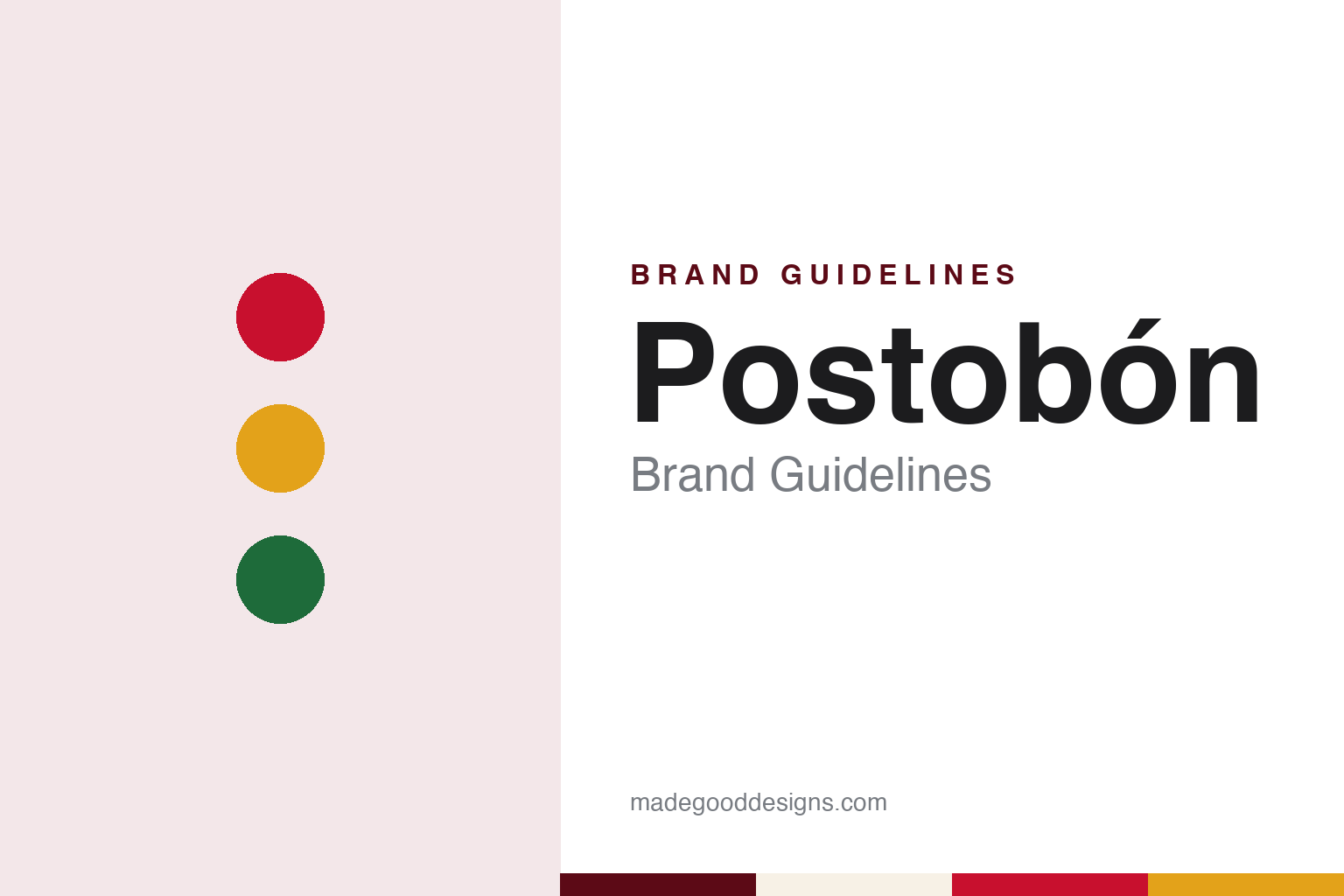
Two constants: an apple red, kola amber and valley green palette and a bold grotesque sans register. Abstract homage — not a Postobón product or mark; no bottle, label or logo is reproduced.
Posada & Tobón
A drugstore owner, his young employee and a kola.
Postobón began in Medellín on 11 October 1904, when Gabriel Posada and Valerio Tobón formed the partnership Posada & Tobón to make soft drinks. The company name is a contraction of the two surnames, English Wikipedia notes. In the company’s own telling, Tobón was a young man from Guarne, in Antioquia, who worked in a drugstore owned by Posada, and the pair started with a thousand pesos and a small factory on the corner of the Colombia and Sucre streets in the centre of the city.
Their first drink was Kola-Champaña, which the company credits to Tobón himself. Spanish Wikipedia says it became popular in commercial and family circles; the company lists the bars, clubs, homes, hotels and dances where it was served. Distribution was the problem. The company says its drinks first travelled on foot, by mule and in wooden carts, and Colombia’s mountainous geography meant one factory could not serve the country, so in 1906 Posada & Tobón opened branches in Manizales and Cali.
New products followed. In 1917 the company launched Agua Cristal, a bottled water that it says was filtered and treated with ultraviolet light and sold under the slogan “Agua absolutamente pura e higiénica.” In 1918 came Bretaña, a carbonated water sold as a mixer, and with it, the company says, the crown cap. It also says that in 1924 its Freskola drink won a gold medal at an international exhibition in Rome.
Growth came through alliances with rivals. The company says Posada & Tobón reached commercial pacts with Gaseosas Colombiana and Gaseosas Lux under which the Postobón, Colombiana and Lux brands could be made in any of the three firms’ plants, giving national coverage. Spanish Wikipedia dates the merger of Gaseosas La Colombiana with Posada & Tobón, forming Postobón, to 1951.
Colour
An apple soda, a cola champagne and a truck fleet.
The figure who shaped the modern company was Carlos Ardila Lülle, a civil engineer from Bucaramanga who, the company and Spanish Wikipedia agree, went to work at Gaseosas Lux in 1950. In 1968 Lux merged with Postobón and Ardila Lülle became president. Under him, the company says, Postobón brought together the main soft-drink firms in the country through acquisitions and mergers.
Two drinks have become its signatures. Manzana Postobón, an apple-flavoured soda, appeared in 1954, and the company says Ardila Lülle had a key part in developing it. Colombiana, a cola champagne, is the company’s most popular soda, English Wikipedia says. Other flavours in the Postobón line include grape, orange, pineapple and lemon.
The company also points to the road. It says that in the 1950s it began to assemble a fleet of trucks and vehicles for distribution, and that today the Postobón name painted on those vehicles is seen on city streets and rural roads across Colombia; it says it reaches 90 per cent of the national territory. Sport has been the other stage. English Wikipedia records that Postobón sponsored a professional cycling team from 1986, which rode the Tour de France that year and lasted ten years, that it has sponsored the football club Atlético Nacional since 1998, and that it has been an official sponsor of the Colombian football leagues since 2010.
The range widened from the 1960s. The company says it introduced diet sodas in 1962, which it describes as the first dedicated line of its kind in Latin America; launched Hit ready-to-drink juices in 1997; added the Squash sports drink in 1999; began distributing Gatorade in 2002; launched Mr. Tea in 2005 and the Peak energy drink in 2006; and in 2006 bought Productora de Jugos and its Tutti Frutti brand. Spanish Wikipedia adds that the Tutti Frutti deal included a fruit-pulping plant in Tuluá, in Valle del Cauca.
Typography
Design and documentation.
The seven brands in this group all make food or drink, and they come from five countries: Alicorp, Noel, Postobón, Guaraná Antarctica, La Costeña, Crown and Maeil, from Peru, Colombia, Brazil, Mexico and South Korea. Food and drink brands in general sit at many different points in the trade, from family firms that still carry a founder’s name to names that now belong to much larger groups, and a single brand can be sold everywhere from a corner shop to a supermarket shelf.
A food or drink brand’s identity is usually carried less by a single product than by a pack, a name and the everyday meal or treat it promises, because the company behind the name may have changed hands, moved its factory or grown far beyond the town where it started. That makes the questions behind each name worth asking plainly: who started it, who owns it now, and where its products are actually made and packed.
Each guide separates what independent sources record from what the company says about itself — its founding story, its owners over time, where its products are made and how its packaging has changed — and marks plainly what rests only on the company’s own word.
Aa
A bold grotesque sans for a soda name read off truck panels. (Specimen set in Archivo, a sans STAND-IN; NOT the Postobón logo.)
Postobón
Pepsi, beer and the Ardila Lülle group.
Postobón belongs to the Organización Ardila Lülle, the Medellín-based conglomerate that the company says was founded by Carlos Ardila Lülle in 1951 and today employs more than 40,000 people. The group’s other businesses include sugar mills, the broadcaster RCN, the football club Atlético Nacional and a maker of plastic bottles, according to the Postobón website and Spanish Wikipedia.
Since 1980 Postobón has bottled Pepsi under a contract with PepsiCo, which Spanish Wikipedia says is still in force. The two sources differ on 7 Up: Spanish Wikipedia dates the licence to 1980, while the company dates its 7UP franchise to 1999. Beer has come and gone. Spanish Wikipedia says the Ardila Lülle group entered brewing in 1995 with Cervecería Leona, a rivalry with Bavaria known as the “Guerra de las Polas,” before Bavaria took full control of Leona in 2004; in 2014 the group returned to beer in an alliance with Heineken and Chile’s Compañía Cervecerías Unidas, and in 2019 the Central Cervecera de Colombia began producing beer and malt.
Postobón makes its drinks in Colombia. Its “who we are” page lists 18 manufacturing plants and 53 distribution centres, while its presence page and Spanish Wikipedia give 19 plants, in cities including Bogotá, Barranquilla, Medellín, Pasto and Yumbo. The company describes the Yumbo plant, opened in 2009 in Valle del Cauca, as the largest and most modern drinks plant in the country. Since 2014, it says, it has followed a “multicategory” strategy that now takes in sauces, snacks and coffee as well as drinks.
For a design guide, Postobón shows how a regional bottler can turn a soda flavour, a fleet of trucks and a football shirt into one national signature. Compare Jumex, the Mexican juice and nectar maker, and Galletas Noel, another Medellín company. For this guide we use apple red, kola amber and valley green with a bold grotesque sans, an unofficial interpretation; no product or logo is reproduced.
Explore & save
Keep Postobón’s identity on hand — save it to a board in the Made Good inspiration library.
Postobón identity set
Pin the Postobón apple red, kola amber and valley green palette and the bold grotesque sans register to your own board.