La Costeña Brand Guidelines
The 1923 grocery whose pickled chiles became a canning group.
Aa
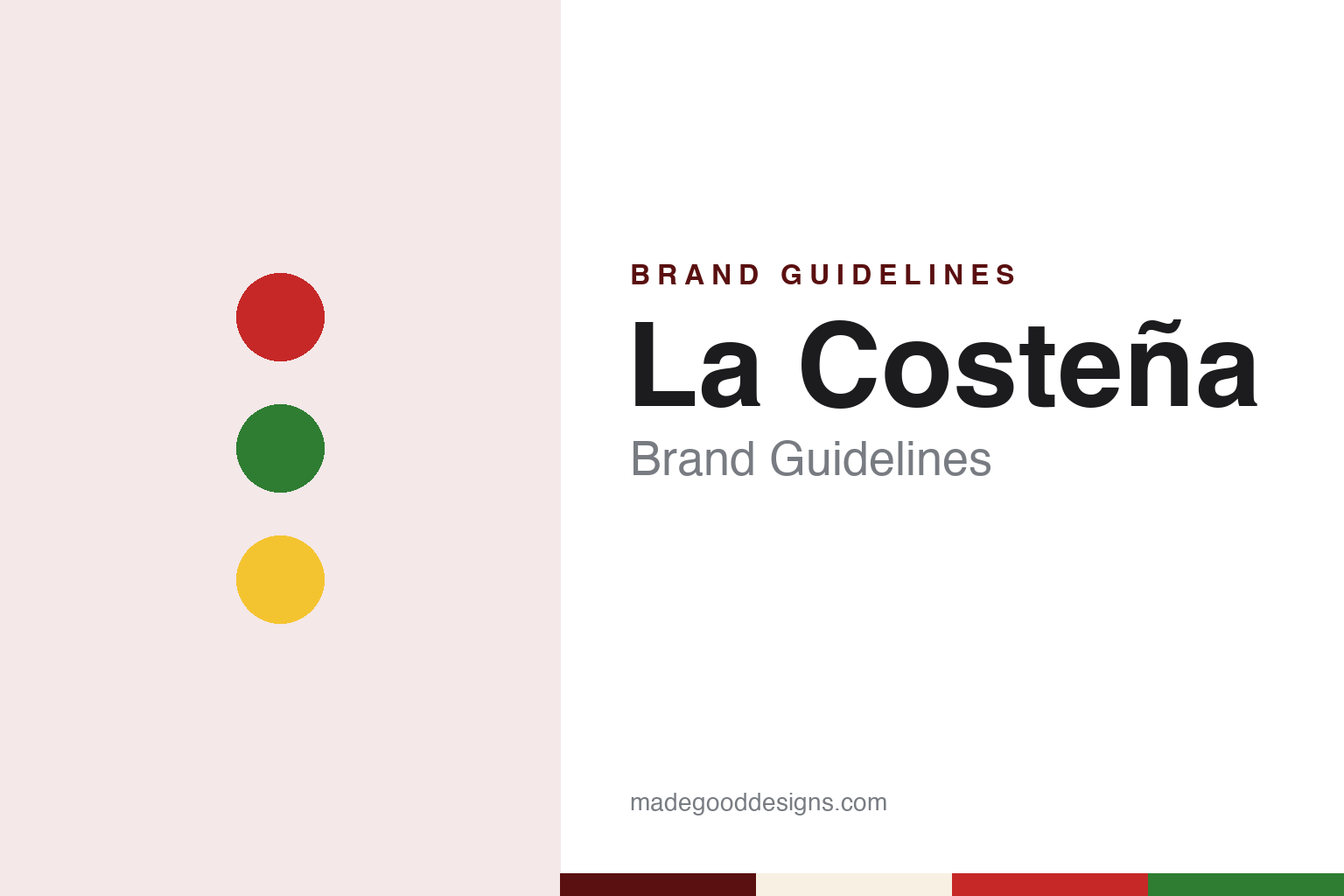
Two constants: a chile red, jalapeño green and corn yellow palette and a slab-serif shopfront register. Abstract homage — not a La Costeña product or mark; no can, label or logo is reproduced.
A grocery and a jar of chiles
Serrano chiles in vinegar, then cans of its own.
La Costeña dates its beginning to 1923. The company’s own history says that Vicente López Resines took over a grocery shop called “La Costeña”, and that the shop became popular for its serrano chiles in vinegar. English Wikipedia tells the story the same way, saying that López bought the little shop and began preparing chili peppers in vinegar there, though it spells his second surname “Recines”; the company spells it Resines, and that is the spelling used here. The business still trades as Conservas La Costeña — conservas being the Spanish word for preserved and canned foods — and the shop’s name became the brand on every can and jar.
The next step was packaging. The company says that between 1937 and 1948 López decided to make his own cans and opened its first production plant, in Mexico City. English Wikipedia gives 1937 as the year he set up his own container company and 1948 as the year a main factory of about 5,000 square metres was built in the capital, and says that in 1951 the company installed its first automatic production line, for three-kilogram cans. Making the container in-house is a thread that runs through the company’s own account of itself: later entries in its timeline are about seams, lids and cartons as much as about recipes.
From the 1950s the products travelled. The company says that between 1951 and 1971 its products reached the whole of Mexico for the first time, and that in that period a new plant opened in Ecatepec, in the State of Mexico, on the northern edge of the capital’s metropolitan area, which it describes as a 40-hectare site and its present home. English Wikipedia dates the move to Ecatepec to 1971. The company is still headquartered there, in the municipality of Ecatepec de Morelos.
Colour
Seams, lids, cartons and a second plant.
La Costeña’s timeline reads in part as a history of the can itself. Between 1986 and 1991, the company says, it replaced lead-soldered containers with cans closed by an electrostatic seam, a change it presents as an environmental measure, and opened a second plant in Guasave, in the north-western state of Sinaloa, for its tomato purée and vegetable lines. Between 1997 and 2003 it introduced easy-open lids and installed an aseptic Combibloc carton system at Guasave, and it says it gained ISO 9001:2000 certification in the same period. In 2007–2008 it opened an automated distribution centre that it calls one of the largest in Latin America, and a second distribution centre followed between 2011 and 2013.
The range grew well beyond the original pickled chiles. English Wikipedia lists jalapeños, serranos and chipotles, beans, tomato purée, ketchup, mayonnaise, vegetables, creams, soups, sauces and vinegar among its products. The chiles remain the brand’s calling card: the company’s website, in 2026, frames the brand around Mexican tradition and heat, under the line “¿Te atreves o te rajas?” — roughly, “Do you dare, or do you back down?” — and the statement that Mexico is understood through its stories, its traditions and its spice.
The brand has also been recognised as a mark. In 2014, the company says, the Mexican Institute of Industrial Property (IMPI), the country’s trademark office, declared La Costeña a “Marca Famosa” (famous brand),. Earlier, between 2011 and 2013, it received what it calls a national public-image award marking its 90-year history and its presence in more than 50 countries. In 2018 it marked its 95th anniversary with thanks to its employees and to consumers around the world.
Typography
Design and documentation.
The seven brands in this group all make food or drink, and they come from five countries: Alicorp, Noel, Postobón, Guaraná Antarctica, La Costeña, Crown and Maeil, from Peru, Colombia, Brazil, Mexico and South Korea. Food and drink brands in general sit at many different points in the trade, from family firms that still carry a founder’s name to names that now belong to much larger groups, and a single brand can be sold everywhere from a corner shop to a supermarket shelf.
A food or drink brand’s identity is usually carried less by a single product than by a pack, a name and the everyday meal or treat it promises, because the company behind the name may have changed hands, moved its factory or grown far beyond the town where it started. That makes the questions behind each name worth asking plainly: who started it, who owns it now, and where its products are actually made and packed.
Each guide separates what independent sources record from what the company says about itself — its founding story, its owners over time, where its products are made and how its packaging has changed — and marks plainly what rests only on the company’s own word.
Aa
A slab serif with the weight of a painted shop sign, for a brand named after a grocery. (Specimen set in Alfa Slab One, a slab-serif STAND-IN; NOT the La Costeña logo.)
La Costeña
Exports, and a Minnesota canner.
La Costeña reached the United States early. English Wikipedia dates its entry to the US market to 1975, and by 2010, it says, the company was exporting to 40 countries; the company’s own timeline speaks of a presence in more than 50 countries by its 90th anniversary.
In 2014 La Costeña became an American manufacturer as well as an exporter. That year, English Wikipedia says, citing the Minneapolis Star Tribune, it acquired Faribault Foods, a canning company in Faribault, Minnesota, founded in 1895. The deal brought La Costeña a set of US brands, which English Wikipedia lists as including S&W beans, Butter Kernel, Kuner’s, Mrs. Grimes, Pride and Chilliman. It also gave the Mexican company canning capacity north of the border, alongside its plants in Ecatepec and Guasave.
Its head office is still in Ecatepec, more than a century after López Resines took over the grocery. The brand’s story, as the company tells it, joins three things that a design guide can use: a named shop, a single pickled product that made it popular, and a long effort to control the container that carried the product to market — from the first cans of the 1930s and 1940s to easy-open lids and cartons.
For a design guide, La Costeña shows how the name of one neighbourhood grocery can carry a canning group from chiles in vinegar to a factory in Minnesota. Compare Herdez, the Mexican food group that began as a Monterrey distributor in 1914, and Valentina, the Guadalajara hot sauce. For this guide we use chile red, jalapeño green and corn yellow with a slab serif, an unofficial interpretation; no product or logo is reproduced.
Explore & save
Keep La Costeña’s identity on hand — save it to a board in the Made Good inspiration library.
La Costeña identity set
Pin the La Costeña chile red, jalapeño green and corn yellow palette and the slab-serif shopfront register to your own board.