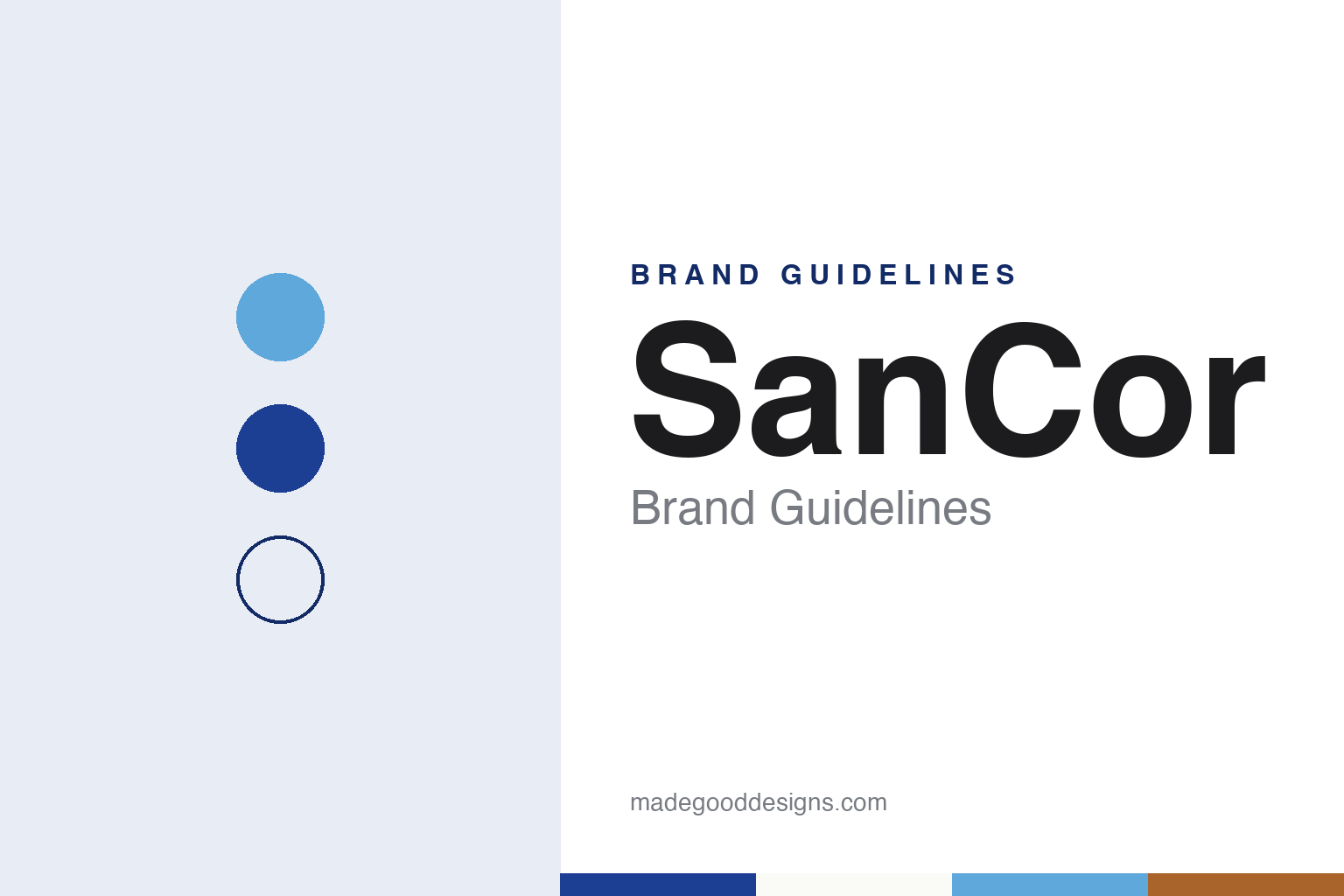
SanCor Brand Guidelines
Two provinces, one cooperative and two blue ovals.
Aa
Two constants: a celeste, cooperative blue and milk white palette and a bold dairy sans register. Abstract homage — not a SanCor product or mark; no pack, logo or oval is reproduced.
Santa Fe plus Córdoba
Dairy farmers on a provincial border join forces.
SanCor’s name is a map. Spanish Wikipedia says it is an acronym made from the first three letters of the two provinces where the business grew up, Santa Fe and Córdoba. The cooperative was formed by dairy farmers’ cooperatives in the farming country along the border between the two provinces, an area English Wikipedia calls Argentina’s “central milk basin.” Its full name was SanCor Cooperativas Unidas Limitada, “united cooperatives,” and Spanish Wikipedia describes it as a second-degree cooperative: a cooperative whose members were themselves cooperatives of farmers.
English Wikipedia dates the founding to 17 September 1938, in the town of Sunchales, in Santa Fe province, where the cooperative kept its head office. Its first plant, a butter factory, opened in Sunchales in 1940, both Wikipedias say. Butter made SanCor’s name. Spanish Wikipedia says a plant at Brinkmann, in north-eastern Córdoba, opened in 1943 and was fitted out specially for butter, and that the product took the company to international standards of quality. Production of dulce de leche, Argentina’s milk caramel, began the same year.
The cooperative then grew outward. Spanish Wikipedia says SanCor began exporting butter and dulce de leche in 1943, pasteurised milk in 1962, and yogurts and desserts in 1970. English Wikipedia says it opened an office in New York in 1953 to support its foreign trade, and branch offices in Buenos Aires and other Argentine cities from 1956. In 1986 it set up a Brazilian subsidiary, SanCor do Brasil, based in São Paulo. In 1994, according to English Wikipedia, it became the first Argentine cooperative to issue its own negotiable debt instruments. For decades, Spanish Wikipedia says, SanCor was the country’s leading dairy company, and English Wikipedia names La Serenísima as its main competitor.
Colour
Two ovals in two blues.
The SanCor mark is simple and well documented. Spanish Wikipedia describes the logo as two concentric ovals in two colours: light blue (celeste) on the outside and a darker blue on the inside, with the acronym SanCor written in white inside the inner oval.
The mark carried a broad range. English Wikipedia lists milk, powdered milk, cream, cheeses, butter and dulce de leche, sold under several brand names besides SanCor itself, among them Angelita, Granja Blanca and Chelita. Spanish Wikipedia lists the products as milk, yogurts, dulce de leche, desserts and other dairy foods. Some of those lines were made in partnership. In September 2004, English Wikipedia says, SanCor and Dairy Partners Americas Argentina formed a joint venture, owned in equal shares, to make and sell yogurts, fresh cheeses, desserts and flavoured milks in Argentina, with production split between the two partners’ plants; in 2009 SanCor bought the joint venture’s assets. Spanish Wikipedia says that in 2002 SanCor also partnered with Arla, the Scandinavian dairy cooperative, to process whey.
The cooperative’s plants were spread across its home basin. Spanish Wikipedia, citing the company’s own list of industrial sites, names six plants still operating in recent years: Devoto, in Córdoba, for cream and butter; Sunchales, for dulce de leche and long-life and flavoured milks; and cheese plants at San Guillermo, Gálvez, La Carlota and Balnearia. It lists about ten more sites that the cooperative had sold or closed during its crisis, among them the original butter plant at Brinkmann.
The cooperative structure shaped how SanCor was run. Spanish Wikipedia, citing a 2020 study published by the Universidad Nacional del Litoral, says its governance combined votes by member cooperative and by volume of milk, with a general assembly and a board made up of working dairy farmers.
Typography
Design and documentation.
The seven brands in this group are all food and drink brands, and all of them come from Argentina or Brazil: Quilmes, SanCor, La Serenísima, Terrabusi, Mantecol, Fargo and Piraquê. Food and drink brands in these two countries in general sit at many different points in the trade, from family firms that still carry a founder’s surname to names that now belong to much larger food groups, and a single brand can be sold everywhere from a corner shop to a supermarket shelf.
A food or drink brand’s identity is usually carried less by a single product than by a pack, a name and the meal or snack it promises, because the company behind the name may have changed hands, moved its factory or grown far beyond the town where it started. That makes the questions behind each name worth asking plainly: who started it, who owns it now, and where its products are actually made and packed.
Each guide separates what independent sources record from what the company says about itself — its founding story, its owners over time, where its products are made and how its packaging has changed — and marks plainly what rests only on the company’s own word.
Aa
A bold geometric sans for a mark built on two ovals. (Specimen set in Montserrat, a sans STAND-IN; NOT the SanCor logo.)
SanCor
Rescue, retrenchment and bankruptcy.
SanCor’s difficulties built up over two decades. English Wikipedia says the cooperative borrowed heavily in the 1990s to invest, ran into trouble when the dairy market turned in 1998, and was overwhelmed after Argentina’s economic collapse of 2001. In late 2006 it signed a letter of intent with Adecoagro, an agribusiness group in which George Soros held a stake, that would have given Adecoagro control, La Capital of Rosario reported in November 2006. Instead, on 11 December 2006, SanCor signed a loan agreement with Venezuela’s state development bank, BANDES, to be partly repaid in exports of powdered milk, so that it could stay a cooperative, La Capital reported. La Nación recalled in 2026 that the government of Néstor Kirchner had intervened to stop the Adecoagro deal.
A dairy crisis in 2016 started the steeper decline. In May 2016, Spanish Wikipedia says, citing Ámbito Financiero, SanCor sold its yogurt, flan and dessert line to the Santa Fe group Vicentin. Infobae reported in March 2017 that it had temporarily closed four plants and laid off 500 workers. In 2017 the national government agreed a rescue loan tied to a restructuring that concentrated production in fewer plants, La Nación and Clarín reported. In February 2019 SanCor signed over plants and brands it had sold to Adecoagro, La Nación reported; the paper later named the Las Tres Niñas brand among them. By May 2020, Córdoba’s La Voz reported, the cooperative was producing about a tenth of what it had made five years earlier.
The end came in 2026. La Nación reported on 16 April 2026 that SanCor, under court-supervised creditor protection since February 2025, had asked a judge in Rafaela to declare it bankrupt, saying the creditor process was no longer a viable way out of the crisis. The paper said the court had verified debts to about 1,500 creditors, that the cooperative had gone from processing about four million litres of milk a day to under 500,000, and that it had about 850 employees; Página/12 reported the same day that workers were owed eight months’ wages. Spanish Wikipedia, citing Clarín of 23 April 2026, says the Santa Fe courts then declared the bankruptcy.
For a design guide, SanCor shows how a farmers’ cooperative can carry its geography in its name and its identity in two blue ovals. Compare Amul, the Indian dairy cooperative founded in 1946, and La Serenísima, its long-time Argentine rival. For this guide we use celeste, a cooperative blue and milk white with a dulce de leche brown and a bold sans, an unofficial interpretation; no product or logo is reproduced.
Explore & save
Keep SanCor’s identity on hand — save it to a board in the Made Good inspiration library.
SanCor identity set
Pin the SanCor celeste, cooperative blue and milk white palette and the bold dairy sans register to your own board.