Amul Brand Guidelines
The Anand dairy co-op and its utterly butterly girl.
Aa
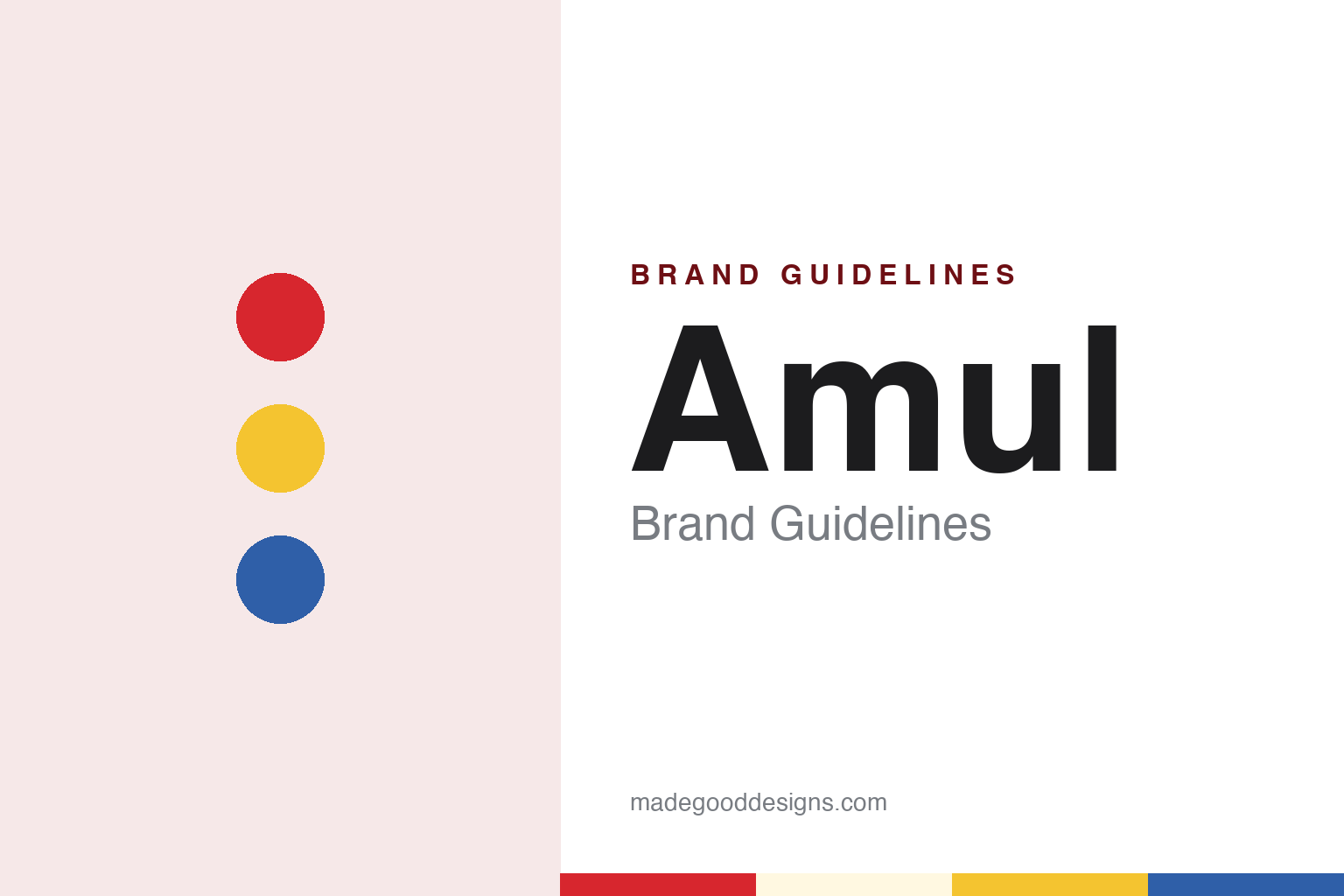
Two constants: a polka red, butter yellow and moppet blue palette and a rounded hand-painted sans register. Abstract homage — not an Amul product or mark; no pack, logo or mascot is reproduced.
The Kaira cooperative
Farmers, a monopoly and a union at Anand.
Amul is not a company in the usual sense but the brand of a farmers’ cooperative. Its story begins in Kaira district (now Kheda), in central Gujarat, in the 1940s. English Wikipedia, citing histories including Ruth Heredia’s The Amul India Story (1997), says small dairy farmers there sold their milk through traders and agents at prices set arbitrarily, while Polson held a near-monopoly on collecting Kaira’s milk and supplying it to Bombay. Led by Tribhuvandas Kishibhai Patel, the farmers approached the nationalist leader Vallabhbhai Patel, who advised them to form a cooperative and supply the government’s Bombay Milk Scheme directly; he sent Morarji Desai to help organise them.
After a meeting at Chaklasi, the farmers formed their union and stopped supplying Polson. It was registered on 14 December 1946 as the Kaira District Co-operative Milk Producers’ Union Limited, based at Anand, English Wikipedia says, citing the union’s own history. Collection was built from the village up: most members were marginal farmers who could deliver only a litre or two a day, so each village formed its own society. By June 1948 the union was pasteurising milk for the Bombay Milk Scheme. English Wikipedia says Tribhuvandas Patel served as its chairman until he retired in the 1970s.
In 1949 the government sent a young engineer, Verghese Kurien, to run its experimental creamery at Anand. English Wikipedia says he spent his evenings helping Tribhuvandas Patel fix the union’s dairy equipment and was persuaded to stay. Daily collection rose from about 200 litres in 1948 to 20,000 by 1952. With the dairy engineer H. M. Dalaya, the union developed a way of making skimmed milk powder from buffalo milk, which was plentiful in India while cow’s milk was in short supply. In a 2007 World Bank volume, Kurien called it the one technological breakthrough that revolutionised India’s organised dairy industry.
Colour
One brand, many unions, a national model.
The Kaira union held the name Amul from 1955, English Wikipedia says. Its method — village societies federated into a district union that owns the processing plant — became known as the Anand pattern, and it spread. Unions were set up in five more Gujarat districts, Mehsana, Banaskantha, Baroda, Sabarkantha and Surat. When Prime Minister Lal Bahadur Shastri visited Anand in October 1964 to open the union’s cattle-feed factory, he talked to the farmers about their cooperative; the next year the government created the National Dairy Development Board to repeat the Anand model across India, with Kurien at its head. Its programme, Operation Flood, began in 1970.
To stop the Gujarat unions competing with one another, the Gujarat Co-operative Milk Marketing Federation (GCMMF) was set up in 1973 as their joint marketing body, and the Kaira union handed the Amul brand to it. That arrangement still stands. The district unions collect and process milk; GCMMF markets everything they make under the one Amul name, from Anand. English Wikipedia describes three tiers — village society, district union, state federation — each electing the one above, with the federation hiring professional managers; it puts the number of milk producers behind GCMMF at 3.6 million. Kurien chaired GCMMF until he resigned in 2006.
Amul products are made in the member unions’ dairies in India. In 2025 Sabar Dairy expanded its plant at Rohtak, in Haryana, to make curd, buttermilk and yoghurt for northern India, The Indian Express reported. The brand has started to travel through partners: in May 2024 it agreed with the Michigan Milk Producers Association to sell Amul-branded fresh milk in the United States, made from local milk, The Hindu reported, and in June 2025 it launched milk in Spain with a Spanish cooperative, according to The Economic Times. In 1999 the cooperative received the “Best of All” Rajiv Gandhi National Quality Award from the Bureau of Indian Standards. Shyam Benegal’s 1976 film Manthan, about the dairy movement, was financed by some 500,000 Gujarat farmers who gave two rupees each.
Typography
Design and documentation.
The seven brands in this group all sell food, and all of them come from India: MDH, Everest, Haldiram’s, Amul, Parle, Britannia and MTR. Indian food brands in general sit at many different points in the trade, from family firms that still carry a founder’s name to names that now belong to much larger groups, and a single brand can be sold everywhere from a neighbourhood shop to a supermarket shelf abroad.
A food brand’s identity is usually carried less by a single product than by a pack, a name and the meal or snack it promises, because the company behind the name may have changed hands, moved its factories or grown far beyond the town where it started. That makes the questions behind each name worth asking plainly: who started it, who owns it now, and where its food is actually made and packed.
Each guide separates what independent sources record from what the company says about itself — its founding story, its owners over time, where its products are made and how its packaging has changed — and marks plainly what rests only on the company’s own word.
Aa
A rounded, hand-painted-feeling sans for a brand that grew up on hoardings. (Specimen set in Fredoka, a sans STAND-IN; NOT the Amul logo.)
Amul
The moppet on the hoarding.
Amul’s best-known piece of design is a cartoon. In 1966 Amul gave its butter account to the Bombay agency run by Sylvester daCunha, known as ASP (Advertising, Sales and Promotion), The Tribune reported in 2001. Working with his art director Eustace Fernandes, daCunha created a little girl as an answer to the rival Polson butter girl. English Wikipedia’s article on the mascot, citing The Economic Times in 2007, says Kurien asked for a character that would be easy to draw and memorable, because most of the advertising would be outdoor, painted by hand, and changed often. The result was the round-eyed Amul girl, in a polka-dot frock with a bow, her hair tied up in a half pony.
The first line, by The Tribune’s account, was a pun on a racehorse: “Thoroughbread, utterly butterly delicious Amul,” with the girl on a horse. Hindustan Times marked the 50th anniversary of that first topical ad, for the horse-racing season, in October 2016; English Wikipedia’s mascot article dates the conception of the character to 1967. From then on the hoardings commented on the news — the Hare Krishna movement’s arrival in Bombay in 1969 drew “Hurry Amul, hurry hurry,” The Tribune wrote — and not always safely. An Indian Airlines strike ad was withdrawn after the airline threatened to stop serving Amul butter, and a festival pun was taken down after protests. By 2001 Rahul daCunha was the agency’s managing director, and in 2016 Hindustan Times quoted him on how a topical could go from idea to hoarding within days.
For a design guide, Amul shows how a farmers’ cooperative can own one of a country’s most recognised characters by drawing her quickly, often and in the news. Compare Kerrygold, the Irish dairy board’s butter, and Lurpak, the Danish cooperative butter now owned by Arla. For this guide we use a polka red, a butter yellow and a moppet blue with a rounded sans, an unofficial interpretation; no product or logo is reproduced.
Explore & save
Keep Amul’s identity on hand — save it to a board in the Made Good inspiration library.
Amul identity set
Pin the Amul polka red, butter yellow and moppet blue palette and the rounded hand-painted sans register to your own board.