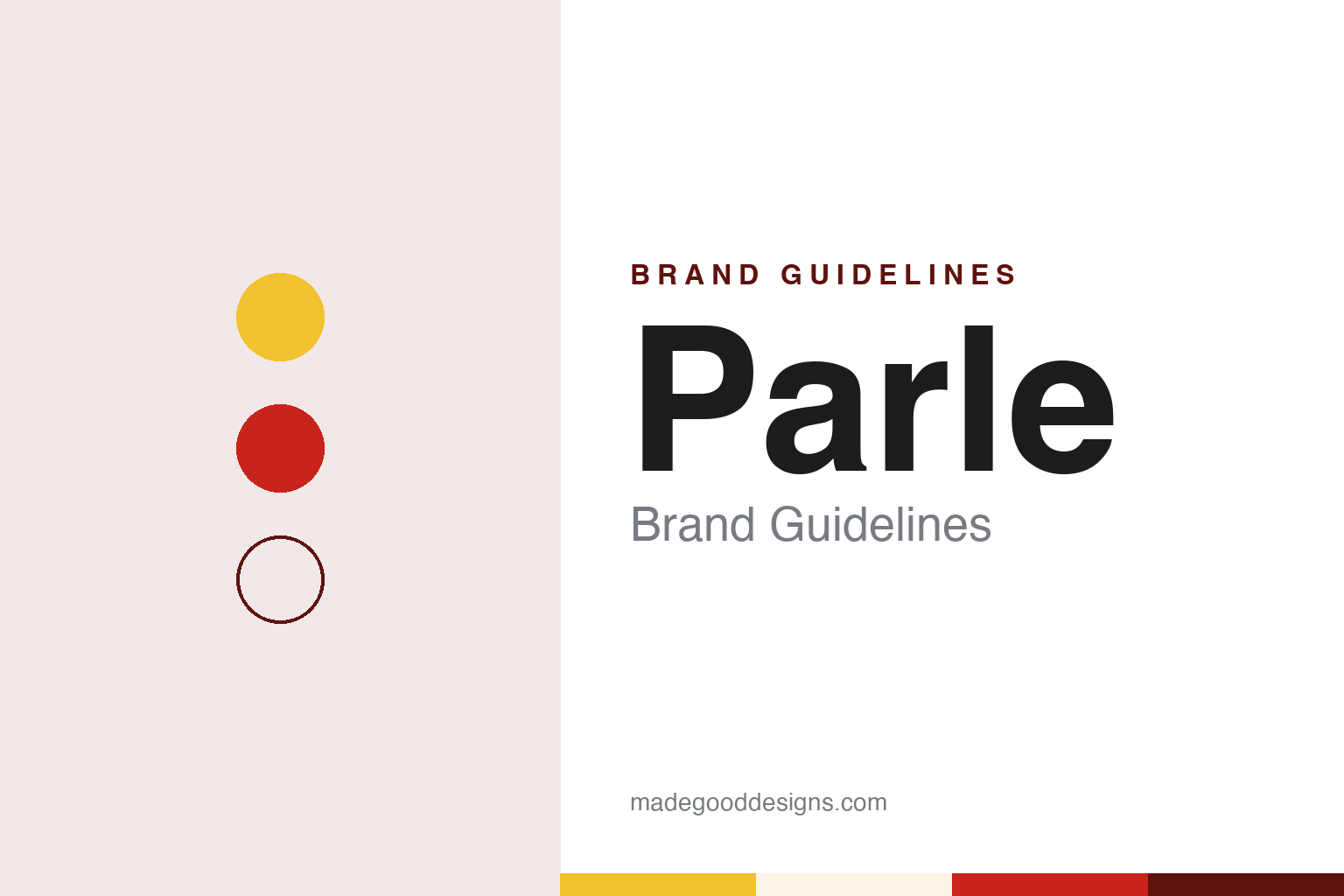
Parle Brand Guidelines
The Vile Parle biscuit maker behind Parle-G.
Aa
Two constants: a wrapper yellow, biscuit red and wax-paper white palette and a bold geometric sans register. Abstract homage — not a Parle product or mark; no pack, logo or illustration is reproduced.
Twelve people in Vile Parle
A tailor’s family, a confectionery works and a suburb’s name.
Parle takes its name from a place. English Wikipedia says Parle Products was founded in 1929 by the Chauhan family of Vile Parle, in what is now Mumbai. It names the founder as Mohanlal Chauhan, from Pardi near Valsad in Gujarat, who came to the city to make a living, tried tailoring, then turned to food: a bakery making bread, buns, rusks, scones and nankhatai. His five sons worked in the business with him. The company tells its own story in slightly different terms. Its website says that “Mr. Mohanlal Dayal founded the House of Parle in 1928” and that its first factory opened in Vile Parle in 1929 “with just 12 people making confectionery.”
Biscuits came ten years later. Both English Wikipedia and the company date the first Parle biscuit to 1939: Parle Gluco, a plain glucose biscuit. Independence gave it a message. In 1947, English Wikipedia says, citing the literary scholar Jill Didur’s 2006 book Unsettling Partition, Parle ran an advertising campaign presenting Gluco as an Indian alternative to British biscuits; The Economic Times described the same campaign in 2013 as Gluco announcing “independence from British biscuits.”
The range grew around that first biscuit. The company’s own timeline lists Monaco in 1942, which it calls India’s first salted cracker; Cheeslings in 1956; the Kismi and Poppins sweets in 1963 and 1966; Krackjack, a sweet-and-salty biscuit, in 1972; Melody chocolate toffee in 1983; Mango Bite in 1989; and Hide & Seek chocolate-chip biscuits in 1996. It says it received its first Monde Selection award in 1971, and that in its early decades it built a 250-foot oven, which it describes as India’s longest. Melody had a moment of its own in May 2026, when Prime Minister Narendra Modi gave a pack to Italy’s prime minister, Giorgia Meloni, in Rome; India Today and Mint reported that her video of the gift went viral and the sweet sold out on quick-commerce sites within hours.
Colour
From Gluco to G, and the child on the wrapper.
Parle Gluco became Parle-G around 1980. The Economic Times, in a 2013 history of the brand by Shephali Bhatt, dates the change to 1980 and says it was made to set the biscuit apart from the many look-alike glucose biscuits then coming onto the market; the company’s timeline places it in the early 1980s. Both say the “G” first stood for glucose. In 2004, The Economic Times reported, the line became “G maane Genius” — G means genius — and the 2013 campaign celebrating “Kal ke Genius,” tomorrow’s geniuses, had words by the poet and lyricist Gulzar and the voice of the actor Piyush Mishra.
The pack is the brand’s most familiar asset. For decades Parle-G came in a white-and-yellow wax-paper wrapper carrying a picture of a small child, English Wikipedia says. Stories about who the child was have circulated for years. In the 2013 Economic Times piece, Parle’s group product manager Mayank Shah said the face was simply “an illustration by an Everest creative back in the 60s” — Everest being the advertising agency, not the spice company of the same name — and that the names attached to it online were folklore. The same agency made the brand’s first television commercial in 1982, in which a grandfather and his grandchildren sing “Swaad bhare, Shakti bhare, Parle-G,” full of taste, full of strength. In 1998 the brand chose the children’s television superhero Shaktimaan as its endorser rather than a film star. In 2001 the wrapper moved from wax paper to BOPP plastic film, the paper said, keeping its traditional design.
Scale became part of the story. The Economic Times reported in March 2011 that a Nielsen study had named Parle-G the world’s best-selling biscuit brand; the company dates Nielsen’s finding to 2003, and the trade site exchange4media carried a similar report in 2002. In February 2013 the same paper reported that Parle-G had become the first home-grown Indian consumer brand to pass ₹5,000 crore in retail sales, and in January 2013 that it was stocked in more than six million shops.
Typography
Design and documentation.
The seven brands in this group all sell food, and all of them come from India: MDH, Everest, Haldiram’s, Amul, Parle, Britannia and MTR. Indian food brands in general sit at many different points in the trade, from family firms that still carry a founder’s name to names that now belong to much larger groups, and a single brand can be sold everywhere from a neighbourhood shop to a supermarket shelf abroad.
A food brand’s identity is usually carried less by a single product than by a pack, a name and the meal or snack it promises, because the company behind the name may have changed hands, moved its factories or grown far beyond the town where it started. That makes the questions behind each name worth asking plainly: who started it, who owns it now, and where its food is actually made and packed.
Each guide separates what independent sources record from what the company says about itself — its founding story, its owners over time, where its products are made and how its packaging has changed — and marks plainly what rests only on the company’s own word.
Aa
A bold geometric sans for a biscuit sold in every corner shop. (Specimen set in Poppins, a sans STAND-IN; NOT the Parle logo.)
Parle
One family name, three companies.
The Parle name is shared by three separate businesses, all descended from the original family firm. According to English Wikipedia, citing The Times of India in 2009, the youngest son, Jayantilal Chauhan, separated from his four elder brothers; the brothers kept the biscuits and sweets business, which is today’s Parle Products, while Jayantilal took the soft-drinks side. That side later passed to his two sons and became Parle Agro, the maker of Frooti and Appy, now run by Prakash Chauhan’s daughters, and the bottled-water business Bisleri, led by Ramesh Chauhan. Parle Products is run by Vijay, Sharad and Raj Chauhan, English Wikipedia says. The family soft-drinks business, it adds, had grown after Coca-Cola left India in 1977, with brands such as Gold Spot and Thums Up.
The shared name has been tested in court. When Parle Agro moved into confectionery, Parle Products sued it in February 2008 over its use of the Parle name on competing sweets, The Economic Times reported. In 2009 the Bombay High Court allowed Parle Agro to keep selling confectionery as “Parle” or “Parle Confi,” provided its packs made clear that it was a separate company with no connection to Parle Products, the paper reported in January 2009. A further twist came in 2026: after the Melody gift, shares in the listed Parle Industries rose, Hindustan Times reported, although that company works in real estate and infrastructure and is not connected to the biscuit maker, which is privately held.
Parle Products remains a private company with its registered office in Vile Parle East. Beyond the original Mumbai factory, English Wikipedia lists its own plants in states including Uttar Pradesh, Rajasthan, Karnataka, Telangana, Gujarat, Madhya Pradesh, Uttarakhand, Haryana and Bihar, with the Bahadurgarh and Muzaffarpur plants among the largest, and says it also uses contract manufacturers, a practice The Economic Times reported in 2003.
For a design guide, Parle shows how one everyday biscuit, a child’s face and a yellow wrapper can carry a family name for nearly a century. Compare Britannia, its great biscuit rival, and Jacob’s, another biscuit name split between two owners. For this guide we use a wrapper yellow, a biscuit red and a wax-paper white with a bold geometric sans, an unofficial interpretation; no product or logo is reproduced.
Explore & save
Keep Parle’s identity on hand — save it to a board in the Made Good inspiration library.
Parle identity set
Pin the Parle wrapper yellow, biscuit red and wax-paper white palette and the bold geometric sans register to your own board.