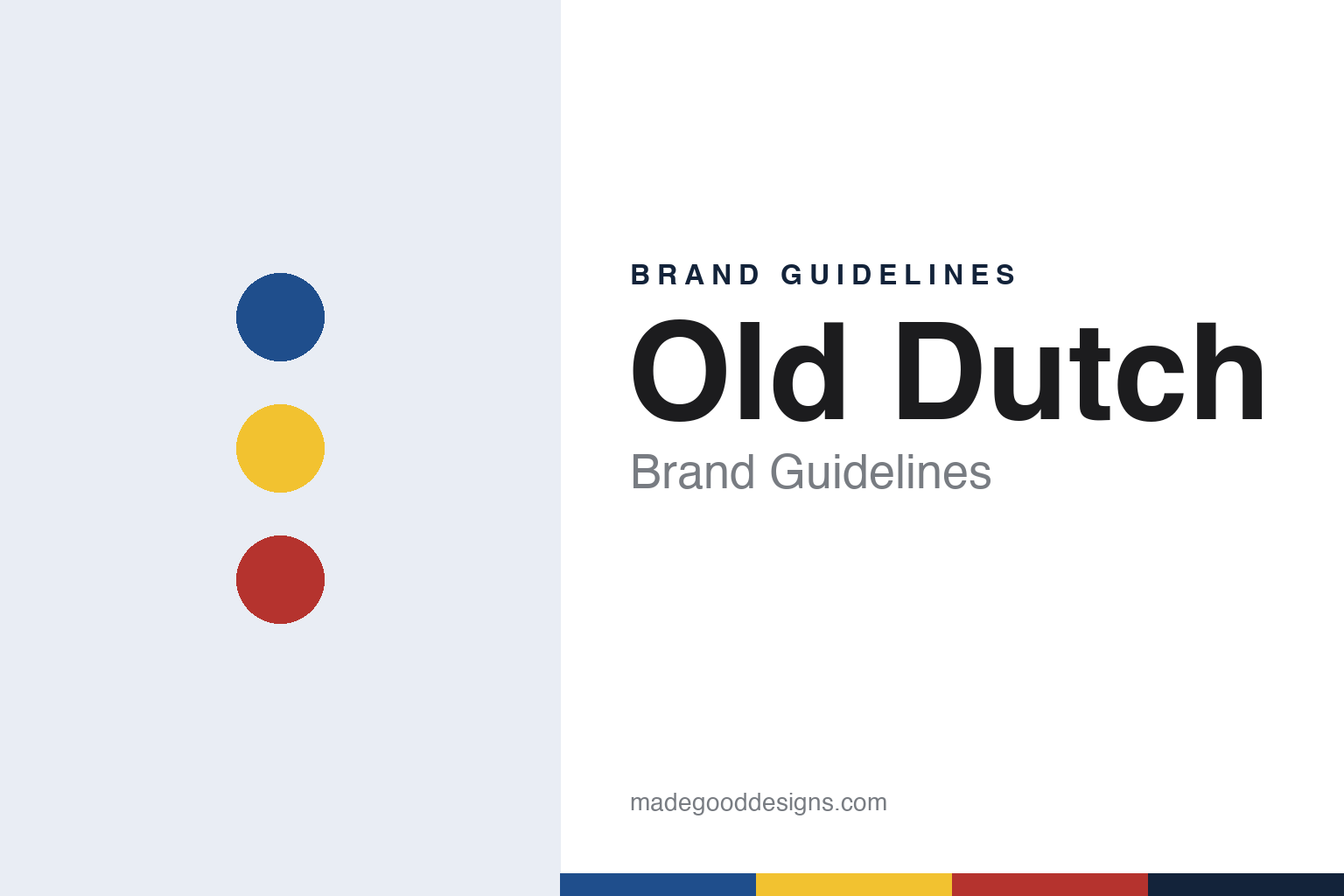
Old Dutch Brand Guidelines
The Minnesota chip maker behind Canada’s windmill bags.
Aa
Two constants: an Old Dutch blue, gold and red palette and a rounded grotesque sans register. Abstract homage — not an Old Dutch product or mark; no bag, windmill logo or character is reproduced.
Old Dutch Products Co.
A chip business started in Minnesota in 1934.
Old Dutch began in Minnesota, not in Canada. English Wikipedia says the company started as Old Dutch Products Co., founded by Carl J. Marx in St. Paul in 1934, and moved to Minneapolis in 1937 and to Roseville, Minnesota, in 1968, where its American headquarters remain. The US company’s website describes those “humble beginnings” as “a modest potato chip business run out of a garage in Minnesota,” and an earlier version of its site, archived in 2018, spoke of “the first tin of Old Dutch Potato Chips” reaching store shelves.
The name was chosen for what it suggested. Citing the historian Janis Thiessen’s Snacks: A Canadian Food History, published by the University of Manitoba Press in 2017, English Wikipedia says Marx picked “Old Dutch” because the Dutch were associated with cleanliness and quality. The company has leaned on the second word ever since: “Quality Lives Here” is the line on both its American and Canadian websites, and the US site carried it as early as 2010, when it described its chips as coming “fresh from the heart of the Upper Midwest.”
The move into Canada came twenty years after the founding. English Wikipedia says Old Dutch opened a plant in Winnipeg, Manitoba, in 1954 to make chips for the Canadian market. The Canadian company’s own timeline gives a slower start: it dates the beginning of the business in Winnipeg to 1954, says that in 1956 Ford trucks were delivering potato products made in the United States to Winnipeg stores, and says work began in 1958 on turning a building on Sargent Avenue into its first Canadian potato plant, which started production in 1959.
Colour
A windmill, a slogan and a box.
The brand’s best-known sign is a windmill, a picture that matches the Dutch name. The Canadian company says that “since 1954, our windmill has stood for quality and trust, old world charm,” and its president’s message on the Canadian website signs off with “Trust the windmill!” The company also invites readers to “ask anyone in Western Canada” whether they remember the windmill, the chips and dips and “the colourful characters on the bags.”
The Canadian site tells the story in a distinctly local voice. It says Old Dutch “first started in Winnipeg, Manitoba as a little chip company,” and that “most Winnipeggers didn’t even realize that the Old Dutch brand was their own”. The Canadian business began in Winnipeg in 1954, twenty years after the founding in Minnesota.
Packaging is part of the identity too. English Wikipedia notes that Old Dutch chips are sold in bags and in cardboard “twin packs” and “triple packs” holding two or three inner packages, and the American company has long called its boxes of potato chips its “signature” format, in archived versions of its website from 2010 and 2018.
The range grew well beyond plain chips. The Canadian timeline says the first tortilla chips came off the line at a newly built plant called Condillo Foods in 1980, and that Arriba flavoured tortilla chips followed in 1998. English Wikipedia lists Ripples, Dutch Crunch kettle-cooked chips and Restaurante Style tortilla chips among the company’s lines, along with puffed corn, pretzels, dips and salsas, and says that Ketchup, All Dressed and Salt & Vinegar chips may not be available outside Canada.
Typography
Brands and owners.
The seven brands in this group are all food brands, and all of them are Canadian: President’s Choice, Clover Leaf, Maple Leaf, Lantic, Christie, Neilson and Old Dutch. Canadian food brands in general sit at many different points in the trade, from family firms that still carry a founder’s name to names that now belong to much larger food groups, and a single brand can be sold everywhere from a corner store to a national supermarket chain.
A food brand’s identity is usually carried less by a single product than by a pack, a name and the meal or snack it promises, because the company behind the name may have changed hands, moved its factory or grown far beyond the town where it started. That makes the questions behind each name worth asking plainly: who started it, who owns it now, and where its food is actually made and packed.
Each guide separates what independent sources record from what the company says about itself — its founding story, its owners over time, where its food is made and how its packaging has changed — and marks plainly what rests only on the company’s own word.
Aa
A rounded grotesque sans — friendly, bold, built for a chip bag. (Specimen set in Rubik, a sans STAND-IN; NOT the Old Dutch logo.)
Old Dutch
From Western Canada to coast to coast.
The Canadian company dates its national reach to 2006, when it bought Humpty Dumpty Snack Foods, a Kitchener, Ontario, company listed on the Toronto Stock Exchange. CBC News reported on March 21, 2006, that Humpty Dumpty’s board was recommending a takeover offer from Old Dutch Foods Ltd., made through a subsidiary, and described Old Dutch as privately held. Humpty Dumpty’s chief executive told CBC that his company’s market was Eastern Canada and New England, while Old Dutch had a strong position in Western Canada and the Midwestern United States.
Humpty Dumpty had its own long history. English Wikipedia says it was founded in 1947 in Scarborough, Maine, by George Robinson and Norman Cole, was bought by Borden in 1989 and passed to the Canadian firm Small Fry in 2000. After the 2006 purchase, its Canadian potato chips were renamed Old Dutch while the Humpty Dumpty name stayed on other snacks, Wikipedia says, and the Canadian company’s timeline marks the deal as the moment Old Dutch potato chips were launched in Eastern Canada.
The purchase came with a factory that did not last. On September 27, 2013, CBC News reported that the former Humpty Dumpty plant in Lachine, in Montreal — built in 1964 and acquired by Old Dutch in 2006 — had closed, with 216 people losing their jobs. The company blamed the age of the plant, CBC said, and said Quebec customers would be served by its plants in New Brunswick, Manitoba and Alberta.
Today the business has two arms. English Wikipedia names the American company Old Dutch Foods, Inc., based in Roseville, and the Canadian one Old Dutch Foods, Ltd., with its head office in Winnipeg. The Canadian company calls itself “a family-owned Canadian Company” with “four manufacturing facilities” and distribution centres across Canada, and says it produces “products for the Canadian market from these facilities”; its president’s message is signed by Steve Aanenson. The American website lists Barrel O’ Fun and Humpty Dumpty alongside Old Dutch among its brands, and its home page carries the line “Celebrating 90 Years.”
For a design guide, Old Dutch shows how a single picture can carry a brand across a border and through a change of scale, from a Minnesota garage to plants across Canada. Compare Lay’s, the American chip brand that grew into a global one, and Kettle Chips. For this guide we use a windmill blue with chip gold and a brick red with a sans, an unofficial interpretation; no product or logo is reproduced.
Explore & save
Keep Old Dutch’s identity on hand — save it to a board in the Made Good inspiration library.
Old Dutch identity set
Pin the Old Dutch blue, gold and red palette and the rounded grotesque sans register to your own board.