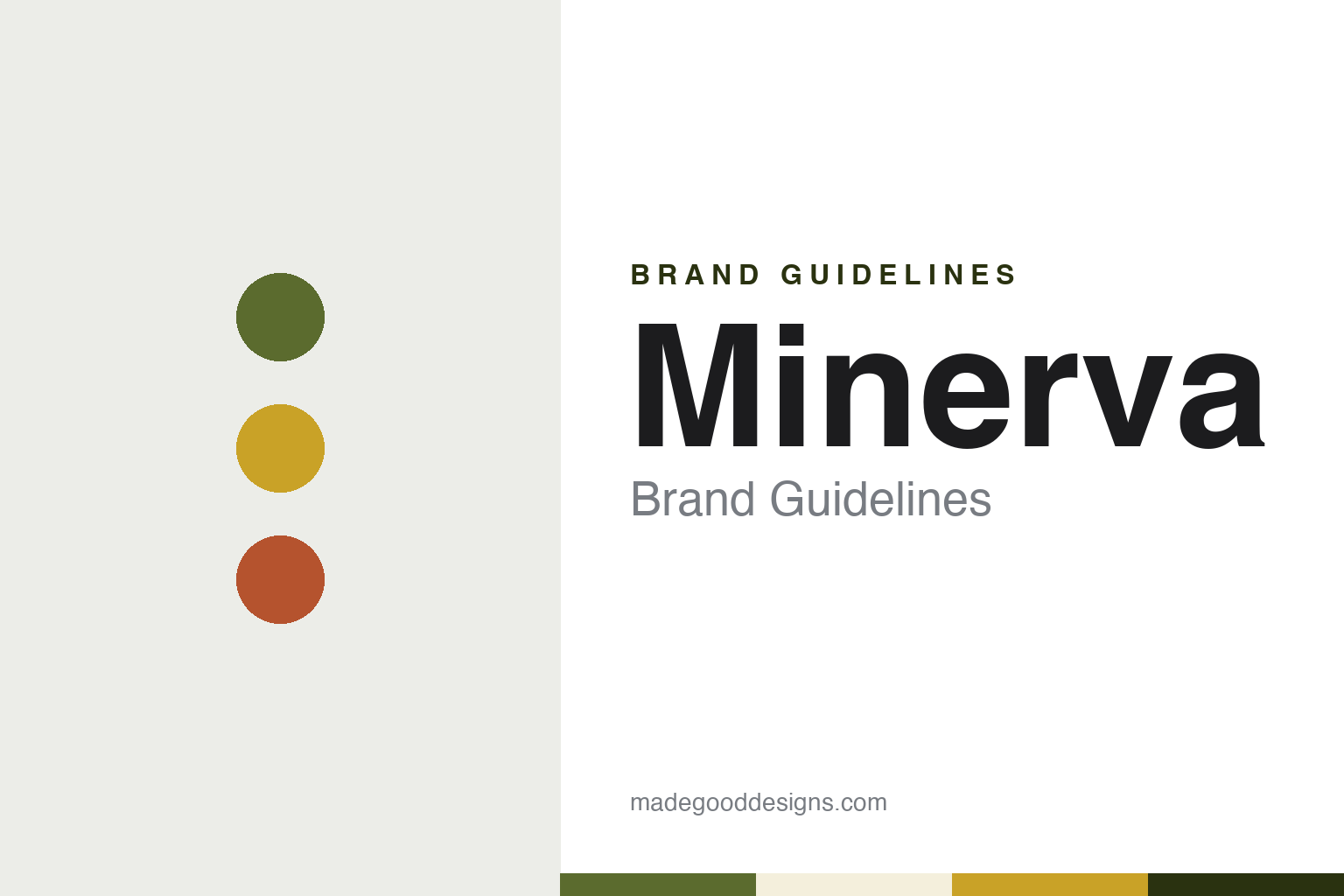
Minerva Brand Guidelines
The Athens olive oil house that became a food group.
Aa
Two constants: an olive green, oil gold and terracotta palette and a classical serif register. Abstract homage — not a Minerva product or mark; no bottle, label or logo is reproduced.
From trade to olive oil
A grocery importer in Athens and Piraeus and a goddess’s name.
Minerva is a Greek food company built on olive oil, and it dates itself further back than most of its rivals. The company says its history begins in 1887 with the trading house of Karakostas–Giannakos, which imported and exported groceries and colonial goods in Athens and Piraeus in the late 19th century. It calls itself the oldest olive oil company in Greece.
Olive oil came in the next century. The company says that from 1904 the business expanded into trading olive oil and gradually specialised in it, creating branded products under the names Minerva, the Roman name of the goddess of wisdom, and Reggina. It marked 120 years of the brand in 2024, and its brand page describes Minerva olive oil as something passed down from generation to generation in Greek families.
In the 1930s and 1940s, the company says, Minerva moved from trade into industry, taking on the production, packing and selling of olive oil products itself. It says it was the first to pack olive oil in a glass bottle under a brand name, as Minerva olive oil, and that the brand became a mark of quality for the grocery shops of the time. Its first press advertisements for Minerva olive oil date from the same period. From 1949 and through the 1950s the company concentrated on exports, and it says the Minerva name became established in many countries abroad.
Colour
A village oil, a margarine and a growing shelf of brands.
The brand family widened from the late 1970s. The company says it launched Fast margarine in 1979 and a new branded extra virgin olive oil, Horio, whose name means “village” in Greek, in 1982. In the 2000s it added line extensions, among them a Horio oil from the Koroneiki olive variety, Fast with yoghurt, Fast with honey and Minerva oils from mountain areas and from a single olive grove. In 2004 it began a partnership with the Finnish company Raisio to bring the Benecol brand to Greece under the name Minerva Benecol.
Cheese followed. In 2008, the company says, Minerva bought the cheese-making plant of the Greek dairy company FAGE in Ioannina, together with a milk collection station at Andravida, and used them to start a range of traditional Greek cheeses under the Horio name; in 2008 and 2009 it also expanded into certified organic products. Its range now includes a Minerva organic feta with protected designation of origin.
In 2014 Minerva bought the TOP vinegar brand and its production plant from Pernod Ricard Hellas, which the company describes as a historic brand that Greek families had grown fond of, and which it also sells abroad. The company’s brand list today runs from Minerva, Horio and Altis oils to Fast, Flora and Sol, Pummaro tomato products, Brava sauces and TOP vinegar. It says it has more than 300 products on the market and promotes Greek products and the Mediterranean diet in 25 countries.
Typography
Design and documentation.
The seven brands in this group all make food, and all of them come from Greece, Switzerland or France: Lacta, Allatini, Papadopoulos, Minerva, Zweifel, Ragusa and Francine. Food brands from these three countries sit at many different points in the trade, from family firms that still carry a founder’s surname to names that now belong to much larger food groups, and a single brand can be sold everywhere from a corner shop to a supermarket shelf.
A food brand’s identity is usually carried less by a single product than by a pack, a name and the meal or snack it promises, because the company behind the name may have changed hands, moved its factory or grown far beyond the town where it started. That makes the questions behind each name worth asking plainly: who started it, who owns it now, and where its products are actually made and packed.
Each guide separates what independent sources record from what the company says about itself — its founding story, its owners over time, where its products are made and how its packaging has changed — and marks plainly what rests only on the company’s own word.
Aa
A classical serif with full Greek support, for a brand named after a Roman goddess. (Specimen set in Noto Serif, a serif STAND-IN; NOT the Minerva logo.)
Minerva
A multinational partner, a Boeotian plant and a run of acquisitions.
Minerva’s modern growth began with an outside shareholder. The company says that in 1977 the Paterson Zochonis group, which it describes as a multinational of Greek interests, brought it new technology and know-how; that group is today’s PZ Cussons. In 1993, the company says, it decided together with the group to build a factory at Schimatari in Boeotia, north of Athens, which it has kept modernising since. English Wikipedia says PZ Cussons sold its factories in Greece and Poland, together with their local commercial operations, in the summer of 2012, as part of a move to focus on its core business.
The company gives its current shareholders as dating from 2019. That year, it says, its main shareholder became Mirties Enterprises Company Ltd, controlled by the investment fund Diorama Investments Sicar S.A., with Elikonos 2 S.C.A. SICAR and the EOS Hellenic Renaissance Fund as minority shareholders. Acquisitions have followed. In 2021 Minerva bought the tomato products business of ELAIS-Unilever Hellas, including the Pummaro and Pelargos brands and the factory at Gastouni, and in the same year added the Brava and Delicia brands of mustard, mayonnaise, ketchup and condiments. In 2025, the company says, it bought the trademarks Altis, Elanthi, Flora and Sol, strengthening its position in olive oil and other oils.
The company says its production is based at two plants in Greece. Schimatari is its central production site, packing olive oil and making butter and spreads, and that the Gastouni plant, in Ilia in the north-west Peloponnese, makes the Pummaro and Pelargos tomato products and works with about 100 local farmers. Its head office is in Metamorfosi, in Attica, with an office in Thessaloniki. It is not connected with the Thessaloniki underwear and swimwear maker also called Minerva.
For a design guide, Minerva shows how a classical name on a glass bottle of olive oil can anchor a whole family of Greek kitchen brands. Compare Gaea, another Greek olive oil brand, and Lesieur, the French oil maker. For this guide we use an olive green, an oil gold and a terracotta with a classical serif, an unofficial interpretation; no product or logo is reproduced.
Explore & save
Keep Minerva’s identity on hand — save it to a board in the Made Good inspiration library.
Minerva identity set
Pin the Minerva olive green, oil gold and terracotta palette and the classical serif register to your own board.