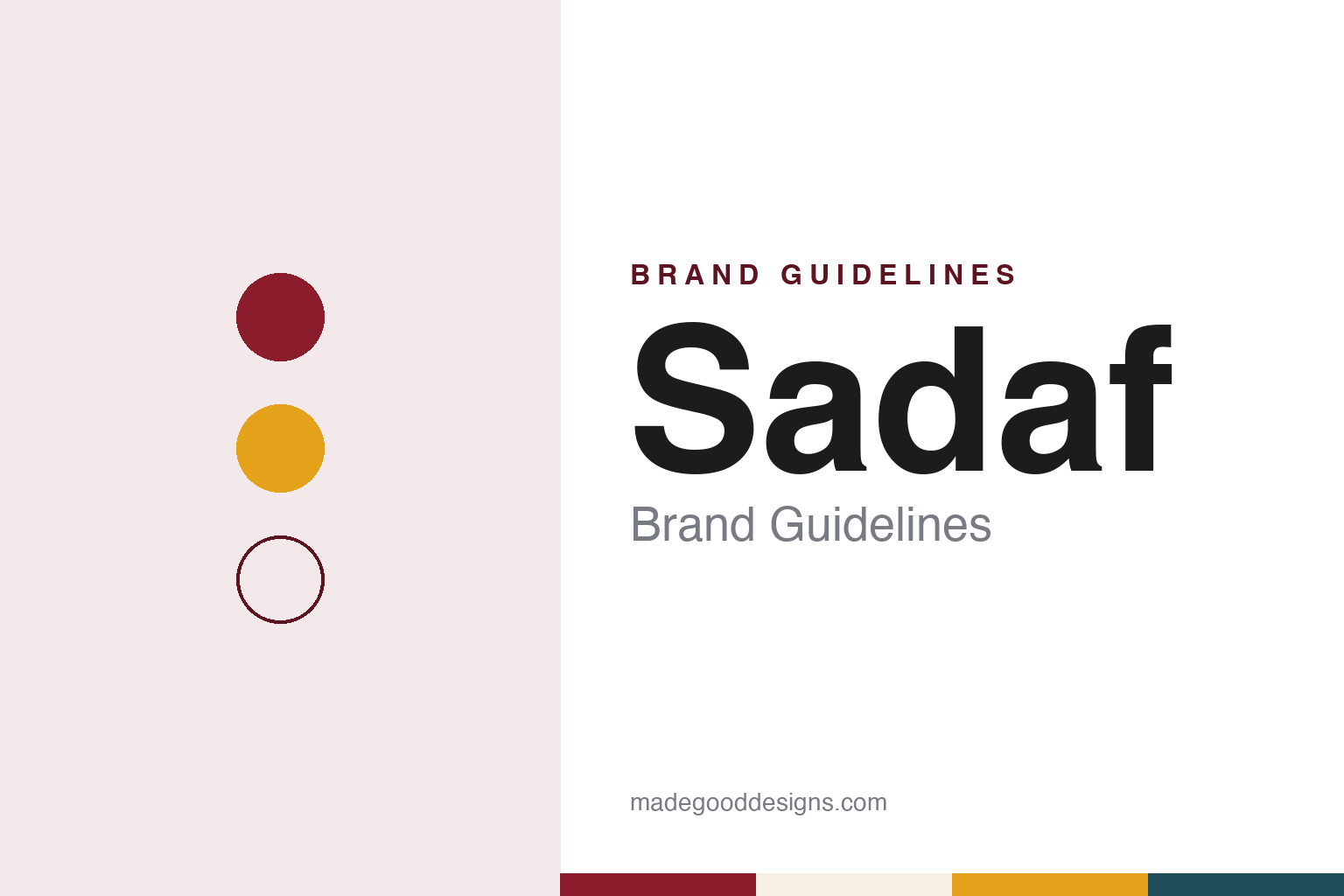
Sadaf Brand Guidelines
The Los Angeles pantry brand built for a homesick community.
Aa
Two constants: a pomegranate, saffron and teal palette and a warm book serif register. Abstract homage — not a Sadaf product or mark; no pack, logo or label is reproduced.
Seventeen products
Two brothers, a new city and the taste of home.
Sadaf is a Los Angeles specialty-food brand. The company says Sadaf Foods was founded in 1982 by two Iranian brothers who had recently immigrated to Los Angeles. In its own telling, they missed the aromas and flavours of home, naming saffron, turmeric, dried limes and rose water, and found that traditional Middle Eastern ingredients were almost impossible to buy in local supermarkets. So they began to source and import those ingredients themselves for a growing community.
The start was small. Sadaf says the business began with 17 products and a three-person team. It describes itself today as family-owned and headquartered in Los Angeles, and in a statement on its website says it is owned by two Iranian-American brothers, operates only in the United States and has no offices abroad. The Sadaf name is a registered trademark of Soofer Co., Inc., according to the notice at the foot of the company’s website.
Independent coverage confirms the Los Angeles base. In May 2019 the Los Angeles Times, in a piece by Amy Scattergood on dried limes and the Iranian cookery writer Najmieh Batmanglij, described Sadaf as a Los Angeles-based company that carries dried limes whole, powdered and in their black form, and said the chef Jessica Koslow bought hers there wholesale.
In a press release issued through the Specialty Food Association in May 2026, Sadaf described itself as a name in Middle Eastern and Mediterranean specialty foods for more than 44 years.
Colour
An importer’s catalogue, packed in Los Angeles and abroad.
Sadaf describes itself as a sourcing business as much as a maker. The company says it now offers more than 1,200 products in more than 35 categories, sourced from over 22 countries, and that it chooses suppliers for regional specialities, working with local factories and farmers. Its allergen notice says products are packed on shared equipment and that not all of them are packed in its own facility, so the label of each product is the guide to where and how it was packed.
The catalogue is organised around Persian home cooking as well as the wider region. Sadaf’s website groups dried herb mixes for sabzi, ready-to-eat stews, rice mixes, soup mixes for aash and pickles under torshi alongside saffron, teas, rock sugars, flower waters and yogurt soda. The same site sells other companies’ brands, including Ahmad Tea, Dunar rice and Rabee rose water, and lists halal, kosher and organic ranges. Sadaf says it picks products according to regional culinary specialities and its customers’ preferences, and that it deals directly with its suppliers.
The company now reaches beyond its first community. It says it employs more than 100 people, distributes in all 50 states, and supplies neighbourhood grocers as well as larger chains, naming Whole Foods, Sprouts and Kroger.
New products have followed the same idea of tradition made convenient. In May 2026 Sadaf launched a Halva Cake, a tahini-based dessert sold in a mould that is turned out onto a plate, in three flavours: caramel and hazelnut, pistachio and chocolate, and cinnamon and almond cookie. The company presented it as a “flip-and-serve” dessert for both grocery shelves and foodservice. The launch was covered by Trend Hunter on 16 May 2026 and by Milling Middle East & Africa on 29 May 2026, both drawing on the company’s announcement.
Typography
Design and documentation.
The seven brands in this group all make food, and they come from Israel, the United States and Saudi Arabia: Osem, Elite, Strauss, Bamba, Tnuva, Sadaf and NADEC. Food brands in general sit at many different points in the trade, from family firms that still carry a founder’s name to names that now belong to much larger food groups, and a single brand can be sold everywhere from a corner shop to a supermarket shelf.
A food brand’s identity is usually carried less by a single product than by a pack, a name and the meal or snack it promises, because the company behind the name may have changed hands, moved its factory or grown far beyond the town where it started. That makes the questions behind each name worth asking plainly: who started it, who owns it now, and where its food is actually made and packed.
Each guide separates what independent sources record from what the company says about itself — its founding story, its owners over time, where its food is made and how its packaging has changed — and marks plainly what rests only on the company’s own word.
Aa
A warm book serif for a pantry brand of saffron and rose water. (Specimen set in Lora, a serif STAND-IN; NOT the Sadaf logo.)
Sadaf
A family company and a diaspora market.
Sadaf’s story is one of a diaspora brand that grew with its customers. The company dates its start to 1982, and its own account ties that start to recent Iranian immigrants in Los Angeles looking for familiar ingredients. Four decades on it describes itself as a multigenerational family company, with some employees who have been there for more than 30 years. It also says it gives to shelters, food banks and community centres in Los Angeles and supports disaster relief.
Its public statement sets out its position on ownership in plain terms. Sadaf says it is privately owned by its two founding brothers, conducts its banking only with banks operating in the United States, and has no financial or political affiliations with any government. Those are the company’s own statements.
The brand also works as a distributor. Alongside its own Sadaf range, the company’s website offers rice, teas, sweets and flower waters from other makers, and lists television commercials and a wholesale catalogue among its pages.
Its signature ingredients remain those named in its founding story: saffron, turmeric, dried limes and rose water, together with teas and Persian herb mixes. Its 2026 press material describes a portfolio of spices, aromatic teas, traditional sweets, speciality grains and pantry essentials, sold to home cooks and chefs in the United States and abroad.
For a design guide, Sadaf shows how a pantry brand can build an identity on a list of familiar ingredients rather than a single hero product. Compare it with Ziyad, the Chicago Middle Eastern pantry brand, and Cortas, the Lebanese maker of flower waters. For this guide we use pomegranate, saffron and teal with a serif, an unofficial interpretation; no product or logo is reproduced.
Explore & save
Keep Sadaf’s identity on hand — save it to a board in the Made Good inspiration library.
Sadaf identity set
Pin the Sadaf pomegranate, saffron and teal palette and the warm book serif register to your own board.