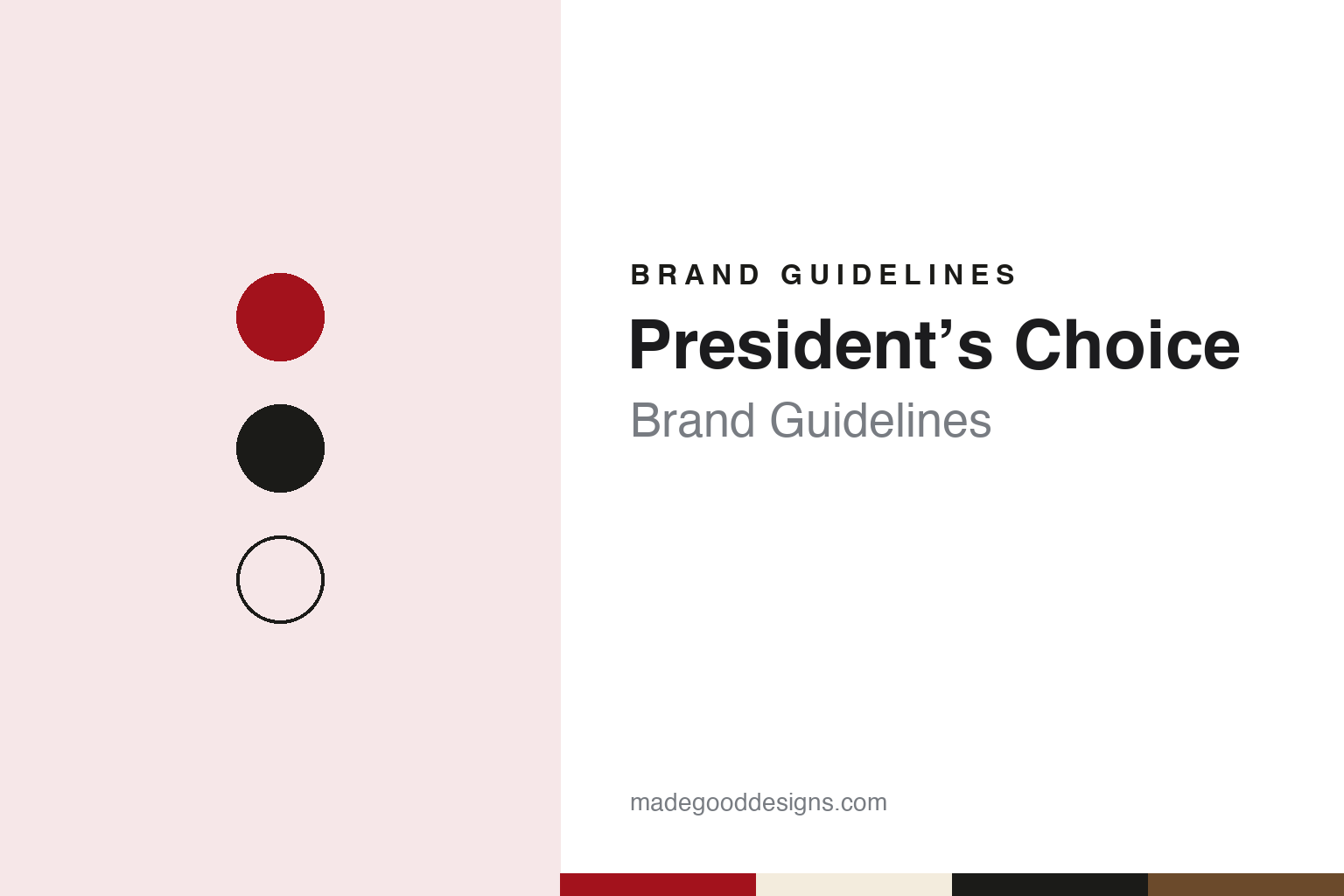
President’s Choice Brand Guidelines
The Loblaw store brand written in Dave Nichol’s hand.
Aa
Two constants: a red, black and cream palette and a signature serif register. Abstract homage — not a President’s Choice product or mark; no pack, logo or signature is reproduced.
The president’s choice
A grocery president, a designer and a coffee pack.
President’s Choice is the premium private label of Loblaw Companies, the Canadian grocery group controlled by George Weston Limited and headquartered in Brampton, Ontario. English Wikipedia’s article on the brand says the concept was created in 1983 and that the first PC products reached Loblaw shelves in 1984; its article on Loblaw dates the launch to 1983, beginning with President’s Blend gourmet coffee. Either way, the new line followed Loblaw’s No Name generic range, introduced in 1978 in simple black-and-yellow packaging, according to English Wikipedia.
The idea is credited to Dave Nichol, who joined Loblaws as executive vice president in 1972 and became its president in 1976, English Wikipedia says. In 1985 he became president of Loblaw International Merchants, the group’s product development arm, a post he held for eight years. Nichol also endorsed the products personally, and the President’s Choice logo was written in his own handwriting, according to the brand’s Wikipedia article.
The packaging was the work of Don Watt, the Toronto designer who founded Don Watt and Associates in 1966 and whom Galen Weston hired in 1973 to redesign the Loblaws brand, English Wikipedia says. Over the following years Watt designed branding, stores and packaging for several Loblaw lines: No Name, President’s Choice, Too Good To Be True and the “Green” range. He recalled that Nichol’s only stipulation for the first PC Gourmet Coffee pack was “don’t make it yellow” — the colour already used by No Name — and that “PC was chosen because it was the president’s ‘choice’,” meaning the best value and quality relative to the competition, as quoted from his 2006 Marketing Hall of Fame profile.
Watt was inducted into Canada’s Marketing Hall of Legends in 2006 and into the Private Label Hall of Fame in 2008; Nichol had been inducted into the Hall of Canadian Marketing Legends in 2005, English Wikipedia says.
Colour
A comic-book flyer and a cookie.
Loblaw promoted the brand in print. The Insider’s Report, first published in November 1983, was a free flyer that Nichol described to The New York Times in 1994 as combining “zaniness and food tips in a comic book format.” English Wikipedia says it appeared three times a year, came to be devoted almost entirely to PC products, and by 1990 reached 59 percent of Ontario households, according to an A.C. Nielsen survey.
Its best-known product is The Decadent Chocolate Chip Cookie, introduced in 1988 according to English Wikipedia’s article on Nichol. The brand’s article says the cookie contained 39 percent chocolate chips by weight, and that it took the supplier, Colonial Cookie of Kitchener, Ontario, more than a year to make a cookie that met Nichol’s standards. The Toronto Star reported in July 1993 that it had become Canada’s best-selling cookie within three years, despite being stocked in only about a fifth of the country’s stores. The pack was built around the product itself: the photographer Russ Rudd lined up hundreds of cookies on a conference table and photographed the best-looking ones, and an enlargement of one became the cover shot, set against a background of dozens of chocolate chips, the article says.
Other lines followed. The Memories of sauces were tied to dishes Nichol said he had found on his travels, such as a satay sauce from Bali, and Canadian Business reported that one of them, a Szechwan peanut sauce and dressing, had outsold ketchup in some stores. In spring 1989 Loblaw launched G.R.E.E.N., which the trade magazine Prepared Foods called in 1990 the first major “green” product line from a North American company; it drew criticism from Greenpeace and from a consumers’ association, and within a year had grown to about 100 products, English Wikipedia says. Too Good To Be True! followed in 1991, PC Organics in 2001, PC Home in 2002 and the Blue Menu range, which replaced Too Good To Be True!, in 2005.
Typography
Design and documentation.
The seven brands in this group are all food brands, and all of them are Canadian: President’s Choice, Clover Leaf, Maple Leaf, Lantic, Christie, Neilson and Old Dutch. Canadian food brands in general sit at many different points in the trade, from family firms that still carry a founder’s name to names that now belong to much larger food groups, and a single brand can be sold everywhere from a corner store to a national supermarket chain.
A food brand’s identity is usually carried less by a single product than by a pack, a name and the meal or snack it promises, because the company behind the name may have changed hands, moved its factory or grown far beyond the town where it started. That makes the questions behind each name worth asking plainly: who started it, who owns it now, and where its food is actually made and packed.
Each guide separates what independent sources record from what the company says about itself — its founding story, its owners over time, where its food is made and how its packaging has changed — and marks plainly what rests only on the company’s own word.
Aa
A signature serif — for a logo first written by hand. (Specimen set in DM Serif Display, a serif STAND-IN; NOT the President’s Choice logo.)
President’s Choice
A store brand with a national reach.
The brand also travelled. English Wikipedia says PC products began appearing in some US supermarkets in the early 1980s and were sold in a handful of states by 1991, the year Loblaw developed Sam’s American Choice, a private label for Walmart. By late 1993 PC products were on the shelves of about 1,200 US stores in 34 states, largely through deals with Walmart, and Chicago’s Jewel and, from 1995 to 1999, Lucky Stores were among the American grocers that carried them, the article says. The New York Times wrote about Nichol and the brand in February 1994.
The President’s Choice name was stretched beyond food. President’s Choice Financial, launched in 1998, was the first time a major Canadian retailer had developed full banking services, English Wikipedia says. Nichol left Loblaws in 1994 and became chief executive of Destination Products International, a subsidiary of the private-label soft-drink maker Cott; Watt had sold his Watt Group to Cott in 1992 and bought it back in 1999 as Watt International.
After Nichol, the face of the brand changed. Galen G. Weston became Loblaw’s executive chairman in October 2006 and the President’s Choice spokesman in 2007, according to English Wikipedia. Today President’s Choice remains a Loblaw brand alongside No Name. The Decadent’s documented maker was a separate supplier, Colonial Cookie of Kitchener.
For a design guide, President’s Choice shows how a store brand can borrow the signals of a national brand — a handwritten signature, a named hero product, a house magazine — and keep them for four decades. Compare Christie, a long-established Canadian biscuit name, and Laura Secord, another Toronto-born food brand. For this guide we use a red, black and cream with a serif, an unofficial interpretation; no product or logo is reproduced.
Explore & save
Keep President’s Choice’s identity on hand — save it to a board in the Made Good inspiration library.
President’s Choice identity set
Pin the President’s Choice red, black and cream palette and the signature serif register to your own board.