Panda Brand Guidelines
The Vaajakoski liquorice named after a chocolate wrapper.
Aa
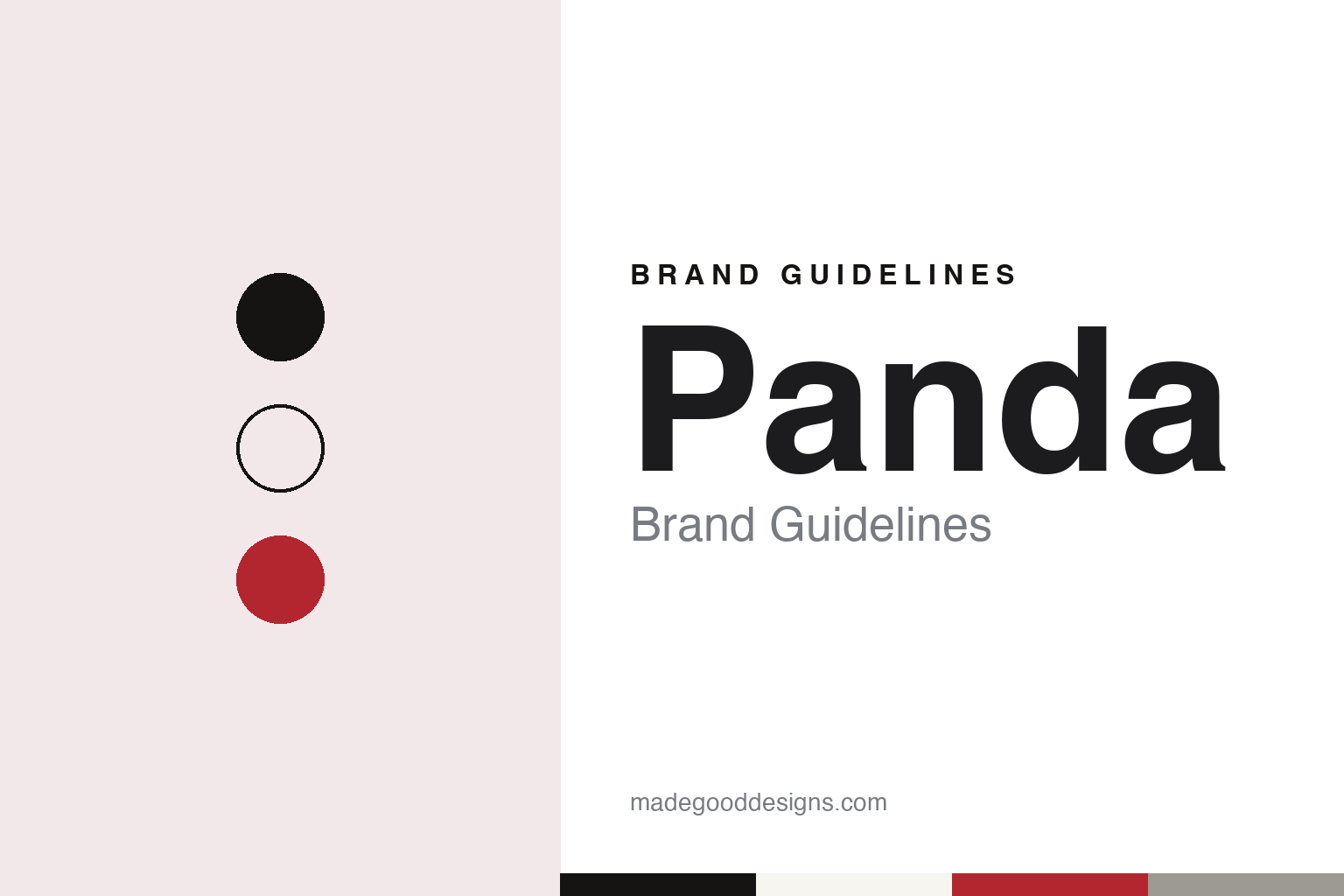
Two constants: a liquorice black, panda white and berry red palette and a rounded friendly sans register. Abstract homage — not a Panda product or mark; no pack, logo or sweet is reproduced.
The attic at Marjala
A co-operative, a berry house and a first batch of sweets.
Panda was not started by a confectioner but by a co-operative. In 1920 SOK, the central wholesale society of the Finnish co-operative shops, began making sweets at Vaajakoski, next to Jyväskylä in central Finland. The company says production started in the attic of Marjala, a wooden building belonging to a berry-processing plant, where a small group of about 19 inexperienced workers learned the trade by trial and error. The business was known simply as SOK’s confectionery factory. The Oulu newspaper Kaleva reported in 2018 that 66,000 kilograms of sweets were made in the first year, among them lines called Kumipallo, Lotta and Herkku; the company says the first sweets reached the shops in March 1921, and that demand was strong enough for the factory to move to two shifts that year.
Liquorice arrived a few years later. The company dates it to 1927, when liquorice production began upstairs at Marjala; its own timeline says the first liquorice product was a gum-arabic pastille containing liquorice extract. Panda’s international site credits the recipe to a liquorice master, Väinö Hilden, in 1927, and the Finnish site says its liquorice is still cooked and pressed according to his recipes. The soft liquorice the brand is known for today came next: the company says production began at Vaajakoski in 1934 and the first soft liquorice reached the shops the following year, with liquorice granules added in 1936.
In June 1929 the sweet factory moved into a new, larger building close to Marjala, and that August it opened a chocolate department, the company says. Finnish Wikipedia records that when the later additions to that old factory were demolished in 2012, the original 1929 section was kept as a protected building. The war years narrowed the range sharply. Finnish Wikipedia says that by the end of 1942 carrot marmalade was the only product on offer, and the company says new products took off after chocolate rationing ended in 1949 — among them a chocolate bar called Panda-Pop.
Colour
A chocolate bar, a mascot and a flower-shaped liquorice.
The brand took its name from that chocolate bar’s wrapper. The company says that in the early 1950s the artist Bror Zetterborg was asked to design the Panda Pop pack, and that his panda drew so much affection that the figure was added first to the factory’s other packs and finally adopted as the name of the whole factory. Kaleva dates the panda wrapper to 1952, and the Central Finland Chamber of Commerce, in its profile of the company, says the bear was drawn that year by the factory’s graphic designer. In the 1952 Olympic year, the company says, a mascot in a panda suit toured the country on SOK’s “sweet train,” handing out sweets, and by 1956 the panda mark appeared on all of the factory’s products. In 1961 the factory was renamed Panda Suklaatehdas SOK Vaajakoski — the Panda chocolate factory.
The company says a single, official Panda logo came only in the late 1960s; before that, its marketing had used a variety of playful panda figures. The bear has since stepped back. In 2018 Kaleva reported that only a few products still carried the panda, and that the name instead appeared in the panda’s colours on the side of the packs. The company also chose not to sign a marketing tie-up with the pandas at Finland’s Ähtäri Zoo, the newspaper reported, because the link between the logo and the animal was too weak.
Several products have outlived the changes. The company dates its Pepe liquorice bars to 1957 and its Juhlapöydän Konvehteja chocolate box to 1967; Kaleva reported that more than three million of those boxes were made every year. The most recognisable shape is the hollow, flower-like liquorice the company calls Lakukka. In August 2023 it became the first confectionery to receive the Design from Finland mark, awarded on application by the Association for Finnish Work, the broadcaster Yle reported; the mould was acquired around the turn of the 1960s and 1970s, and Panda told Yle it has no exact record of who developed the shape. On the brand’s international site, the Panda name, the floral design and the liquorice shape are all listed as trademarks.
Typography
Design and documentation.
The seven brands in this group all make sweets or chocolate, and they come from four European countries — Germany, Britain, Spain and Finland: Maoam, Barratt, Walker’s Nonsuch, Toffifee, Merci, Fini and Panda. European confectionery brands in general sit at many different points in the trade, from family firms that still carry a founder’s surname to names that now belong to much larger food groups, and a single brand can be sold everywhere from a corner kiosk to a supermarket shelf.
A confectionery brand’s identity is usually carried less by a single sweet than by a pack, a name and the treat it promises, because the company behind the name may have changed hands, moved its factory or grown far beyond the town where it started. That makes the questions behind each name worth asking plainly: who started it, who owns it now, and where its sweets are actually made and packed.
Each guide separates what independent sources record from what the company says about itself — its founding story, its owners over time, where its sweets are made and how its packaging has changed — and marks plainly what rests only on the company’s own word.
Aa
A rounded friendly sans for a brand named after a panda. (Specimen set in Fredoka, a sans STAND-IN; NOT the Panda logo.)
Panda
From the co-operative to Orkla, without leaving Vaajakoski.
Panda changed owners four times in less than two decades. The company says it took the official name Oy Panda Ab in the early 1980s while still owned by SOK, and that in 1988 SOK sold the business to its management. In 1995 the Norwegian food company Rieber & Søn bought Panda, the company says, and in 2000 the Finnish private-equity investor MB Rahastot acquired it, bringing it back into Finnish ownership alongside the management, as Turun Sanomat reported at the time, according to Finnish Wikipedia.
On 26 May 2005 Felix Abba, the Finnish arm of Norway’s Orkla group, announced that it was buying Oy Panda Ab from MB Rahastot and Panda’s senior management. The press release gave Panda’s 2004 revenue as nearly €52 million and its staff as about 300, and said 70% of its products were sold in Finland and 30% exported, mainly to the Nordic countries, Britain, the United States and Canada; Turun Sanomat reported that the price was not disclosed. Finnish Wikipedia says Panda was merged into Orkla’s Finnish snacks company Chips at the end of 2013. Today the brand’s sites carry Orkla’s copyright, and its international site lists the trademarks as belonging to Orkla Suomi Finland.
Production has stayed at Vaajakoski. The company says all Panda chocolate and liquorice is made at its factory there. Kaleva’s 2018 fact file dates the chocolate factory to 1969 and says both factories were brought under one roof in 2011, which the Jyväskylä newspaper Keskisuomalainen also reported that year. Exports began in 1963 with liquorice rolls for the United States, the company says, and spread to the Netherlands, Norway, Sweden and Austria. In 2018 Panda’s marketing director told Kaleva that about half of its liquorice production was exported, mainly to the United States, Britain and Canada; the company says it has led the Finnish liquorice market since 1986.
For a design guide, Panda shows how a mascot drawn for one chocolate wrapper can name a whole factory, and how a liquorice shape can become a mark of its own. Compare Fazer, the Helsinki confectioner, and Kalev, the Estonian sweet maker that is also owned by Orkla. For this guide we use liquorice black, a panda white and a berry red with a rounded sans, an unofficial interpretation; no product or logo is reproduced.
Explore & save
Keep Panda’s identity on hand — save it to a board in the Made Good inspiration library.
Panda identity set
Pin the Panda liquorice black, panda white and berry red palette and the rounded friendly sans register to your own board.