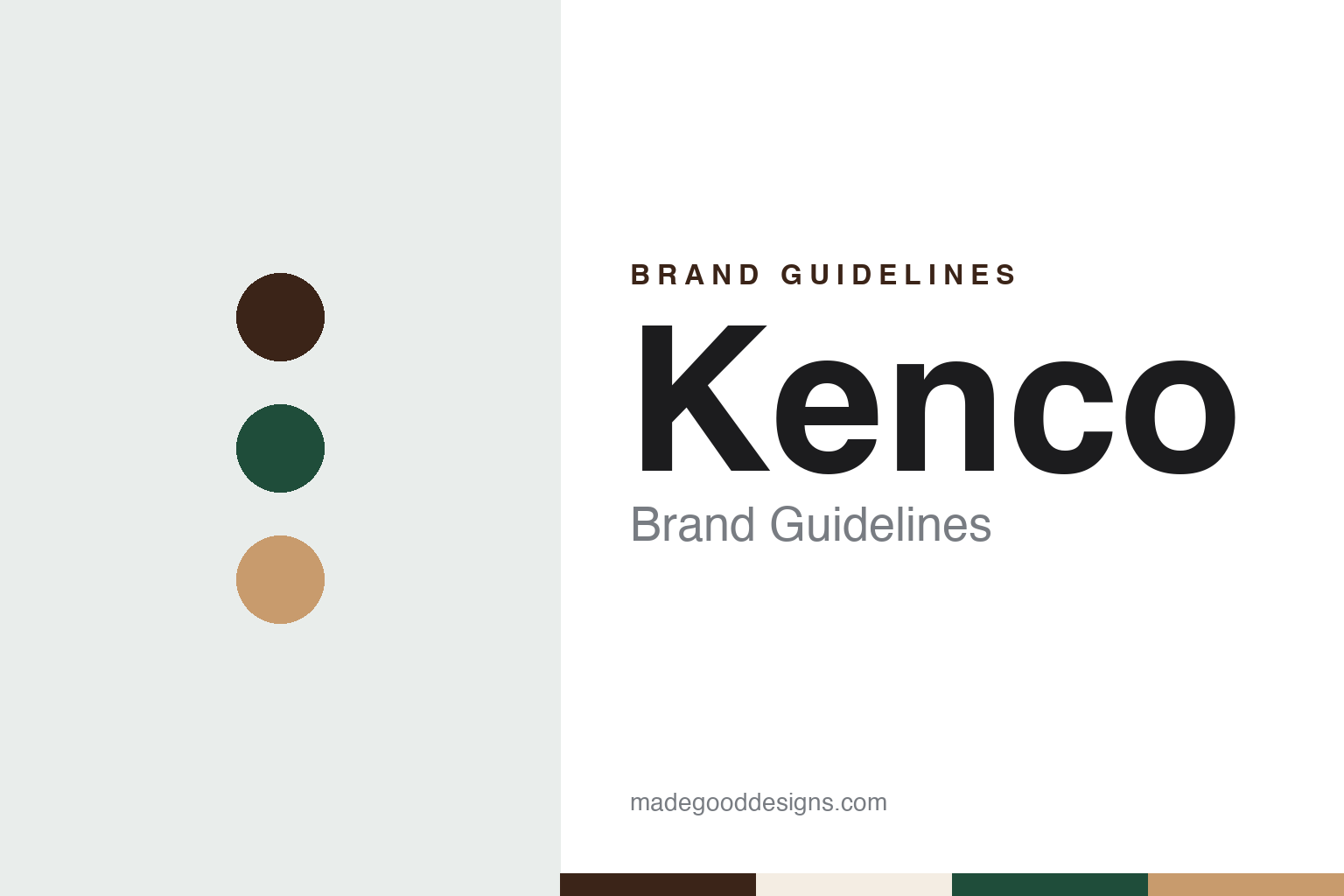
Kenco Brand Guidelines
The Kenya Coffee Company from Mayfair, 1923.
Aa
Two constants: a roast brown, Mayfair green and crema palette and a clean British sans register. Abstract homage — not a Kenco product or mark; no jar, pack or logo is reproduced.
The Kenya Coffee Company
A growers’ co-operative, a Mayfair shop and a mail-order list.
Kenco began in London in 1923 as The Kenya Coffee Company Limited. The company says it was founded that year as a co-operative of coffee farmers in Kenya; English Wikipedia, citing the company and a 1959 notice in the Glasgow Evening Times, describes the founders as a co-operative of retired white Kenyan coffee growers. Its coffee was sold from a shop in Vere Street, Mayfair, where English Wikipedia names L.C. Gibbs and C.S. Baines as the men behind the counter.
The shop roasted and ground coffee for local customers, but most of its trade was by mail order. English Wikipedia says the company advertised in Tatler, Country Life and The Times to reach country houses, and the company says its coffee found its way to London restaurants such as Scott’s and to events such as Wimbledon. As demand grew it moved to 30 Sloane Street, next door to the food merchant and caterer John Gardiner, and through the 1930s it added premises in Bermondsey and Earlsfield.
The next step came from that neighbour. After the Second World War, English Wikipedia says, Tom Kelly, a Gardiner employee, persuaded his employer to buy the Kenya Coffee Company and was then put in charge of it. Kelly widened the business beyond mail order: he moved into catering and opened eleven coffee shops in places such as Wimbledon, the King’s Road and Golders Green, selling cakes as well as coffee. The company says it opened what it believes was the first branded coffee-shop chain in the UK. Kelly also took on the rights to sell Gaggia machines, so the company began supplying espresso machines to other coffee bars.
In 1962 the business became the Kenco Coffee Company. English Wikipedia says the change reflected the falling share of its coffee bought from Kenya; the company says it was by then sourcing beans from markets all over the world and changed its name to reflect that.
Colour
Trust Houses, Cadbury Schweppes, General Foods, Kraft, JDE.
Kenco has changed hands many times since Gardiner’s day. In October 1964 the hotel group Trust Houses bought John Gardiner, the catering magazine The Caterer recorded in a company profile, and in 1969 Trust Houses sold Kenco to Cadbury Schweppes, The Times reported on 3 January that year.
Cadbury Schweppes kept it for less than two decades. In 1986 it sold its food businesses, Kenco among them alongside Typhoo tea and Hartley’s jam, to a management buyout that named itself Premier Brands, The Times reported in January 1986. A year later Kenco was sold on to General Foods, the American maker of Maxwell House, in a deal that English Wikipedia, citing the business writer Richard Koch, links to Hillsdown’s purchase of Premier. The economist John Sutton, writing in 1991, said the acquisition made General Foods the leading coffee manufacturer in the United Kingdom, with about a quarter of the market.
From there Kenco followed the path of American packaged food. General Foods’ owner, Philip Morris, combined it with Kraft as Kraft General Foods in 1989, and the business was renamed Kraft Foods in 1995, the New York Times and the Los Angeles Times reported. When Kraft split in two in 2012, Kenco went with the snacks and international business, Mondelēz International. Two years later Mondelēz announced it would merge its coffee operations with the Dutch company D.E Master Blenders 1753, Marketing Week reported in May 2014, and the combined company began trading in 2015 as Jacobs Douwe Egberts, owner of brands including Douwe Egberts.
In December 2019 Jacobs Douwe Egberts merged with Peet’s Coffee to form JDE Peet’s, headquartered in Amsterdam and listed on Euronext Amsterdam from 2020. On 25 August 2025 Keurig Dr Pepper agreed to buy JDE Peet’s for about $18 billion, the BBC and Reuters reported, and in January 2026 it launched its all-cash offer after obtaining competition clearances, Reuters reported. Keurig Dr Pepper has said it plans to separate the combined business into a coffee company and a drinks company. Kenco itself is sold in the United Kingdom and Ireland, English Wikipedia says.
Typography
Design and documentation.
The seven brands in this group all sell coffee, and they come from Britain, France, Switzerland, the United States and Italy: Kenco, Carte Noire, Percol, Nescafé, Caribou Coffee, Gloria Jean’s and Caffè Mauro. Coffee brands in general sit at many different points in the trade, from family roasters that still carry a founder’s surname to names that now belong to much larger food and drink groups, and a single brand can be sold everywhere from a café counter to a supermarket shelf.
A coffee brand’s identity is usually carried less by a single product than by a pack, a name and the cup it promises, because the company behind the name may have changed hands, moved its roastery or grown far beyond the town where it started. That makes the questions behind each name worth asking plainly: who started it, who owns it now, and where its coffee is actually roasted and packed.
Each guide separates what independent sources record from what the company says about itself — its founding story, its owners over time, where its coffee is made and how its packaging has changed — and marks plainly what rests only on the company’s own word.
Aa
A clean British sans for a brand with a Mayfair address. (Specimen set in Libre Franklin, a sans STAND-IN; NOT the Kenco logo.)
Kenco
Freeze-dried jars, refills and “firsts.”
Kenco’s modern identity rests on instant coffee. In the 1980s it introduced a freeze-dried instant, which the company says used the same beans as its roast and ground coffee, was sold in a special jar from Japan and was backed by two decades of advertising campaigns.
Sourcing became part of the brand story from the 2000s. The company says it began working with the Rainforest Alliance in 2003 and that all its coffee was certified by 2010; it launched a Sustainable Development coffee in 2004 and Eco Refills, a pouch for refilling jars, in 2009. English Wikipedia, citing the company’s website, says a 2008 relaunch took 75% of the beans for its instant range from Rainforest Alliance certified farms. In 2014, the company says, it started Coffee vs Gangs, a long-term programme to create opportunities for young people in Honduras.
Kenco also likes to claim “firsts.” In 2011 it launched Millicano, which it calls the first whole-bean instant: a blend of instant coffee with 15% finely milled roast and ground coffee, English Wikipedia says. The innovation consultancy ?What If!, which worked on the product, said it sold nearly a million packs in its first four weeks, and in 2014 The Grocer reported complaints from coffee drinkers about changes to how Millicano was made. The company names further firsts in 2017, with an instant flat white, and in 2019, with Ice Latte, which it calls the first ambient iced coffee.
The latest change came in June 2026, when a brand refresh reduced the Smooth, Rich and Decaf jars from 200g to 190g alongside a new recipe and new packaging, The Grocer and the Northern Echo reported. Kenco said the new recipe offered “a richer, more authentic taste.”
For a design guide, Kenco shows how a 1920s mail-order coffee merchant can turn into a supermarket instant brand while keeping its founding name in shortened form. Compare Maxwell House, the General Foods coffee that shared its owners from 1987, and Douwe Egberts, its sister brand at JDE Peet’s. For this guide we use roast brown, a Mayfair green and a crema tone with a clean sans, an unofficial interpretation; no product or logo is reproduced.
Explore & save
Keep Kenco’s identity on hand — save it to a board in the Made Good inspiration library.
Kenco identity set
Pin the Kenco roast brown, Mayfair green and crema palette and the clean British sans register to your own board.


