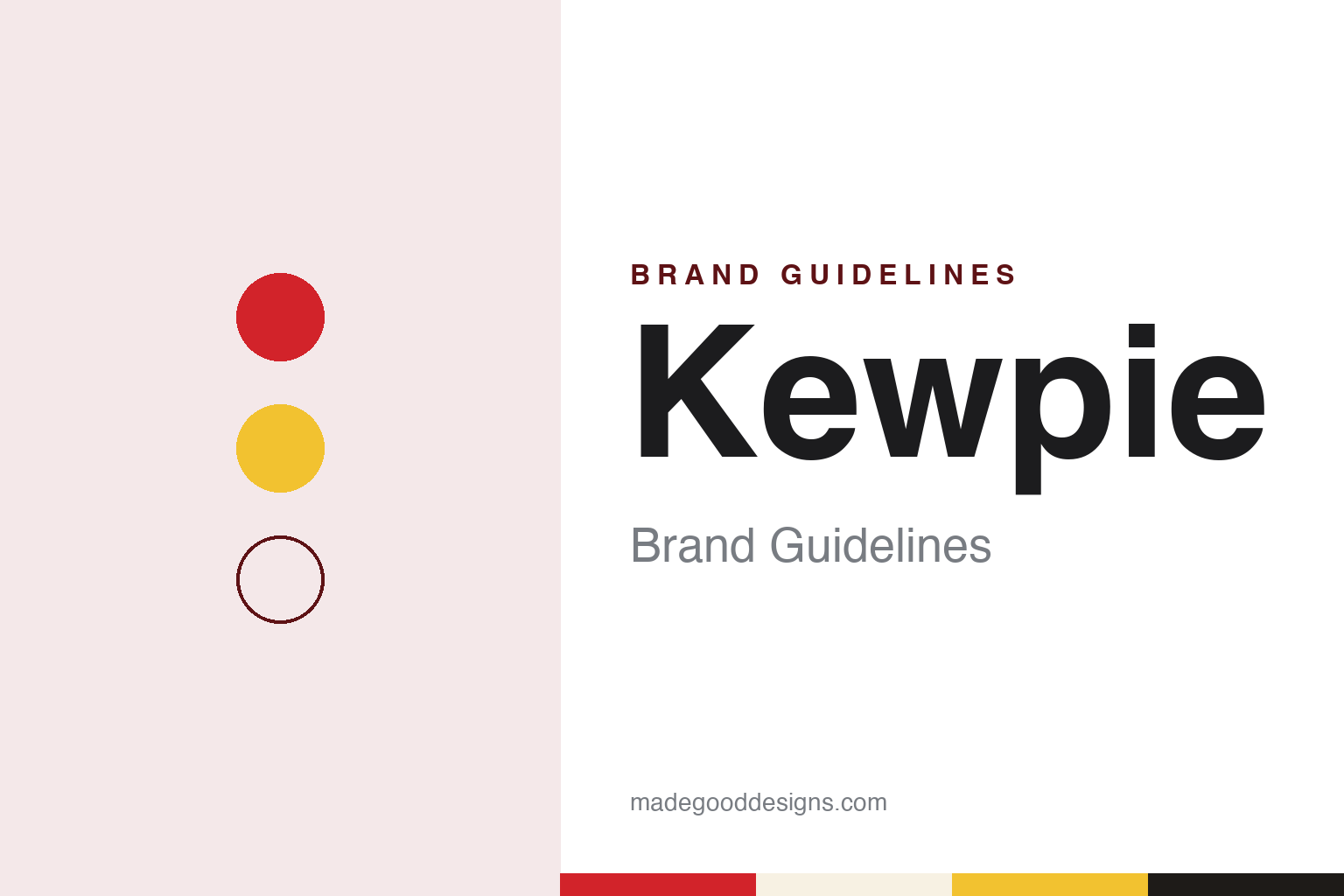
Kewpie Brand Guidelines
Japan’s first mayonnaise, in a red mesh and a soft bottle.
Aa
Two constants: a mesh red, yolk yellow and cream palette and a rounded friendly sans register. Abstract homage — not a Kewpie product or mark; no bottle, logo or character is reproduced.
Shokuhin Kogyo
A Tokyo food firm, a trainee abroad and Japan’s first mayonnaise.
Kewpie began in Tokyo in November 1919, as a food manufacturer called Shokuhin Kogyo Co., Ltd. — “food industry” — in what is now Nakano ward. The company says it started out making sauces and canned goods, and that Toichiro Nakashima was listed as one of several directors when it was set up; he went on to start its mayonnaise and to play the key role in its growth, and the company calls him its founder. A year earlier, in 1918, Nakashima had founded a trading business, Nakashima Shoten, now Nakashimato Co., Ltd., which marketed the products Kewpie made until 1972.
The idea came from abroad. In the 1910s, the company says, Nakashima spent about three years in Britain and the United States as an overseas trainee of Japan’s then Department of Agriculture and Commerce, studying canning, and there first met orange marmalade and mayonnaise. Its Japanese history adds that he noticed how Americans ate salads, and potato salad, dressed with mayonnaise. After the Great Kanto earthquake of 1923, as Tokyo rebuilt and clothing and food grew more Western, he judged that Japan was ready for it.
In March 1925 Shokuhin Kogyo launched Kewpie Mayonnaise, which the company describes as Japan’s first mayonnaise. It was made with egg yolks only, not whole eggs, a choice the company has kept ever since. The name came from the Kewpie, the cherub-like character created by the American illustrator Rose O’Neill, which the company says was popular at the time; it says the name was chosen so that the product would be loved by everyone. Japanese Wikipedia says the company registered the Kewpie trademark in Japan in 1922 and in the United States in 1965. The company writes its name キユーピー, with a full-size “yu” where modern spelling would use a small one, which Japanese Wikipedia says is a design choice.
The start was slow. The company says first-year sales came to 120 cases, about 600 kilograms, and that some shoppers, who had never heard the word mayonnaise, mistook it for hair pomade. Its advertising, the company says, used carefully drawn pictures of a jar of Kewpie placed casually on a family dining table. By 1941 shipments had reached almost 100,000 cases, roughly 500 tonnes.
Colour
A red mesh, a soft bottle and a star-shaped nozzle.
The war stopped the business. Around 1943, the company says, ingredients could no longer be had and production halted; after 1945 the only way to restart was through the black market, which Nakashima refused, so the mayonnaise returned only in 1948. In 1957 Shokuhin Kogyo renamed itself Kewpie Corporation: “food industry” had become a generic phrase used by many firms, and the brand had been familiar for more than 30 years, so the company simply took the brand’s name.
Much of what people recognise in Kewpie today arrived over the following decades, and the company’s own timeline dates each step. A pack in a polyethylene bag came in 1956. In 1958 came two things at once: a stand-up plastic bottle, joining the glass jars and bags, and the red mesh pattern on the pack. The company credits the plastic bottle, together with price cuts as its production became more efficient, for the rapid growth of Japan’s mayonnaise market. A 1-kilogram bottle followed in 1963. In 1972 Kewpie adopted a multi-layer bottle, which sandwiches an oxygen-blocking layer between layers of polyethylene, and a star-shaped nozzle. An aluminium seal over the mouth came in 1988; from 1998 the air left in the neck was replaced with nitrogen; and the bottle was made lighter in 2000 to reduce its environmental load.
The cap kept changing too. A double cap, with a fine nozzle under a flip lid and the star-shaped opening beneath when the cap is unscrewed, arrived in 2004 and went nationwide in 2005; the company says the fine nozzle is for decorating a dish and the star for generous servings, and that the cap draws on universal-design thinking, such as being comfortable to twist. A three-hole cap was added to the 350-gram bottle in 2018. The company says the purpose of most of this engineering is to keep oxygen away from the oil, which would otherwise spoil the flavour. It also says Kewpie Mayonnaise received a Good Design Long Life Design Award in 2017, and that in 2007 it was among the first foods certified by the Japan Aerospace Exploration Agency (JAXA) as Japanese space food.
Typography
Design and documentation.
The seven brands in this group are pantry, sauce, snack and cultured-drink names from Japan, China, South Korea and the United States: Yakult, Calpis, Kewpie, Lao Gan Ma, Huy Fong Foods, Ottogi and Pocky. Asian pantry and drink brands in general sit at many different points in the trade, from family firms that still carry a founder’s name to product names that belong to much larger food groups, and a single brand can be sold everywhere from a neighbourhood grocer to a supermarket shelf on another continent.
A pantry or drink brand’s identity is usually carried less by a single recipe than by a bottle, a jar, a box and the name printed on it, because the company behind the name may have changed hands, licensed its product abroad or grown far beyond the city where it started. That makes the questions behind each name worth asking plainly: who started it, who owns it now, and where its products are actually made and packed.
Each guide separates what independent sources record from what the company says about itself — its founding story, its owners over time, where its products are made and how its packaging has changed — and marks plainly what rests only on the company’s own word.
Aa
A rounded friendly sans for a mayonnaise named after a cartoon cherub. (Specimen set in Zen Maru Gothic, a sans STAND-IN; NOT the Kewpie logo.)
Kewpie
A sister company, a family name and 70 countries.
Kewpie has long worked alongside a sister company. Nakashimato marketed Kewpie’s products from the start until 1972, when sales moved to Kewpie itself; today, the company says, Nakashimato looks after the group’s advertising, brand management, IT systems and property. The jam and marmalade maker Aohata has the same roots: it was set up with investment from Nakashima Shoten to make the Aohata marmalade that Shokuhin Kogyo had first produced. In 1962 Kewpie founded its own vinegar maker, now Kewpie Jyozo, to brew a vinegar for mayonnaise from apple juice and malt, and the same year it began broadcasting Kewpie’s Three-minute Cooking on television. The company says that long-running work such as that programme, advertising urging people to eat more vegetables from 1974 and its sponsorship of the All-Japan Mothers’ Chorus from 1978 reflects a belief, set by former chairman Yuichi Nakashima, that advertising should be built up as an asset. Factory tours, which it calls “Open Kitchen,” began in earnest in 1961.
Kewpie Corporation is a listed company; Japanese Wikipedia says its shares joined the Tokyo Stock Exchange’s Second Section in 1970 and the First Section in 1973. Its chairman is Amane Nakashima, and its head office has been in Shibuya since 2016. The company reports consolidated net sales of ¥513.4 billion for fiscal 2025 and 10,773 employees. Japanese Wikipedia lists plants in Japan in Aomori, Ibaraki, Tokyo, Osaka, Hyogo and Saga prefectures, and plants abroad in California from 1982, Thailand from 1987, Beijing from 1993, and Guangzhou and the Philippines from 2018. Kewpie says it makes condiments in the Asia-Pacific, North America and Europe and sells under the KEWPIE and 丘比 names in more than 70 countries and regions. Kewpie Mayonnaise turned 100 in March 2025, and the company says it holds the top share of Japan’s mayonnaise market by value.
The character on the pack has been tested in court. Japanese Wikipedia says that in 1998 a representative of the Japan Kewpie Club, which had acquired Japanese rights from Rose O’Neill’s estate, sued, arguing that the mayonnaise logo infringed copyright; the claim was dismissed.
For a design guide, Kewpie shows how a borrowed cartoon, a red mesh and a soft bottle with a star-shaped nozzle can carry one product for a century. Compare Kikkoman, whose 1961 soy-sauce dispenser is another Japanese table classic, and Hellmann’s, the American mayonnaise. For this guide we use a mesh red, a yolk yellow and a cream with a rounded sans, an unofficial interpretation; no product or logo is reproduced.
Explore & save
Keep Kewpie’s identity on hand — save it to a board in the Made Good inspiration library.
Kewpie identity set
Pin the Kewpie mesh red, yolk yellow and cream palette and the rounded friendly sans register to your own board.