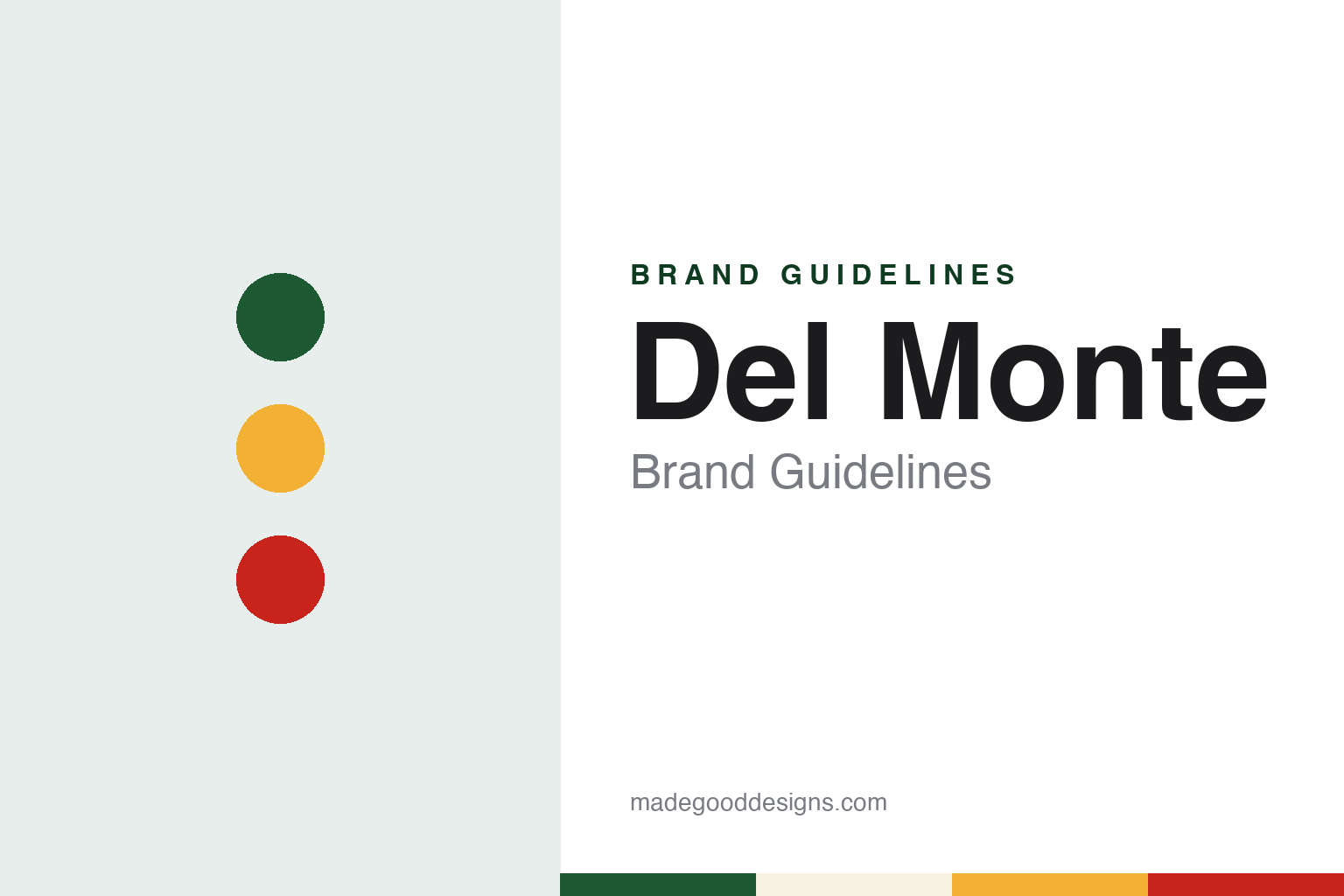
Del Monte Brand Guidelines
A hotel name, a shield and a brand reunited in 2026.
Aa
Two constants: a shield green, peach gold and shield red palette and a heritage label serif register. Abstract homage — not a Del Monte product or mark; no can, shield or logo is reproduced.
A hotel, a coffee and a can of peaches
How a resort’s name became a canner’s brand.
Del Monte is named after a hotel. English Wikipedia says that in the 1880s a small Oakland food distributor made products for the Hotel Del Monte, a resort on the Monterey Peninsula, and first used the Del Monte name for a premium blend of coffee prepared for the hotel. By 1892 the firm had chosen Del Monte as the brand for a new line of canned peaches, and the name moved from the hotel’s coffee cups into the fast-growing California canning trade.
Consolidation followed. In 1899, English Wikipedia says, eighteen West Coast canning companies merged to form the California Fruit Canners Association. The Del Monte shield, the badge that still frames the name, was introduced in 1909. Then, in 1916, the California Fruit Canners Association joined the food brokers Griffin & Skelley, Central California Canneries, the J.K. Armsby Company and the Alaska Packers Association in a five-way merger that created the California Packing Corporation, known as Calpak.
English Wikipedia says Calpak came to operate more than sixty canneries across the western states and Alaska, and spread to Hawaii in 1917 and to Florida, the Midwest and the Philippines in the 1920s. Del Monte was its leading brand, and in June 1967 the company adopted that name as its own, becoming the Del Monte Corporation. The brand, in other words, is older than the company that took its name.
Colour
From R.J. Reynolds to a split that lasted four decades.
In 1979 Del Monte became part of R.J. Reynolds Industries, English Wikipedia says. After Kohlberg Kravis Roberts bought RJR Nabisco in 1988 the new owners sold off its divisions. That sale divided Del Monte in two. In 1989 the fresh-fruit business went to the British group Polly Peck, while the processed-food business, Del Monte Foods, was sold to an investor group of Merrill Lynch, Citicorp Venture Capital and the Japanese soy-sauce maker Kikkoman. English Wikipedia says Kikkoman acquired the Del Monte brand for much of Asia at the same time.
The fresh-fruit business became Fresh Del Monte Produce. After Polly Peck collapsed it passed to the Mexican businessman Carlos Cabal Peniche, and in 1996 it was acquired by Mohammad Abu-Ghazaleh, who took it public a year later, according to English Wikipedia; he remains its chairman and chief executive. Fresh Del Monte sold pineapples, bananas and other produce under the name, and in 2004 bought Del Monte Europe.
Del Monte Foods, the American canner, followed a separate path. Texas Pacific Group bought it in 1997 and floated it in 1999; in 2002 it took over several brands from Heinz, including StarKist and 9Lives, in an all-stock deal; and in March 2011 an investor group led by KKR acquired it and delisted its shares. On 19 February 2014, English Wikipedia says, the Singapore- and Philippines-listed Del Monte Pacific completed the purchase of Del Monte’s consumer food business for US$1.675 billion; the pet-food side became Big Heart Pet Brands. Del Monte Foods moved its headquarters from San Francisco to Walnut Creek, California, in 2015. A Del Monte Foods press release of March 2026 still stated that its companies were not affiliated with Fresh Del Monte, Del Monte Canada, Del Monte Asia, Conagra’s Productos Del Monte in Mexico or Del Monte Panamerican.
Typography
Design and documentation.
The seven brands in this group are all pantry staples, and all of them come from the United States: Jell-O, Hidden Valley, Hunt’s, Del Monte, Dole, Libby’s and Skippy. American pantry brands in general sit at many different points in the trade, from names that still recall a founder or a hometown to names that now belong to much larger food groups, and a single brand can be sold everywhere from a corner store to a supermarket shelf.
A pantry brand’s identity is usually carried less by a single product than by a can, a jar, a name and the meal it promises, because the company behind the name may have changed hands, moved its factory or grown far beyond the town where it started. That makes the questions behind each name worth asking plainly: who started it, who owns it now, and where its products are actually made and packed.
Each guide separates what independent sources record from what the company says about itself — its founding story, its owners over time, where its products are made and how its packaging has changed — and marks plainly what rests only on the company’s own word.
Aa
A heritage label serif for a brand named after a California resort. (Specimen set in Libre Baskerville, a serif STAND-IN; NOT the Del Monte logo or shield.)
Del Monte
Chapter 11, three buyers and one name again.
The split ended through bankruptcy. On 1 July 2025 Del Monte Foods filed for Chapter 11 protection to carry out a restructuring agreed with its lenders, English Wikipedia says. In January 2026 Fresh Del Monte agreed to buy the bulk of its assets for about $285 million in a court-supervised sale under Section 363 of the US Bankruptcy Code, the trade site Just Food reported. On 19 March 2026 Del Monte Foods announced that it had completed three sales covering substantially all of its businesses. Fresh Del Monte took the vegetable, tomato and refrigerated-fruit businesses, including the Del Monte, S&W and Contadina packaged brands, together with global ownership of the Del Monte brand and its intellectual property, subject to existing licensing arrangements. B&G Foods bought the broth and stock business with College Inn and Kitchen Basics, and Pacific Coast Producers bought the shelf-stable fruit business, including the rights to use the Del Monte and S&W names on ambient packaged fruit and fruit sauces in the United States, Puerto Rico and Mexico.
Fresh Del Monte said the deal, approved by the US Bankruptcy Court for the District of New Jersey, put the brand under a single owner for the first time in nearly four decades. The assets it bought included four US facilities, in Texas, Illinois, Wisconsin and Washington, two manufacturing plants in Mexico and an operation in Venezuela, the company said. In May 2026 it named Pittsburgh, where Del Monte Foods had kept offices since the 2002 Heinz deal, as the hub of its new Foods division. On 9 June 2026 shareholders approved a change of name to Del Monte Corporation, and the New York Stock Exchange ticker changed from FDP to DMC on 29 June 2026, the company announced. Its US executive office is in Coral Gables, Florida.
“Existing licensing arrangements” matter, because the name still appears on products from separate companies. Del Monte Pacific continues to sell Del Monte products in the Philippines and India, its website shows, and Del Monte Corporation states that it is not related to the bankrupt Del Monte Foods entities. The consumer site, delmonte.com, still calls the brand “The Original Plant-Based Food Company.”
For a design guide, Del Monte shows how a shield and a resort’s name held together across separate owners for decades. Compare Dole, its old pineapple rival, and Cirio, the Turin canner. For this guide we use a shield green, a peach gold and a shield red with a serif, an unofficial interpretation; no product or logo is reproduced.
Explore & save
Keep Del Monte’s identity on hand — save it to a board in the Made Good inspiration library.
Del Monte identity set
Pin the Del Monte shield green, peach gold and shield red palette and the heritage label serif register to your own board.