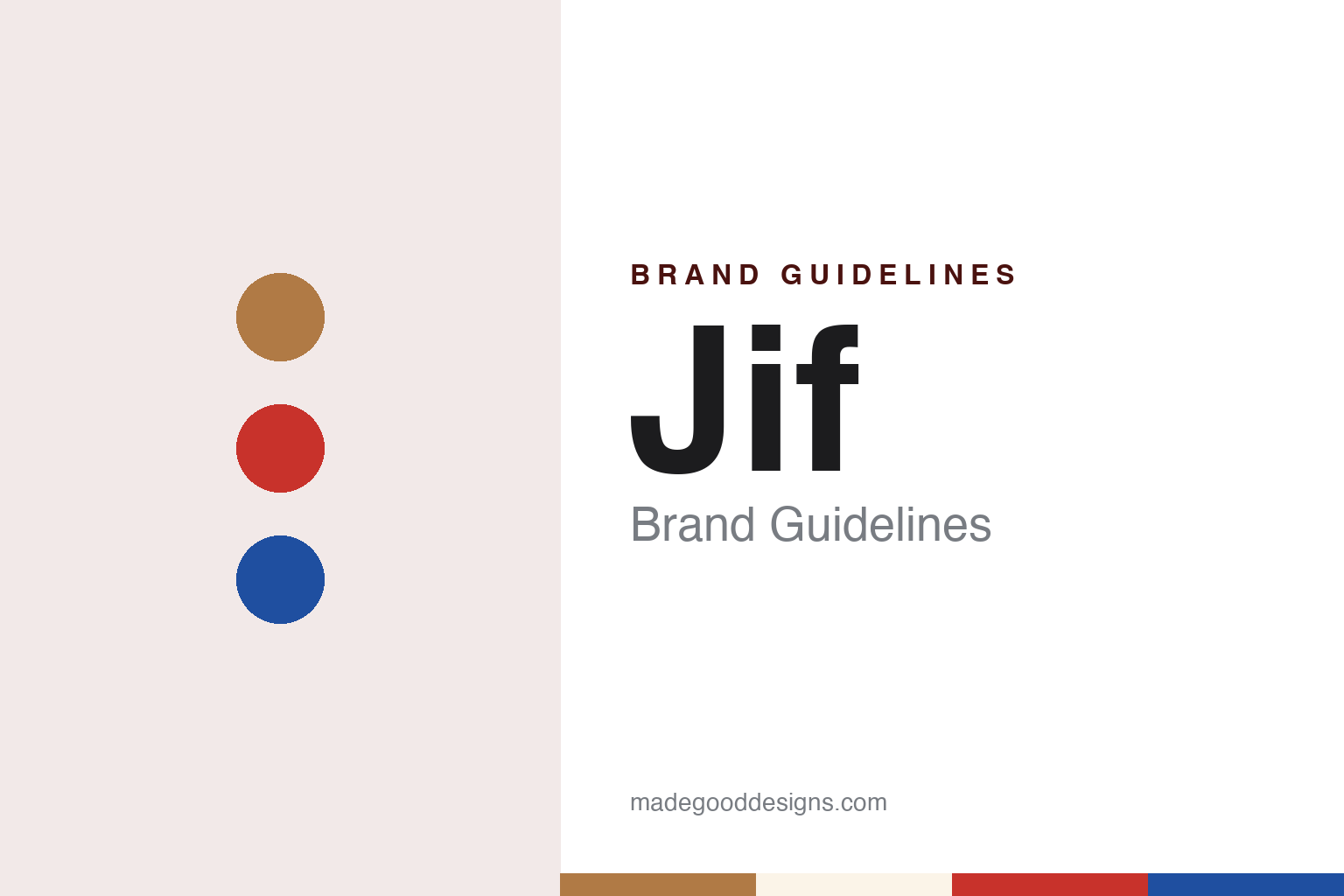
Jif Brand Guidelines
The Lexington peanut butter that taught America to be choosy.
Aa
Two constants: a roasted peanut, spread red and kangaroo blue palette and a bold rounded sans register. Abstract homage — not a Jif product or mark; no jar, label or logo is reproduced.
Big Top
A Lexington businessman, a peanut butter and a buyer from Cincinnati.
Jif began under another name. English Wikipedia says that in 1946 William T. Young, a Lexington native who had returned home after the Second World War, founded W. T. Young Foods in Lexington, Kentucky, to make a peanut butter called Big Top. He built it into one of the leading peanut butter producers in the United States, and in 1955 he sold the business, its brand and its Lexington manufacturing plant to Procter & Gamble. Young stayed on to run the peanut butter operation for P&G until 1957, when he left to start a storage company; he later became better known as a racehorse breeder at his Overbrook Farm, English Wikipedia says.
P&G did not simply keep Big Top. According to English Wikipedia, the company reformulated and rebranded the product to compete with Skippy and Peter Pan, the two established national brands. It sweetened the recipe, adding sugar and molasses, used oils other than peanut oil in the hydrogenation process, and gave the result a new, short name: Jif. The new product was publicly announced in April 1956, as tests began in selected markets.
The national launch came in 1958. The brand’s own timeline says Jif went on sale across the country that year, first as a “creamy-smooth” spread and then as a crunchy variety, and that both jars featured a colourful kangaroo mascot called Jifaroo. English Wikipedia adds that the rollout used a heavily publicised house-to-house distribution of free sample jars from special trucks painted with Jifaroo, a blue kangaroo. In 1962, the company says, it changed the formula to raise the share of peanuts to 90%, the level the US Food and Drug Administration required for a product to be called “peanut butter” rather than “peanut spread.” By 1981 Jif had become the largest peanut butter brand in the United States, a position English Wikipedia says it held at least through 2008.
Colour
A beveled jar, a choosy mother and a pronunciation joke.
Jif’s early advertising sold texture and convenience. English Wikipedia records an early slogan, “Jif is never dry; a touch of honey tells you why,” and says early advertising also stressed the beveled edge at the base of the jar, which was meant to make it easier to scrape out the last of the peanut butter. The company says that in 1971 it began sweetening with molasses rather than honey.
The line that has stayed with the brand longest arrived in the 1960s. The company dates “Choosy Mothers Choose Jif” to 1966 and says it became “Choosy Moms Choose Jif” in 1988; English Wikipedia says that for many decades television commercials ended with the line, and that from 1998 to 2000 many ads used a jingle with the words “Moms like you choose Jif, choose Jif!”
The range grew steadily from the original Creamy and Crunchy. The company dates Extra Crunchy to 1976, Simply Jif to 1991, a Reduced Fat variety to 1994, the portable Jif To Go single servings to 2006 and a natural line to 2009; English Wikipedia adds hazelnut spreads announced in May 2012 and, in 2014, a peanut-butter-flavoured breakfast cereal made under licence by Kellogg’s. In 1986, the company says, its jars switched from glass to plastic. In 2014 Jif became a sponsor of the US Olympic Team for the Winter Games, and in 2020 it launched Jif Squeeze.
That same year the brand made a joke of its own name. In 2020, the company says, its #JifvsGif campaign went viral through a partnership with the animated-image platform Giphy, together with a run of jar labels that replaced the usual branding with the word “Gif”.
Typography
Design and documentation.
The seven brands in this group are all American pantry and convenience brands: Jif, Peter Pan, Kraft Mac & Cheese, Rice-A-Roni, Velveeta, Stouffer’s and Bisquick. American pantry brands in general sit at many different points in the food trade, from names that began with a single company or inventor to names that now belong to much larger food groups, and a single brand can be sold everywhere from a corner store to a national supermarket chain.
A pantry brand’s identity is usually carried less by a single recipe than by a pack, a name and the meal or shortcut it promises, because the company behind the name may have changed hands, moved its factories or grown far beyond the place where it started. That makes the questions behind each name worth asking plainly: who started it, who owns it now, and where its products are actually made and packed.
Each guide separates what independent sources record from what the company says about itself — its founding story, its owners over time, where its products are made and how its packaging has changed — and marks plainly what rests only on the company’s own word.
Aa
A bold rounded sans for a short, friendly three-letter name. (Specimen set in Baloo 2, a sans STAND-IN; NOT the Jif logo.)
Jif
From Procter & Gamble to Smucker, and one very large plant.
Jif spent more than four decades as a Procter & Gamble brand. In 2002 The J.M. Smucker Company of Orrville, Ohio, acquired Jif together with the Crisco shortening brand from P&G, English Wikipedia says. The two companies did business again in 2008, when Smucker bought P&G’s Folgers coffee business. In 2020 Smucker introduced a new corporate identity meant to separate the company from the Smucker’s brand on its jams, and that December it sold Crisco to B&G Foods, while keeping Jif.
Jif is still made where Big Top began. English Wikipedia says all variants are produced at a facility in Lexington, Kentucky, which it describes as the largest peanut butter production facility in the world, and at a smaller plant in Memphis, Tennessee. The Lexington site is the one Procter & Gamble bought from William T. Young in 1955.
That plant was at the centre of a recall in 2022. On 20 May 2022 Smucker announced a recall of Jif peanut butter products made at the Lexington facility, in the United States and Canada, because of potential salmonella contamination; English Wikipedia notes that products from the Memphis plant were not affected. The US Centers for Disease Control and Prevention linked a salmonella outbreak to Jif peanut butter and later declared it over, reporting 21 illnesses in 17 states, four hospitalisations and no deaths. Other companies also recalled foods made with Jif, such as snack trays and chocolates, the CDC said.
The brand marked its 50th anniversary in 2008, and its most recent additions have leaned on flavour; in 2024, the company says, it launched a peanut butter and chocolate flavoured spread. Smucker also owns other peanut butter brands, among them Laura Scudder’s and Adams, which it bought in 1994 and 1998, according to English Wikipedia.
For a design guide, Jif shows how a three-letter name, a mascot from the launch trucks and a slogan about choosy parents can carry a pantry staple for nearly seventy years. Compare Peter Pan, the older national rival it was built to beat, and Smucker’s, the Orrville brand of its current owner. For this guide we use a roasted peanut tone, a spread red and a kangaroo blue with a bold rounded sans, an unofficial interpretation; no product or logo is reproduced.
Explore & save
Keep Jif’s identity on hand — save it to a board in the Made Good inspiration library.
Jif identity set
Pin the Jif roasted peanut, spread red and kangaroo blue palette and the bold rounded sans register to your own board.