Smucker’s Brand Guidelines
The Orrville apple-butter maker and its “name like Smucker’s” slogan.
Aa
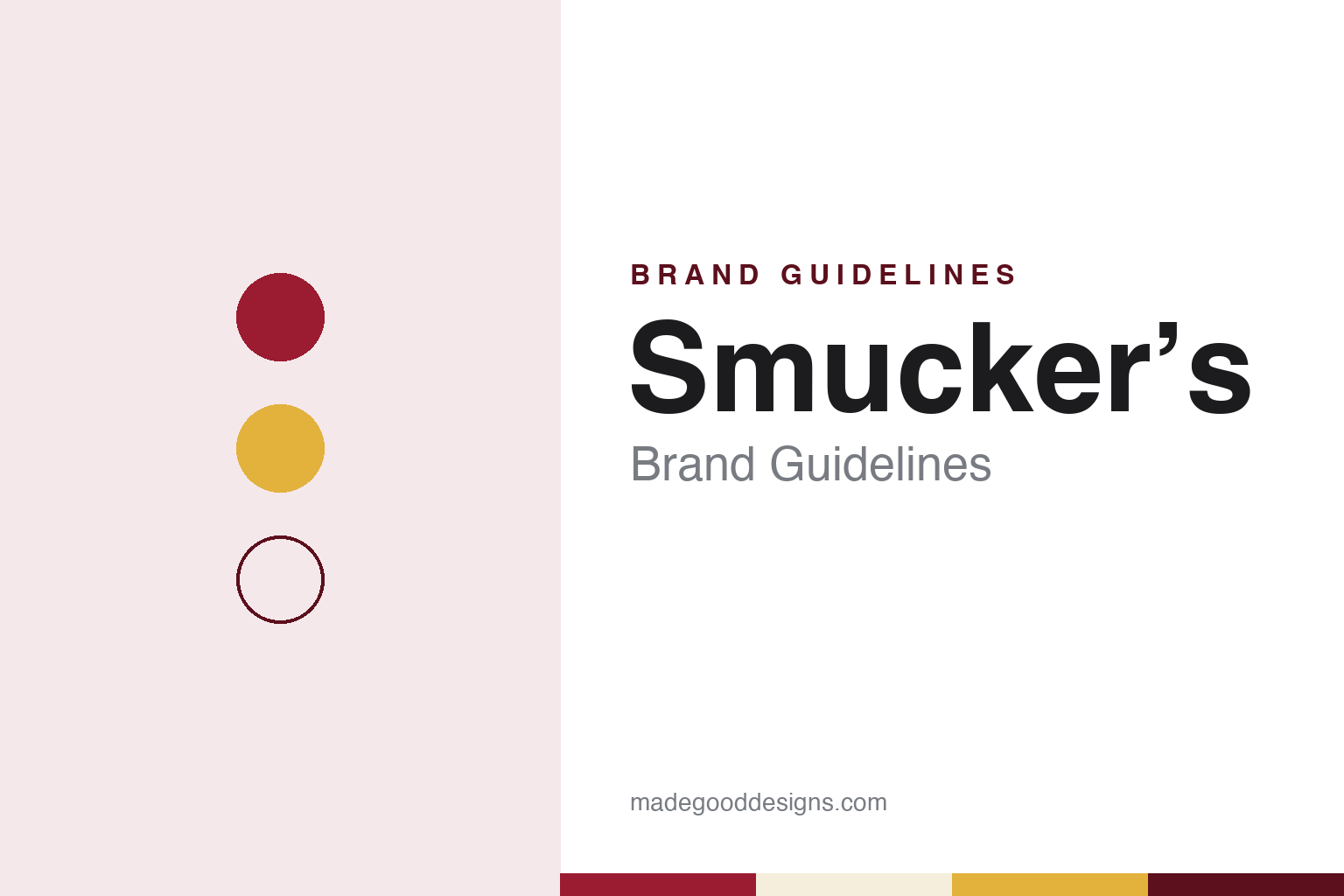
Two constants: a Smucker’s red, gold and cream palette and an old-style serif register. Abstract homage — not a Smucker’s product or mark; no jar, label or logo is reproduced.
A cider mill in Orrville
Apple butter from the back of a wagon.
Smucker’s began in Orrville, Ohio, in 1897. That year Jerome Monroe Smucker (1858–1948), a farmer from a Mennonite family of Swiss descent, built a cider mill in the town, English Wikipedia and the Encyclopedia of Cleveland History say. He pressed apples for local farmers and made apple butter, which he sold from the back of a horse-drawn wagon. The company says the first apples came from trees planted in the area by Johnny Appleseed, and Smucker’s brand website still opens its story with that cider mill and the first jar of apple butter.
The family name had travelled. English Wikipedia and the American Business History Center, in a 2020 history by Gary Hoover, say the founder’s forebears came from Switzerland to Pennsylvania in the 1750s as Schmucker, spelled the name Smoker for a time, and settled on Smucker before moving to Ohio.
The business was incorporated in 1921. Soon afterwards it began making jams and jellies, and by 1928 it was selling in Ohio, Pennsylvania and Indiana, English Wikipedia says. In 1935 it opened a fruit-processing plant in Washington state, nearer to the apples; English Wikipedia credits the move to the founder’s eldest son, Willard Smucker. Under Willard, the American Business History Center says, the company also created a custom-shaped glass jar, which English Wikipedia dates to 1939, the year annual sales reached $1 million. Ice cream toppings followed in 1940, and in 1942 Smucker’s began national distribution, with a first shipment of fruit spreads to Los Angeles, according to the Encyclopedia of Cleveland History.
Colour
A slogan built on an unusual surname.
Smucker’s is best known for six words. “With a name like Smucker’s, it has to be good” is credited to Lois Wyse, the Cleveland advertising executive, author and columnist, by the Encyclopedia of Cleveland History, which says the company has used it since 1962. English Wikipedia says Wyse Advertising, the Cleveland agency she co-founded, was hired for Smucker’s radio advertising in 1960. The company gives an earlier date: its own FAQ says the slogan has been used “since the mid-1950s.” We give both dates as they were published.
The company’s explanation of the line is plain. Smucker’s says it first referred to the unusual family name, with the idea that such an odd name had better stand on outstanding products, and that its meaning shifted as the name became associated with quality: seeing the Smucker name on a product came to be taken as an assurance in its own right.
The label has its own reference to the family. Smucker’s says the house shown on its label represents the founder’s home on Main Street in Orrville, from which J.M. Smucker for a time ran the business. The company does not publish colour or typeface specifications for the label, and the sources we checked do not document them.
The product range grew around the jar. The company bought the Mary Ellen jam brand in 1963 and Dickinson’s, a maker of gourmet preserves, in 1979, English Wikipedia says; in 1964, the Encyclopedia of Cleveland History says, Kellogg’s began using Smucker’s jam in its Pop-Tarts. In 1978 Smucker’s introduced a low-sugar spread, and by 1980 it was the leading maker of jams and jellies in the United States, according to English Wikipedia and the American Business History Center. Magic Shell, the ice cream topping that hardens as it cools, was bought in 1982. Today the Smucker’s brand website lists jams, jellies, preserves, marmalades, Simply Fruit and Goober spreads alongside peanut butters and toppings.
Typography
Design and documentation.
The seven brands in this group all make jam and fruit spreads, and they come from Switzerland, Austria, Germany, the United States and France: Hero, Darbo, Zentis, Schwartau, Smucker’s, Andros and St. Dalfour. Jam brands in general sit at many different points in the trade, from family firms that still carry a founder’s surname to names that now belong to much larger food groups, and a single brand can be sold everywhere from a village shop to a supermarket shelf in another continent.
A jam brand’s identity is usually carried less by a single product than by a jar, a lid, a label and the breakfast it promises, because the company behind the name may have changed hands, moved its factory or grown far beyond the town where it started. That makes the questions behind each name worth asking plainly: who started it, who owns it now, and where its jam is actually cooked and filled.
Each guide separates what independent sources record from what the company says about itself — its founding story, its owners over time, where its jam is made and how its packaging has changed — and marks plainly what rests only on the company’s own word.
Aa
An old-style serif for a family name on a jar. (Specimen set in Fraunces, a serif STAND-IN; NOT the Smucker’s logo or label lettering.)
The J.M. Smucker Co.
From one jam maker to a food group, still in Orrville.
The company went public in 1959 and was listed on the New York Stock Exchange in 1965, the Encyclopedia of Cleveland History says. It stayed in Orrville and in the family: in 2016 Mark Smucker, the founder’s great-great-grandson, became chief executive, English Wikipedia says, and the Smucker’s brand website describes the company as being on its fifth generation of Smucker family leadership.
Since the 2000s the jam maker has become a much broader group through acquisitions. It bought Jif peanut butter and Crisco from Procter & Gamble in 2002; the Folgers coffee business, also from Procter & Gamble, in a deal completed in November 2008 that English Wikipedia says doubled the company’s size; and Big Heart Pet Brands, the owner of Milk-Bone and Meow Mix, in 2015. In September 2023 it announced the purchase of Hostess Brands, the maker of Twinkies, for $5.6 billion in cash and stock, and completed it in November that year, English Wikipedia says. Some businesses went the other way: Crisco was sold to B&G Foods in 2020, and the Knott’s Berry Farm jams the company had acquired in 2008 have been discontinued, Smucker’s says.
In September 2020 the company introduced a new corporate logo and identity, intended, English Wikipedia says, to distinguish Smucker the company from the Smucker’s brand on its foods, and it shortened its name to The J.M. Smucker Co. In Canada, English Wikipedia adds, the Smucker’s name is used only for ice cream toppings and preserves.
On where the jars are filled, the company is general. Smucker’s says all of its products are made in facilities in the United States and Canada, and the corporate site lists operations plants across the country, Orrville among them. Which plant makes the jams is not stated in the sources we checked.
For a design guide, Smucker’s shows how a family surname, a house on a label and a single line of copy can carry a brand for more than a century. Compare Bonne Maman, the French jam brand whose jar is its identity, and Justin’s, an American nut-butter brand. For this guide we use a deep preserve red, an apple-butter gold and a label cream with a serif, an unofficial interpretation; no product or logo is reproduced.
Explore & save
Keep Smucker’s’s identity on hand — save it to a board in the Made Good inspiration library.
Smucker’s identity set
Pin the Smucker’s red, gold and cream palette and the old-style serif register to your own board.