Kraft Mac & Cheese Brand Guidelines
The blue box that Canada calls KD.
Aa
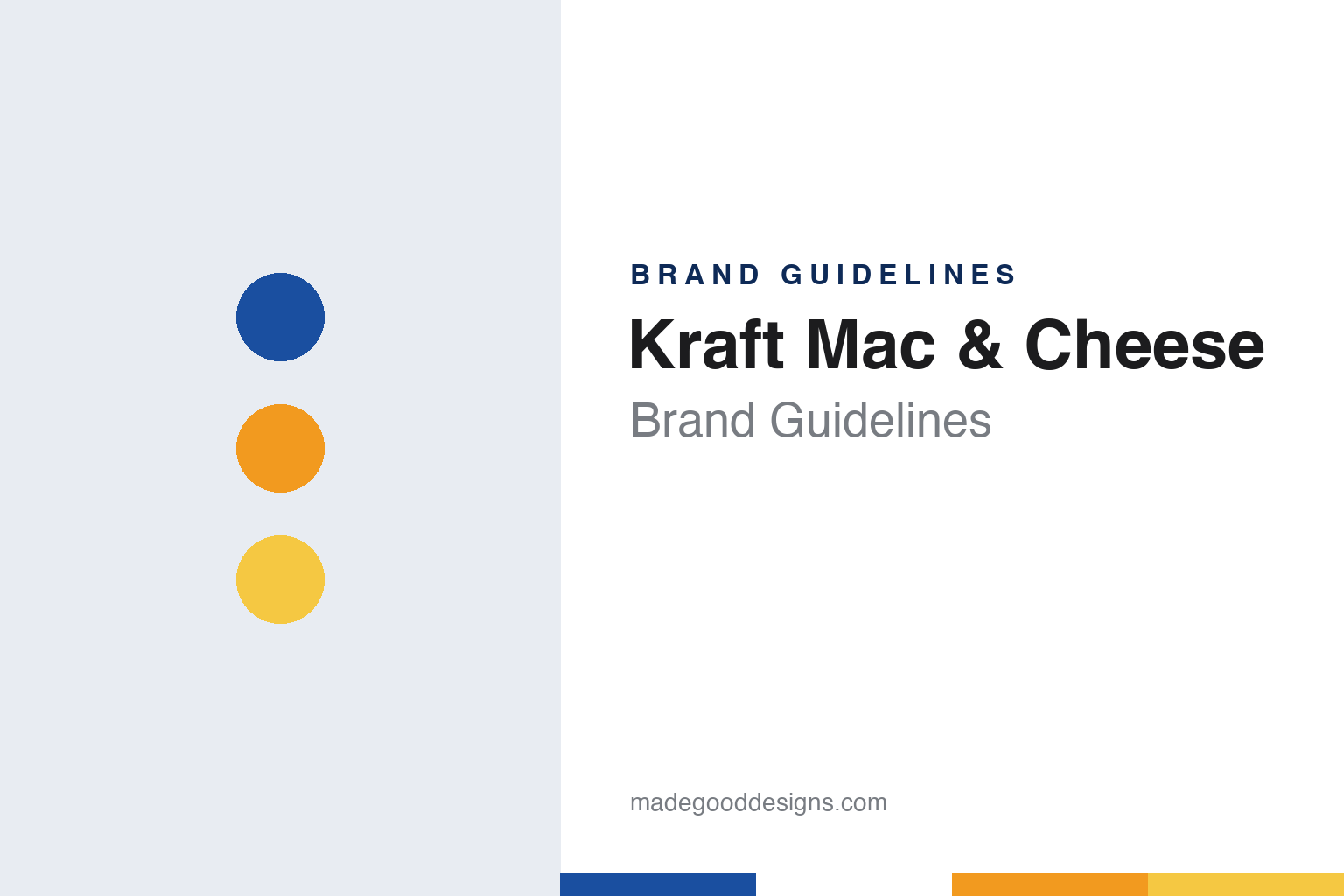
Two constants: a blue box, cheese orange and macaroni yellow palette and a bold friendly sans register. Abstract homage — not a Kraft Heinz product or mark; no box, logo or mascot is reproduced.
Dinner for four
Processed cheese, a salesman’s rubber band and a Depression-era box.
Kraft Mac & Cheese is one product sold under several names. In the United States it is Kraft Mac & Cheese; in Canada it is Kraft Dinner, marketed today simply as KD; and English Wikipedia notes that it has also been sold in the United Kingdom as Cheesey Pasta. The standard box holds dried macaroni and a packet of processed-cheese powder, to which the cook adds milk and butter or margarine. Its maker today is Kraft Heinz, the company formed on 2 July 2015 by the merger of Kraft Foods Group and the H.J. Heinz Company, with co-headquarters in Chicago and Pittsburgh.
The product rests on an earlier Kraft invention. James L. Kraft, who came from Fort Erie, Ontario, built his cheese business in Chicago and in 1916 won a patent for a method of making processed cheese, The Walrus reported in 2012. Processed cheese uses emulsifying salts that let it keep far longer than natural cheese, and that long life is what made a shelf-stable boxed dinner possible. English Wikipedia, citing Scholastic and The Walrus, says the idea of selling pasta and cheese together came from a St. Louis salesman, Grant Leslie, who began attaching grated cheese to boxes of pasta with a rubber band during the Great Depression.
English Wikipedia, citing grocers’ advertisements in Iowa, Ohio and Illinois newspapers from February and March 1936, says Kraft’s version was first marketed in many US states that year, advertised as grated cheese and macaroni, “dinner for four in nine minutes.” Grocers’ advertisements in the Ottawa Journal, the Winnipeg Tribune and other Canadian papers show it on sale in Canada from late 1937, the same article says.
The timing suited the product. According to English Wikipedia, citing The Walrus and a 2010 Chicago Tribune history, wartime rationing of milk and dairy products, more meatless meals and more women working outside the home made a quick boxed dinner attractive during the Second World War. One food ration stamp bought two boxes, and 50 million boxes were sold during the war. The ten-month shelf life also suited Canada, where many homes still had no refrigerator, The Walrus reported.
Colour
A yellow box turns blue, and the recipe changes.
The box is the brand’s best-known design asset. The original box was mainly yellow; its main colour changed to blue in 1954, English Wikipedia says, citing the Chicago Tribune, and US advertising aimed at children later urged them to ask for “The Blue Box.” In 1991 Kraft introduced a mascot, Cheesasaurus Rex, an orange cartoon tyrannosaurus covered in cheese, who featured in advertising until the late 2000s, the food site Mashed reported in 2021. In 2010 Kraft turned to grown-ups with a multimedia campaign built on nostalgia for a childhood favourite, The New York Times reported in May that year.
The line grew around the original. Spiral noodles followed in 1975 and Velveeta Shells & Cheese in 1984, English Wikipedia says. Easy Mac, a single-serving version made in a microwave with water alone, arrived in 1999, Advertising Age reported, and is now sold as Mac & Cheese Dinner Cups. Deluxe versions swapped the powder for a ready-made cheese sauce in a foil pouch. Licensed shapes have turned the pasta into characters from Looney Tunes, Super Mario Bros. and Star Wars, the Dayton Daily News reported in 2010.
The recipe changed in the 2010s. In November 2013 Kraft said that new pasta shapes for children in the United States would no longer contain the dyes Yellow 5 and Yellow 6, CNN reported. In April 2015 the company announced that from January 2016 the whole US line would drop artificial preservatives and synthetic colours, using paprika, annatto and turmeric for colour instead, The New York Times reported; Kraft said the changes responded to consumer feedback.
The name changed too. Outside Canada the product was rebranded as Kraft Macaroni & Cheese, but English Wikipedia says the word “Dinner” remained in small type on the US box until a 2022 rebrand, since when the US logo has read Kraft Mac & Cheese. In Canada, Kraft Heinz launched the KD Shaker in 2018, a bottle of the cheese powder on its own, the Montreal daily La Presse reported the following year.
Typography
Design and documentation.
The seven brands in this group are all American pantry and convenience brands: Jif, Peter Pan, Kraft Mac & Cheese, Rice-A-Roni, Velveeta, Stouffer’s and Bisquick. American pantry brands in general sit at many different points in the food trade, from names that began with a single company or inventor to names that now belong to much larger food groups, and a single brand can be sold everywhere from a corner store to a national supermarket chain.
A pantry brand’s identity is usually carried less by a single recipe than by a pack, a name and the meal or shortcut it promises, because the company behind the name may have changed hands, moved its factories or grown far beyond the place where it started. That makes the questions behind each name worth asking plainly: who started it, who owns it now, and where its products are actually made and packed.
Each guide separates what independent sources record from what the company says about itself — its founding story, its owners over time, where its products are made and how its packaging has changed — and marks plainly what rests only on the company’s own word.
Aa
A bold friendly sans for a box that children are told to ask for by colour. (Specimen set in Rubik, a sans STAND-IN; NOT the Kraft Mac & Cheese logo.)
Kraft Dinner
A national dish made in Quebec, and a company that planned to split.
In Canada the product holds a status it has nowhere else. In a September 2012 essay, The Walrus called Kraft Dinner Canada’s true national dish, and English Wikipedia, citing a 2008 book, says Canadians buy 1.7 million of the 7 million boxes sold worldwide each week. Because the Canadian name differs from the American one, its advertising is a made-in-Canada effort that cannot easily be adapted for the US market, the Financial Post reported in 2012. The Toronto band Barenaked Ladies sang about eating Kraft Dinner in their song “If I Had $1000000,” and fans took to throwing boxes on stage until the band asked them to give the boxes to food banks instead.
Canada’s KD is also made close to home. When Global News traced a box back to its sources in June 2015, it found the box had been packaged in Mount Royal, Quebec, on the Island of Montreal; the macaroni was made in Montreal from Canadian wheat, and the dried whey and cheddar were made by Kraft at Ingleside, Ontario, from Canadian milk, while several minor ingredients came from the United States. On 25 September 2023 Kraft Heinz Canada announced the first rebrand of KD in nearly ten years, with a new logo, new packaging and a brand platform called “Gotta be KD.”
Ownership has followed Kraft’s own reshuffles. The product belonged to Kraft Foods Inc. until 2012, when the North American grocery business became Kraft Foods Group, and Kraft Foods Group merged with Heinz in 2015 to create Kraft Heinz. On 2 September 2025 Kraft Heinz announced a plan to split into two listed companies, one focused on sauces, spreads, seasonings and shelf-stable meals and the other on North American grocery staples, The Wall Street Journal reported. Steve Cahillane became chief executive on 1 January 2026; on 11 February 2026 the board paused work on the separation, and in its May 2026 quarterly report the company said the timing and completion of the plan remained uncertain, according to its filings with the US Securities and Exchange Commission.
For a design guide, Kraft Mac & Cheese shows how a single box colour can become a brand name in its own right, and how one product can carry different names on either side of a border. Compare Velveeta, another Kraft Heinz cheese brand, and Philadelphia, the Kraft Heinz cream cheese. For this guide we use a box blue, a cheese orange and a macaroni yellow with a bold sans, an unofficial interpretation; no product or logo is reproduced.
Explore & save
Keep Kraft Mac & Cheese’s identity on hand — save it to a board in the Made Good inspiration library.
Kraft Mac & Cheese identity set
Pin the Kraft Mac & Cheese box blue, cheese orange and macaroni yellow palette and the bold friendly sans register to your own board.